
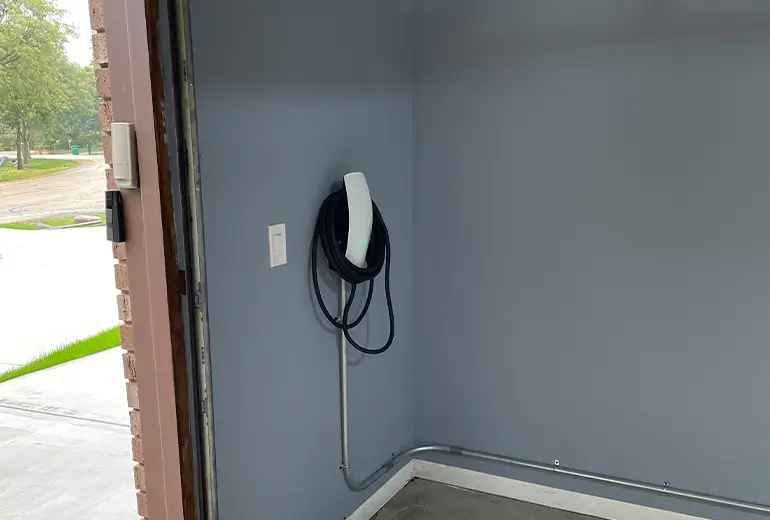
If you’ve been comparing Level 2 home chargers and your eyes have started to glaze over at spec sheets, here’s the honest version from someone who installs all of these every week.
We’re an electrical contractor in Naperville. We don’t sell EV chargers — we wire whatever the homeowner buys. So we’ve got no horse in the race other than this: when a charger is a pain to install, fails early, or causes service calls, we hear about it. And there are real differences between these three.
This post compares the three Level 2 chargers Naperville homeowners ask us about most often: the Tesla Wall Connector, the ChargePoint Home Flex, and the Wallbox Pulsar Plus. It’s based on what we’ve actually wired in homes around Naperville, Aurora, Plainfield, Bolingbrook, and the rest of the western suburbs over the past two years. Not spec sheets. Not affiliate links. Just what we’ve seen.
If you want to skip the comparison and just get a charger installed, we handle all three brands and any other UL-listed Level 2 unit you bring us. EV charger installation in Naperville is one of the things we do most.
The short answer
If you drive a Tesla and only a Tesla: Tesla Wall Connector. Cheaper, native to your car, and the install is straightforward.
If you drive anything else, or you have a mixed-EV household, or you might switch brands: Wallbox Pulsar Plus. It’s the most flexible unit on the market and the build quality has held up.
ChargePoint Home Flex is a fine charger that we don’t recommend as often as we used to. More on why below.
If you want the long version, keep reading.
Tesla Wall Connector
Real-world price (2026): Around $475 for the unit. Cheapest of the three.
The install: Easy. The Wall Connector is one of the simpler Level 2 units to install. Mounting plate, wire it directly to a 60-amp dedicated 240V circuit, terminate, done. We typically finish a Tesla install in 3–4 hours when no panel work is involved.
What we like:
- The native NACS connector is what your Tesla actually uses. No adapter, no awkward J1772 dongle on a CCS-charged car.
- The cable is the right length (24 ft) and stays flexible in cold weather. This matters more than you’d think — the cheap chargers ship a cable that turns into a frozen garden hose every January in DuPage County.
- The unit itself looks clean on a garage wall.
- Tesla pushes firmware updates over Wi-Fi reliably.
What we don’t like:
- It’s NACS-only out of the box. A non-Tesla EV needs a separate adapter, and the experience is rougher.
- The Wi-Fi setup is fine when it works. When it doesn’t (we’ve seen older routers fail to handshake), there’s no Ethernet fallback. ChargePoint and Wallbox both have alternative connection paths.
- Installation requires the Tesla app to commission. If you don’t have a Tesla account, the unit works but you can’t customize charge limits, schedule, or load sharing.
Best for: Single-Tesla households with a clear path to a 60-amp dedicated circuit and a reliable home Wi-Fi network.
ChargePoint Home Flex
Real-world price (2026): Around $700 for the unit. Most expensive of the three.
The install: Standard. ChargePoint sells both a hardwired and a NEMA 14-50 plug-in version. The plug-in version is what most homeowners buy, which means the install is technically just installing a NEMA 14-50 outlet on a 50-amp circuit and plugging the charger in.
We hardwire ChargePoint when the homeowner wants the full 50-amp output (the plug-in version is limited to 40 amps by the receptacle’s continuous-load derating). The hardwire install is a half-day job assuming the panel is ready.
What we like:
- Universal J1772 connector, so it works with every non-Tesla EV on the market plus any Tesla using its included adapter.
- Wi-Fi plus the ChargePoint network — meaning you can use ChargePoint’s app whether you’re at home or finding a public station.
- Solid build quality.
What we don’t like:
- The price is harder to justify in 2026 than it was in 2022. You’re paying $200+ more than competitors for a feature set (the network) that most homeowners don’t use much.
- The mobile app has gotten worse over the past three years. It’s slower, pushes more notifications, and the scheduling UI is finicky.
- We’ve replaced two Home Flex units in the past 18 months that just stopped responding to network commands. The unit still charged the car, but the homeowner couldn’t schedule or control it. Both were under 4 years old. Sample size is small but worth noting.
Best for: Homeowners who genuinely use the ChargePoint public network and want unified app management. If you don’t, you’re paying for features you won’t touch.
Wallbox Pulsar Plus
Real-world price (2026): Around $650 for the 40-amp version, $750 for the 48-amp.
The install: Easy to moderate. Hardwired only — no plug-in option. The unit itself is small (one of the smallest Level 2 chargers on the market), which is genuinely useful in tight garage corners. Wiring is standard 240V on a 50- or 60-amp circuit.
What we like:
- It’s small. We’ve installed Pulsar Plus units in spots where ChargePoint or Tesla wouldn’t physically fit cleanly without ugly conduit runs.
- The DC leakage detection (Type B GFCI built-in) means it can be installed in damp-rated locations like detached carports without an upstream GFCI breaker. Tesla and ChargePoint require an external GFCI in those scenarios.
- The Wallbox app is the cleanest of the three. Scheduling actually works the first time.
- Bluetooth fallback if Wi-Fi isn’t available — a real lifesaver when the homeowner’s router is in a basement and the garage is on the third floor of a townhouse.
- Power sharing across multiple units, which matters if you have two EVs and don’t want to upgrade your panel.
What we don’t like:
- The 5-meter cable is shorter than Tesla’s. If your panel is across the garage from where the car parks, plan accordingly.
- Wallbox the company is European. US support has been fine but not great. We’ve waited 24+ hours for warranty responses.
- Less brand recognition in the US, which becomes relevant when you go to sell the house. Tesla and ChargePoint have name recognition; Wallbox is “what’s that?”
Best for: Mixed-EV households, tight install spaces, multi-charger setups, anyone who values app polish, and homeowners who want flexibility for whatever EV they buy next.
A few things that actually matter more than the brand
After comparing the three units, here’s what we tell every Naperville homeowner before they buy a charger:
Get the panel checked first. Most Naperville homes built before 2000 came with 100-amp service. A 40-amp Level 2 charger eats 40% of that on its own circuit, and you’ve still got AC, an electric range, and everything else competing for the rest. We do panel upgrades from 100-amp to 200-amp service on most older Naperville homes before the charger goes in. Spending $700 on a charger and discovering your panel can’t support it is an expensive surprise.
Cable length matters more than amperage. A 48-amp charger on a 25-foot cable beats a 60-amp charger that won’t physically reach your car. Measure the actual run from where you’d mount the charger to where your car’s charge port will be when parked. Add 5 feet for slack.
Skip the smart features unless you’ll actually use them. Every Level 2 charger sold in 2026 has Wi-Fi, an app, scheduling, and energy reporting. The unit you’ll be happy with five years from now is the one that does basic charging reliably. Smart features are nice when they work and frustrating when they don’t.
Hardwired beats plug-in for permanent installs. A NEMA 14-50 plug-in install is fine if you’re renting and want to take the charger with you. For a homeowner staying put, hardwire it. Fewer connection points to fail, no derating to 40 amps, looks cleaner on the wall.
Confirm ComEd rebate eligibility before you buy. ComEd’s residential EV rebate program requires specific charger types and an eligible installer. Buying a charger that doesn’t qualify, or hiring an installer who isn’t on ComEd’s list, means leaving money on the table. We’re listed as an eligible installer and walk homeowners through the application as part of the install.
What we’d put in our own house
Honest answer: it depends on the car.
If we drove a Tesla, we’d buy the Wall Connector. It’s cheaper, the install is dead simple, and the integration with the car is genuinely better than any third-party charger.
If we drove anything else — Rivian, Ford Lightning, Hyundai Ioniq 5, Mach-E, BMW i4, anything — we’d buy the Wallbox Pulsar Plus. The size, the build quality, the app, and the Type B GFCI built in are real advantages over ChargePoint at a lower price.
We probably wouldn’t buy a ChargePoint Home Flex in 2026 unless we already used the ChargePoint network at work or on the road and wanted unified app management. The price premium isn’t earned anymore.
Once you’ve picked your charger
Pick the unit, then bring it to your installer. Or skip the picking and let an installer who wires these every week tell you what fits your panel, your garage layout, and your budget.
We’re a professional EV charger installer serving Naperville, Aurora, Plainfield, Lisle, Bolingbrook, and the surrounding DuPage and Will County suburbs. We install all three of the chargers compared above, plus any other UL-listed Level 2 unit you bring us. Free estimates, ComEd rebate documentation included, and a real human walking your install from quote through final inspection.
About the author
Alexandr Godonoaga is the lead electrician and owner of Cob Services LLC, a registered electrical contractor based in Naperville, IL (Illinois License #26-00032356). With 10+ years of field experience across Naperville and the western suburbs, Alex has installed Level 2 chargers from Tesla, ChargePoint, Wallbox, JuiceBox, Emporia, and most other UL-listed manufacturers in homes across DuPage and Will County. Cob Services LLC is fully licensed, bonded, insured, ICC-certified, and listed as an eligible installer under ComEd’s residential EV rebate program.
Connect on LinkedIn → Alexandr Godonoaga
Cob Services LLC has no commercial relationship with Tesla, ChargePoint, or Wallbox. We install all three brands and many others. This post reflects our installer-side observations only and is not a paid endorsement.