- Monday - Friday: 09:00AM-05:00PM
- 2020 Calamos Ct Suite 200, Naperville, IL 60563
- [email protected]

Dedicated Circuit Installation in Naperville, IL
Stop the Breaker Trips — Get a Dedicated Circuit That Handles the Load
A dedicated circuit runs a single wire from your breaker panel to one appliance, with its own breaker. Nothing else shares the line. That’s the whole point — when your fridge, dryer, or microwave gets its own circuit, it pulls the power it needs without fighting the rest of the house for it. Fewer tripped breakers. No more dimming lights when the AC kicks on. And in older Naperville homes that were wired before half the appliances we own today existed, dedicated circuits are usually the difference between a system that just barely works and one that’s actually safe.
We’ve been doing this work across Naperville and the western suburbs for over a decade. If your breaker keeps tripping when the microwave runs, or you’re adding a new appliance and want it wired right the first time, give us a call at (630) 427-5923 or request service online. Same-day appointments are usually available.
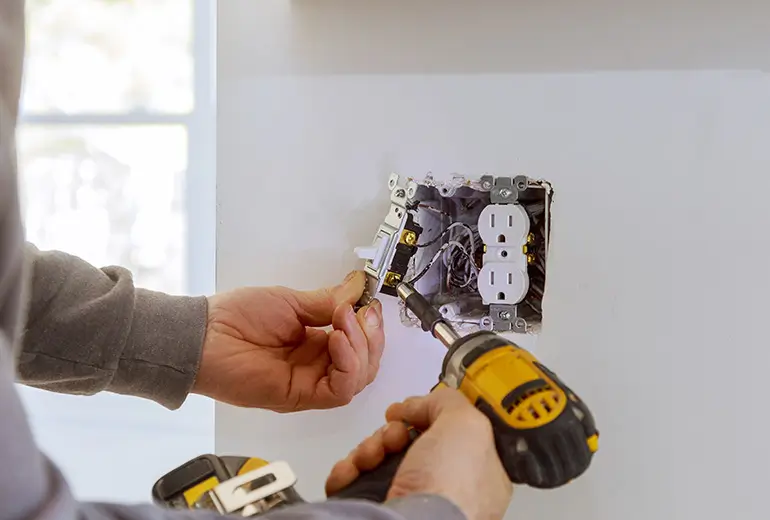
Signs You Need a Dedicated Circuit Installed
Most homeowners don’t think about circuits until something stops working. By then, the wiring has usually been working harder than it should for a while. A few of the patterns we see most often in Naperville-area homes:
- The breaker trips when a specific appliance turns on. Microwaves and space heaters are the usual suspects. If resetting the breaker fixes it until next time, the circuit is overloaded.
- Lights flicker or dim when the fridge compressor cycles, the AC starts, or the dryer kicks into a heat cycle. That voltage drop means the circuit is shared with too many things.
- Outlets feel warm to the touch, or you smell something faintly plastic near a receptacle. Stop using it and call us — that’s a fire risk, not an inconvenience.
- You’re running an extension cord as a permanent solution for a window AC, a freezer in the garage, or a space heater. Extension cords aren’t built for sustained loads.
- You’re adding a new appliance — second fridge, hot tub, EV charger, induction range — and the manufacturer’s manual says it needs its own circuit. (It usually does. More on that below.)
- A home inspector flagged it during a sale or purchase. We get a lot of calls from buyers and sellers in Naperville and Hinsdale after inspections turn up shared circuits where there shouldn’t be any.
If any of that sounds familiar, the next step is a panel inspection. We’ll figure out which circuits are overloaded, what’s safe to add to your existing panel, and what (if anything) needs upgrading. No upsell scripts.
Appliances That Need a Dedicated Circuit (and the Amperage They Need)
The National Electrical Code spells out which appliances are required to be on their own circuit, and most appliance manufacturers add to that list in their installation manuals. Ignoring those specs can void your warranty. Here’s what we install dedicated circuits for most often:
20-amp circuits (120V):
- Refrigerator
- Dishwasher
- Microwave (built-in or over-the-range)
- Garbage disposal
- Sump pump
- Bathroom outlets
- Laundry room outlets
- Home office or workshop
- Window air conditioner
30 to 50-amp circuits (240V):
- Electric dryer (30A)
- Electric range, oven, or cooktop (40–50A)
- Electric water heater (30A)
- Central air conditioner (30–50A, depending on tonnage)
- Hot tub or spa (50–60A)
- EV charger (30–60A — see our EV charger installation page)
- Welder or large workshop tools
A modern home typically has between 7 and 20 dedicated circuits — kitchens alone usually need a separate circuit for each major appliance plus two small-appliance circuits for the countertops. If your home is older and doesn’t have that, we can almost always add what’s missing without a full panel replacement, as long as your existing panel has open slots and enough capacity.
What a Dedicated Circuit Installation Costs in Naperville
Pricing varies more than people expect, mostly because of distance from the panel and what’s between the panel and the new outlet. A few honest numbers:
- Standard 20A circuit, basement panel, short wire run: typically $250–$450 installed
- 20A circuit run through finished walls or up to a second floor: $400–$700
- 30A or 50A 240V circuit (dryer, oven, range): $450–$900
- Long runs to a detached garage or far end of the house: $700–$1,200+
- Permits and inspection (Naperville/DuPage): usually $50–$150 on top, depending on the jurisdiction
If your panel is full and there are no open breaker slots, we may recommend a tandem breaker or a panel upgrade — that’s a separate conversation and a separate quote. We won’t add a new circuit to a panel that can’t safely handle it.
Every quote is in writing before any work starts. No deposits. No “we found a problem” surprises mid-job.
The Install Process — What Actually Happens
For most jobs, a dedicated circuit install is a half-day project. Here’s what it looks like from your end:
- Site visit and load calculation. We look at your panel, count what’s already on it, calculate the available capacity, and walk the wire path from the panel to where the appliance lives.
- Permit pull. Naperville, Aurora, Lisle, Plainfield, and the surrounding villages all require permits for new circuit work. We pull it; you don’t have to think about it.
- Wire run. We run the appropriate gauge wire (12-gauge for 20A, 10-gauge for 30A, 6-gauge for 50A) from the panel to the new outlet location. Where possible we route through unfinished space; if we have to go through finished walls we fish carefully and patch holes neatly.
- Breaker installation. New breaker goes in the panel — GFCI- or AFCI-protected where the NEC requires it (kitchens, bathrooms, garages, outdoor outlets, and most living spaces in newer code cycles).
- Testing. We verify voltage, polarity, and grounding, then test under load with the appliance running.
- Inspection. The local inspector signs off. You get the paperwork.
Most installs happen with the power off only on the affected circuit, so the rest of the house stays running while we work.
Naperville Homes, Naperville Wiring
Naperville’s housing stock runs the gamut. New construction in the south end of town is usually wired to current code with plenty of dedicated circuits already. But a lot of the homes north of Ogden, in older Aurora, in central Lisle, and around Hinsdale and La Grange were built when one circuit per room was considered generous and a microwave was a luxury appliance. Those homes are where we spend most of our time.
Every install meets or beats the current NEC, and we follow the National Electrical Code (NFPA 70) — the standard every U.S. jurisdiction adopts in some form — for wire sizing, breaker selection, and GFCI/AFCI placement.
Service Areas
We install dedicated circuits across:
- Naperville, IL
- Aurora, IL
- Lisle, IL
- Plainfield, IL
- Bolingbrook, IL
- Downers Grove, IL
- Hinsdale, IL
- Burr Ridge, IL
- La Grange, IL
- And surrounding DuPage and Will County communities
Frequently Asked Questions
How do I know if I have a dedicated circuit already?
Open your breaker panel and look at the labels. If a breaker is labeled with a single appliance (“fridge,” “dryer,” “microwave”), that’s a dedicated circuit. If you don’t have labels, flip a breaker off and see what loses power. If only one appliance goes dark, it’s dedicated. If half the kitchen goes with it, it isn’t.
Does a refrigerator really need its own circuit?
The NEC recommends it, manufacturers usually require it, and the practical reason is simple: if your fridge shares a circuit with the microwave and the breaker trips while you’re at work, you come home to spoiled food. A dedicated 20-amp circuit is cheap insurance.
How long does a dedicated circuit installation take?
Most single-circuit jobs take three to five hours, including testing. Longer wire runs through finished walls add time. Panel upgrades or subpanel installs are full-day jobs.
Do I need a permit to add a circuit in Naperville?
Yes. Every municipality in the area requires an electrical permit for new circuit work, and the work has to be inspected. We handle the permit application as part of the job — the cost is folded into your quote.
Can you add a circuit if my panel is full?
Sometimes, with a tandem breaker. If the panel is at its amperage limit or has known safety issues (Federal Pacific, Zinsco, or Sylvania panels are the common problem brands we replace), a panel upgrade is the safer path. We’ll tell you which applies after we look at it.
Will a dedicated circuit installation void my appliance warranty?
Not if we do the work. Our installs follow the manufacturer’s spec sheet, including circuit dedication where required. We document everything in case you ever need to make a warranty claim.
What’s the difference between a dedicated circuit, a circuit upgrade, and a rewire?
A dedicated circuit adds one new line for one appliance. A circuit upgrade replaces aging or undersized wiring on an existing circuit. A whole-house rewire is a much larger project that replaces the wiring throughout the home — usually only needed in homes with knob-and-tube or aluminum wiring.
Ready to Schedule a Dedicated Circuit Install?
Call (630) 427-5923 to talk to a licensed electrician — not an answering service. If it’s outside business hours, send us a service request and we’ll get back to you first thing the next morning. For urgent issues like burning smells, hot outlets, or repeated breaker trips, see our emergency electrical services page.
Cob Services LLC — Licensed, bonded, and insured. Illinois License #26-00032356.
Cob Services LLC
(630) 427-5923
2020 Calamos Ct Suite 200, Naperville, IL 60563
Get Directions