
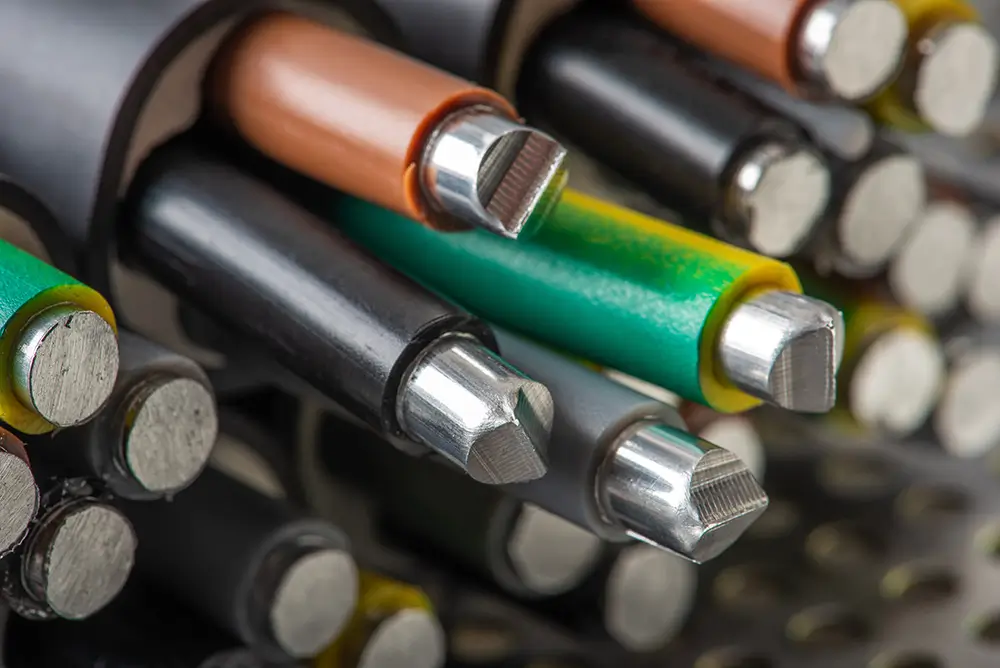
If your house was built somewhere between 1965 and 1973, there’s a real chance the branch circuits behind your walls are aluminum, not copper. We see it most often in older sections of Naperville and in pockets of Lisle, Downers Grove, and Aurora where the original wiring never got touched during a renovation.
I want to walk you through what aluminum wiring actually is, why insurance carriers care about it more than they used to, and how the three main repair options compare when you ask a real electrician for a real number.
How to tell if your house has it
Pop the cover off any outlet or switch (turn the breaker off first, please) and look at the wire screwed to the side of the device. Aluminum is silver. Copper is copper-colored. That’s the giveaway most homeowners miss, because the insulation jacket on the cable is usually marked “AL” or “ALUMINUM” or “Al-Cu” but you have to know to look.
A few other signs we run into on service calls:
- Outlets or switches that feel warm to the touch
- A faint plastic smell near a receptacle, especially one with a heavy load like a window AC
- Cover plates that are discolored or slightly darkened around the screws
- Lights that flicker when a hair dryer or microwave kicks on, even after a panel inspection turns up nothing
If you bought your house with a home inspection report in hand, check the electrical section. Most inspectors flag aluminum branch circuits when they see them. If the report is silent and the house is from this era, don’t assume you’re in the clear. Inspectors only see what’s exposed at the panel and at a sample of receptacles.
Why this matters more in 2026 than it did ten years ago
The CPSC has been clear on the hazard for decades. Their research found that pre-1972 aluminum-wired homes are 55 times more likely to have a connection at an outlet reach what they call “Fire Hazard Conditions” compared to copper-wired homes. The original document is on the CPSC site here: Repairing Aluminum Wiring (Publication 516).
What’s changed recently is the insurance side. Carriers in Illinois have gotten a lot stricter about renewing or writing new policies on homes with unremediated aluminum wiring. Some won’t quote you at all. Others will quote, but with a non-renewal notice if you don’t show proof of remediation within a set window, often 60 or 90 days.
The language in many policies now reads roughly like this: the carrier will not cover fire loss attributable to aluminum wiring unless the wiring was repaired by a licensed electrician using the AlumiConn or COPALUM connector method, with the work permitted, inspected, and documented. Read your declarations page. If you see anything about aluminum wiring in the exclusions section, take it seriously before your next renewal, not after a claim.
The three repair options, ranked the way I’d rank them for a homeowner
Option 1: COPALUM crimp
This is the gold standard. A copper pigtail gets crimped to the aluminum conductor with a special AMP/Tyco connector and a hydraulic crimp tool that creates what is essentially a cold weld. Once it’s done, it’s done. The connection won’t loosen, oxidize, or back out.
Two real-world catches: very few electricians in the Chicago suburbs are certified and tooled up for COPALUM. The dies and crimper are sold only to trained installers. Cost per device tends to run higher than the alternatives because of the labor and the proprietary tooling. If you have a COPALUM-certified shop quote you, expect a meaningfully higher number than an AlumiConn quote, but the work is genuinely permanent.
Option 2: AlumiConn (King Innovation)
A purple lug-style connector with three set screws, torqued to spec, with anti-oxidant compound on the aluminum side. The CPSC has explicitly recognized AlumiConn alongside COPALUM as meeting their standard for a complete and permanent repair. Most insurance carriers that accept COPALUM also accept AlumiConn.
This is the option I recommend most often for Naperville homeowners, because the math usually works. It doesn’t need a proprietary tool, more electricians can do it correctly, and the connectors are widely available. The catch is space. The connectors are bulky, and the small metal boxes used in 1960s and 70s construction can get crowded fast, especially with a three-way switch or a GFCI device. A good electrician will sometimes recommend a deeper or larger box at certain locations, and that’s fine, that’s the work being done right.
Option 3: Twist-on “purple wire nut” pigtailing (Ideal #65 / Twister AL/CU)
I’m including this for completeness, not because I recommend it. The CPSC does not consider purple wire nuts a permanent repair. Independent testing by Dr. Jesse Aronstein and others has shown failures over time. Some insurance companies will accept it, some won’t, and some used to accept it and have quietly stopped.
If a contractor quotes you a very low number to “pigtail your aluminum wiring,” ask specifically what connector they’re using. If the answer is purple wire nuts, you’re getting a price, not a fix.
Option 4: Full rewire to copper
Sometimes this is the right answer, even though it’s the most expensive on paper. If the house is already getting opened up for a kitchen remodel or a basement finish, running fresh copper while the drywall is off costs a fraction of what it would as a standalone job. We’ve also done full rewires on homes where the aluminum was so far gone, with melted devices and burnt-back conductors at multiple locations, that piecemeal remediation didn’t make sense.
A full rewire also gives you the chance to add what wasn’t there in 1970: dedicated circuits for the kitchen counter, AFCI protection in the bedrooms, and proper grounding throughout. If your panel is also a Federal Pacific Stab-Lok or a Zinsco, it’s coming out anyway, and you should plan the rewire and panel replacement together. We wrote up the full process here: What Happens During a Whole Home Rewire in Naperville.
What this looks like in a real Naperville house
A typical 1968 ranch in the older part of town with three bedrooms, two baths, and a finished basement might have somewhere between 60 and 90 device locations once you count every outlet, switch, smoke detector, and light fixture. Each location needs hands on it during remediation.
That’s the honest reason full-house aluminum remediation isn’t a one-day job. We pull every device, inspect the conductor for damage, install the AlumiConn or COPALUM, repack the box, install a new device, and test. Multiply by the number of locations. Add the panel inspection and any feeder repairs. Add permits and inspection time with the City of Naperville.
If a quote comes in dramatically below what other licensed shops are giving you, the corner being cut is almost always one of these: they’re using purple wire nuts, they’re skipping locations they don’t see (“we’ll just get the ones in the kitchen and bathrooms”), or they’re not pulling permits.
A related issue we run into in the same vintage of homes is old cloth-jacketed wiring, which has its own failure pattern. We covered that one here: Is That Old Cloth Wiring in Your Naperville Home Actually a Fire Hazard?
What to do this week if you think you have aluminum
- Pull the cover off two or three outlets and confirm.
- Read the aluminum wiring section of your homeowners policy.
- Get at least two written quotes from licensed Illinois electricians who specifically remediate aluminum wiring, and ask each one which connector they use.
- If you’re already planning a remodel, talk to your electrician about combining the work.
- If you’ve been hearing crackling at outlets, smelling anything plasticky, or seeing scorched cover plates, stop using those circuits and call someone today.
If you’d like us to take a look, Cob Services LLC covers Naperville and the surrounding suburbs, and we’ll tell you straight what the house actually needs. We pull permits, we use AlumiConn or full rewire depending on what fits the home and the budget, and we’ll never quote you a price based on purple wire nuts.
The 1965 to 1973 Naperville housing stock is mostly still standing for a reason. These are well-built homes. The wiring just needs to catch up to the way we live now.