
People call us about generators for one of two reasons. The freezer thawed during a three-day outage last August, or somebody on Nextdoor mentioned ComEd is running maintenance on the local substation again and the kids’ bedrooms run hot when the AC dies. Both calls land in the same place: which brand should I buy.
The honest answer is that the brand matters less than most installers will admit, but it does matter. I have put in close to two hundred whole-home generators across Naperville, Lisle, Plainfield, and the rest of the western suburbs over the last decade. Here is what I actually tell people when they ask, and what I would put in my own backyard.
The three brands worth considering in Naperville
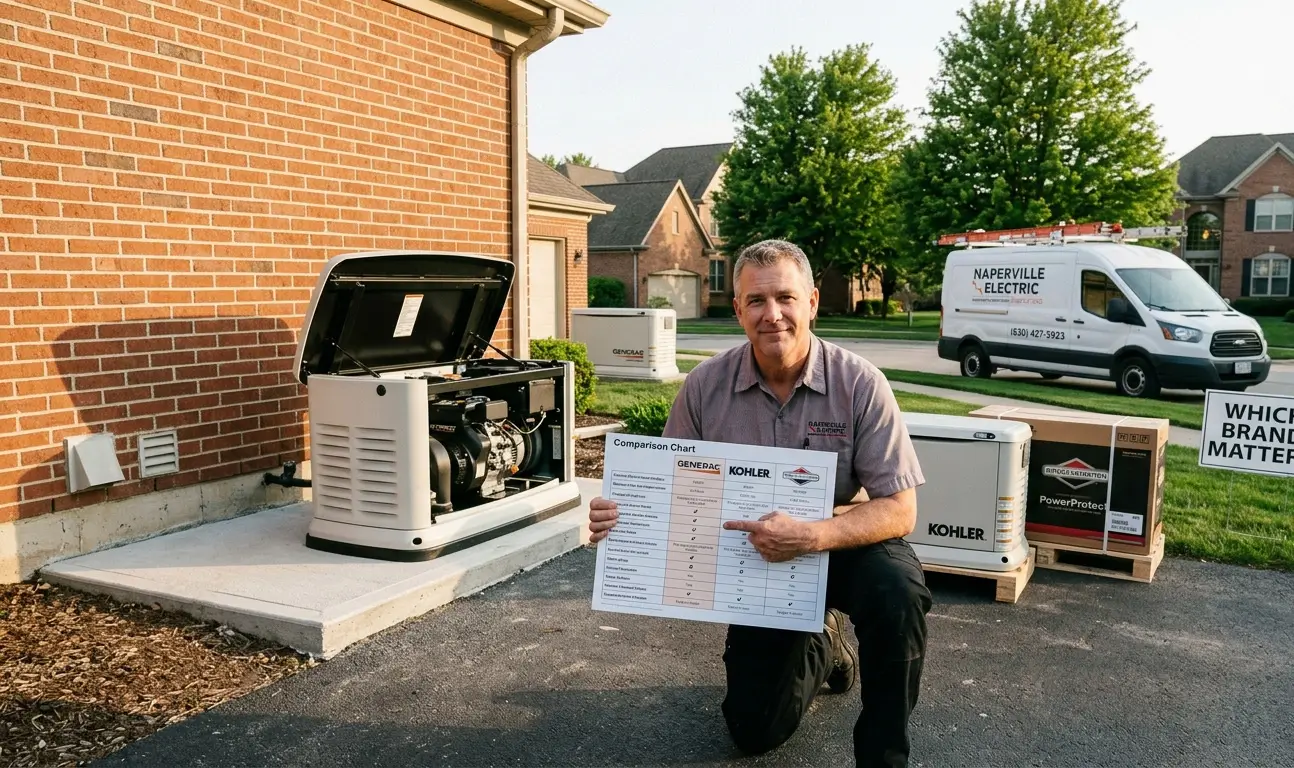
You can buy a residential standby generator from Champion, Cummins, Westinghouse, and a handful of other names. For a whole-home unit that an installer will warranty and a parts truck will actually show up to service, you are realistically looking at Generac, Kohler, or Briggs & Stratton. Cummins is excellent too, but the dealer network in our service area is thinner.
These three each have a clear personality once you have lived with them for a few years.
Generac: the one you have already seen on your neighbor’s lawn
Generac owns somewhere north of 70 percent of the residential standby market in the Midwest, and you can see it from the street. Drive around Hobson West, Saybrook, or White Eagle and almost every concrete pad next to a furnace vent has the Generac silhouette on it. There is a reason.
Their Guardian series, currently the 14kW through 26kW air-cooled lineup, hits the sweet spot for a Naperville two-story. The cellular monitoring through Mobile Link is genuinely useful, you get an alert on your phone when the unit runs its weekly self-test and another one if it throws a fault code. The dealer and parts network is the deepest of any brand by a wide margin. If something fails on a Sunday in February, somebody can get a board out to you on Monday.
Where Generac gets a mixed review from installers is the engine. The G-Force engines in the air-cooled units run a touch louder than Kohler, and the early 24kW Guardians had a known issue with the voltage regulator that Generac eventually addressed with a service bulletin. The newer 26kW units are solid, and the Guardian product line specs are public if you want to compare model numbers.
I install more Generacs than anything else, mostly because of parts availability and because most customers have already seen one and feel comfortable with the brand. If you want a generator that does the job, has the best service backbone in the area, and you do not want to overthink it, this is the one.
Kohler: the one that runs the quietest
Kohler is the choice when somebody on the call says “we have neighbors close” or “the bedroom is right above where it would sit.” A 20kW Kohler 20RCAL air-cooled unit runs at around 65 decibels at 23 feet during a load test. The equivalent Generac runs closer to 67. That sounds like nothing, but decibels are logarithmic and the difference is noticeable when the unit is exercising at 2 PM on a Tuesday and your kid is on a Zoom call.
Kohler engines are built tighter. The five-year, 2000-hour warranty matches Generac’s, but I see fewer engine claims on Kohler in the field. The corrosion-resistant aluminum enclosure also handles the freeze-thaw cycle on the north side of a Naperville house better than the painted steel options.
Where Kohler loses is the dealer network. There are fewer authorized Kohler service techs in DuPage and Will counties, and lead times for non-standard parts can run a week longer. If your unit fails on Saturday of Memorial Day weekend, you will get parts on Friday with a Generac and the following Tuesday with a Kohler.
The other consideration is price. A 20kW Kohler installed in Naperville runs about 8 to 12 percent more than an equivalent Generac once you include the transfer switch, the pad, the gas line, and the electrical work. Whether that is worth it depends on how close your master bedroom is to the planned generator location.
I put Kohlers in for customers who care about noise, who have an HOA that has nudged them about generator placement, or who want the engineering reputation. For pure “keep the lights on” buyers, Generac usually wins on value.
Briggs & Stratton: the underdog that quietly got better
A lot of installers wrote off Briggs in residential standby a few years ago. The pre-2022 units were fine but not exciting, and the dealer support was weaker than the other two. That has changed.
The current PowerProtect and PowerProtect+ lineup, from 13kW up to 26kW, ships with what Briggs calls NGMax technology. The marketing language is a little thick, but the engineering is real: the unit produces more power on natural gas than the comparable Generac or Kohler, which matters because almost every Naperville install runs on natural gas, not propane. Most generator output ratings you see in brochures are propane numbers, and the real-world natural gas output is often 10 to 13 percent lower. Briggs closes most of that gap.
The warranty is also the longest on the market right now at five years on the engine and a separate coverage tier on the alternator. The 26kW PowerProtect+ has the highest motor starting capability of any air-cooled residential unit, which matters in homes with a 4 or 5-ton AC compressor that has to start on the same circuit as a well pump.
The trade-off is the dealer network, which is still smaller than Generac’s in our area, and resale story. If you sell your house in five years, a Generac on the pad is a feature in the listing because buyers recognize the brand. A Briggs is a question the listing agent has to answer.
I install Briggs for customers who do their homework, who care about natural gas output specifically, and who are not planning to sell soon. For a forever home with a big AC system on natural gas, it is genuinely a strong pick.
What size do you actually need
This is where most online generator comparisons go wrong. They tell you to add up the wattage of everything in the house, multiply by some safety factor, and pick the next size up. That gets you to a 30kW liquid-cooled unit and a $22,000 install bill that you did not need.
In real Naperville homes, the size buckets work out like this:
A 1,500 to 2,500 square foot home with one AC unit, gas heat, and standard kitchen appliances does fine on an 18kW air-cooled. Lights, fridge, freezer, sump pump, furnace blower, AC, and the home office outlets all run. The microwave and the oven both run, just not at the same moment as the dryer.
A 2,500 to 4,000 square foot home with two AC zones, an EV charger, and a finished basement wants a 22kW or 24kW. The 26kW comes into play if you have a hot tub, a pool pump, or a well.
Anything bigger than that, or homes with two ACs plus electric heat backup, starts needing a liquid-cooled 32kW or 38kW, and the install price roughly doubles. If you are at that level, your electrical panel is part of the conversation too, because the transfer switch sizing has to match.
For a deeper look at whether your existing service can even handle modern loads with or without backup power, our piece on why your Naperville home may not have enough power for modern living covers the ground.
What the install actually involves in Naperville
A whole-home generator install is not just dropping a unit on a pad. Here is what we are doing on the typical job:
We pull a Naperville electrical permit and a separate gas permit, since the generator ties into your natural gas line. We pour or set a composite pad, level it, and confirm setback distances. The unit has to sit at least 18 inches from any building opening, 5 feet from a property line in most DuPage County setups, and 3 feet of clearance on the service side.
We run the transfer switch, which is either a service-entrance-rated unit that replaces your meter socket or a sub-panel-style switch that feeds a backed-up load center. The choice depends on what you want to keep running and how your existing panel is laid out.
We run the gas line, which on a 22kW unit needs 3/4-inch black pipe minimum and sometimes a step up to 1-inch depending on the distance from the meter. Pressure testing, a leak check, and an inspection follow.
We run the electrical, both the AC output back to the transfer switch and the low-voltage control wiring. Then we commission the unit, which means running it through self-test, simulating a power loss, confirming it transfers in under 10 seconds, and walking the homeowner through the controller.
Two inspections. One for the gas, one for the electrical. The whole job takes one to two days on site once the unit is delivered, and the delivery lead time is what stretches the calendar. Generac availability is best, Kohler runs four to six weeks, Briggs has been about three.
If you want the broader picture on what a residential install involves before you get into brand specifics, our earlier post on generator installation in Naperville and what homeowners should know covers the basics.
Real install costs in Naperville right now
Installed prices in Naperville have settled into these ranges for 2026. These include the unit, transfer switch, pad, gas line within 25 feet, permits, and labor:
A 14kW or 18kW Generac Guardian lands around $9,500 to $12,000 installed. A 22kW comes in at $12,000 to $14,500. A 26kW air-cooled, which is the largest air-cooled unit available, runs $14,500 to $17,500.
A 20kW Kohler 20RCAL is in the $13,500 to $15,500 range. A 26kW Kohler hits $16,500 to $19,000.
A 22kW Briggs PowerProtect+ comes in at $11,500 to $13,500. A 26kW PowerProtect+ runs $13,500 to $16,500. Briggs is generally 5 to 8 percent under the Generac equivalent before the dealer rebate.
Liquid-cooled units, 32kW and above, start at $22,000 and can run past $35,000 depending on the panel work involved. Those are for homes that genuinely need that capacity, not for status.
The variables that push prices up: a gas line run longer than 25 feet, a panel that needs to be upgraded to take a service-entrance transfer switch, a generator location that requires trenching across a driveway, and any HOA-required screening or fencing around the unit.
Surge protection: the line item most quotes skip
A generator does not protect your home from utility-side surges. The transfer switch decouples you from the grid only during an outage. Every other moment, every nearby lightning strike, every ComEd switching event, every transformer hiccup runs into your panel exactly the way it did before you spent $13,000 on backup power.
If you are putting a generator in, put a whole-home surge protector in the panel at the same time. We covered the why in our post on whole-home surge protection in Naperville, but the short version is that the marginal cost when an electrician is already in your panel is about $350 to $500 for the device and labor. After the fact it is closer to $700.
What I would put in my own backyard
A 22kW Generac Guardian with a 200-amp service-entrance transfer switch, a whole-home surge protector at the panel, and natural gas as the fuel. About $13,500 in 2026 dollars. I would skip the Mobile Link cellular subscription after year one because the alerts get tedious. I would not pay extra for a Wi-Fi module that does the same job.
That is the install I actually have at my own house. If I had close neighbors and a bedroom right above the unit, I would put in the 20kW Kohler instead and pay the premium for the noise reduction. If I had a big AC system and wanted maximum natural gas output, I would look hard at the Briggs 26kW.
There is no wrong answer among those three brands. The wrong decisions on a generator project are almost always about sizing, location, or transfer switch type. Those are install calls, not brand calls.
A note on portable generators and interlocks
About one in five generator calls we get is somebody asking whether they can just buy a portable unit at Home Depot and run an interlock kit on the panel. Yes, technically. It is cheaper. It is also a lot more work every time the power goes out, you have to be home to start it, and most homeowners stop using it after the second or third outage because hauling a 200-pound generator out of the garage at 2 AM in February gets old.
If you are doing it anyway, at least have a licensed electrician install the interlock kit and the inlet box. The DIY interlock installs we get called out to repair after the homeowner backfed the panel without one are the most preventable damage we see all year.
When to call
If the power has been out more than 24 hours twice in the last two summers, you have a freezer full of food you care about, you work from home, or somebody in the house is on a medical device, a generator is worth the conversation. If your power is already out and you are reading this on your phone, our emergency line is open and we can get you on the schedule.
Call (630) 427-5923 for a free in-home generator assessment. We measure your gas line, look at your panel, walk the proposed unit location, and tell you which of the three brands actually fits your house. There is no deposit to do the assessment. The price we quote includes the permit fees.