
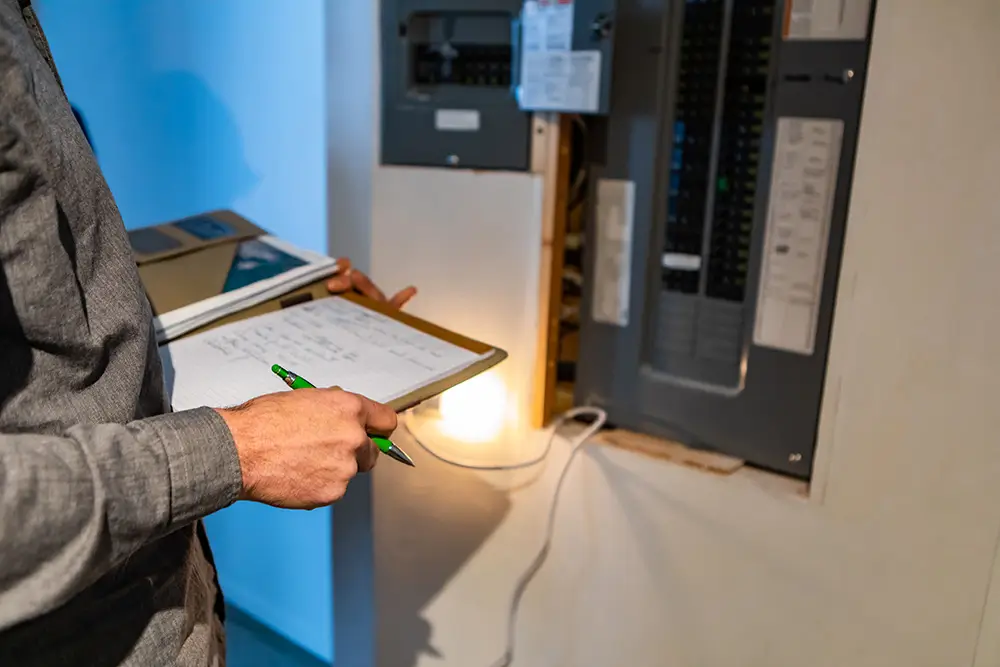
Most people never watch their own electrical inspection happen. The inspector shows up, walks the job, signs off or doesn’t, and you hear about it secondhand. So when a permit gets held up, it feels like a black box. It really isn’t. After a decade of pulling permits and meeting inspectors on jobs around Downers Grove, I can tell you the inspection is pretty predictable, and the things that fail are even more predictable than that.
I’m Alexandr Godonoaga. I own Cob Services LLC (License #26-00032356), and I run residential electrical work across Downers Grove and the rest of DuPage County. Here’s what the Village inspector is actually checking, plus the six problems I see flagged most, so you know what you’re walking into before any work starts.
Who inspects electrical work in Downers Grove, and why it matters
Electrical work in town gets permitted and inspected through the Village of Downers Grove, not the county and not the state. The Village currently works to the 2020 National Electrical Code with its own local amendments. That matters more than it sounds, because the code gets revised every few years, and a fix that sailed through in 2018 might not pass today. You can see the adopted codes and the permit process on the Village of Downers Grove permits page. Inspections go through their portal or by phone, and they want 48 to 72 hours of notice, so a same-day inspection isn’t going to happen here.
Worth being clear about one thing: an inspection isn’t the Village making your life hard. It’s the step that puts your electrical work on record as code-compliant. That’s the same paperwork your insurer wants, and the same paperwork the next buyer of your home will eventually ask about. Work done without it has a way of surfacing at the worst possible moment, which is almost always during a sale.
What the inspector checks
A residential electrical inspection runs in a rough order. The inspector confirms the work matches the permit, then moves through the panel, the grounding, the circuits, the boxes, and the GFCI and AFCI protection. On a rough-in inspection, with the walls still open, they’re checking wiring and boxes before any of it gets covered. On a final, they’re testing what’s live.
There’s nothing mysterious about it. They want to see that the work is safe, built to current code, and that nothing got buried where it can’t be checked. Here’s where jobs actually stall.
The 6 things that fail first
1. Grounding that isn’t continuous
This is the one I see flagged most, and it’s almost always an older home. Plenty of houses near downtown Downers Grove were wired before grounding was standard, so you end up with two-prong outlets, a ground path that quits partway, or a panel that was never properly bonded. The inspector checks for a continuous, low-resistance path to ground, confirms the rod or Ufer is right, and makes sure every metal enclosure is bonded. Break that path anywhere and it fails. We deal with this as part of outlet grounding work, and it’s one of the more common reasons a circuit has to get re-landed.
2. Missing or wrong GFCI and AFCI protection
Code keeps widening where these are required. GFCI protection near water (kitchens, baths, garages, outdoors, basements) and AFCI on most living-area circuits are both standard now. The older the home, the more likely they’re missing entirely. Here’s the part that catches people off guard: the requirement follows the current code, not the code from when the house was built. So a remodel or a panel swap can trigger protection the house never had. Inspectors look at this closely because it’s a direct safety item. A bathroom outlet with no GFCI protection is a fail, no argument.
3. An overloaded or modified panel
The panel is where shortcuts show their face. Double-tapped breakers, where two wires are jammed under a lug built for one. A panel running past capacity. Missing breaker labels. An oversized breaker protecting wire that’s too thin for it. Open knockouts left uncovered. All of it gets flagged. If your home still runs a 60- or 100-amp panel, or you’ve found a Federal Pacific or Zinsco box down in the basement, that’s often the single thing between you and a passed inspection. Most of this comes up during an electrical panel upgrade, and honestly, a clean, correctly labeled panel is one of the fastest routes to an easy final.
4. Box fill and connection problems
This is the one that trips up weekend wiring jobs. Cram too many wires into a junction box and you’ve got a code violation called box fill. Same story for connections made with the wrong connectors, splices left sitting outside a box, or backstabbed receptacles that loosen up over time. Inspectors open boxes and count. It’s tedious, and it’s exactly the kind of detail a careful electrician gets right on the first pass and a rushed one doesn’t. Aluminum branch wiring in 1960s and 70s homes needs the right corrective connectors here too, which is part of why we handle it under wiring updates instead of slapping on a quick patch.
5. Permit and scope mismatches
Sometimes the wiring is perfectly fine and the paperwork is the problem. If the work that got done doesn’t match what the permit describes, or part of the job was never permitted in the first place, the inspection stops there. I see this most when a previous owner ran circuits without a permit and that history finally catches up during a new project. The fix isn’t electrical at all. It’s getting the scope and the permit to line up, which is a big reason we pull the permit ourselves and keep the documented scope matching what’s actually in the wall.
6. Old or hidden wiring that can’t carry the load
Knob-and-tube and cloth-wrapped wiring still turn up behind the plaster in older Downers Grove homes. It held up for decades. But it has no ground, it was never built for what a modern house pulls, and an inspector who finds it during an open-wall job is going to flag it. Depending on how far it runs, the answer is either a section update or a full whole-house rewiring. I’d rather tell you it’s a bigger job than let you paper over wiring that’s going to be somebody’s problem for the next thirty years.
How to pass on the first try
Look at all six and the pattern is the same. Inspections fail on the things that got rushed, hidden, or skipped. A job built to current code, panel labeled, grounding continuous, the right protection in place, and a permit that matches the work, that passes without any drama at all.
Most of these problems are fixable long before the inspector pulls up, as long as the person doing the work knows what’s coming. That foresight is really what you’re hiring for. If you want someone who does it right the first time and stands there with the inspector on-site, that’s the work we do every week as residential electricians in Downers Grove.
And if you found this page because something already feels off, like a warm panel or a burning smell or an outlet that sparks when you plug into it, don’t wait on a scheduled inspection. That’s an emergency electrical call. Get it made safe first. The paperwork can wait.
Alexandr Godonoaga Owner and CEO at Cob Services LLC License #26-00032356 Call (630) 427-5923