
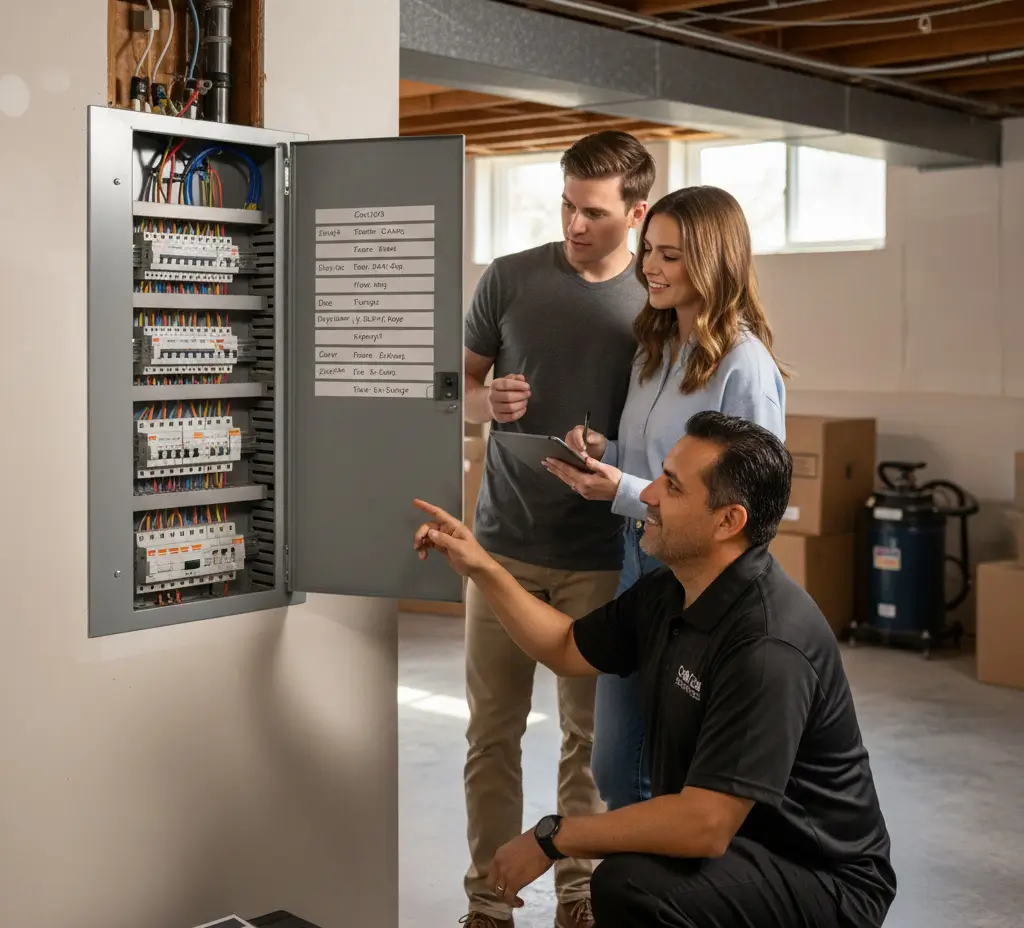
A full kitchen remodel in Naperville usually lands between nine and twelve branch circuits, and seven of those are dedicated. The short version: two 20-amp small appliance circuits at absolute minimum, plus separate circuits for the refrigerator, dishwasher, disposal, microwave, and range, plus a general lighting circuit that legally cannot share with any of it.
If your existing kitchen runs on four circuits, that is not unusual for a house built before the mid-90s. It is also the reason so many Naperville kitchen remodels turn into panel conversations halfway through.
I am Alexandr Godonoaga. I own Cob Services LLC, I hold Illinois electrical license #26-00032356, and I have been wiring kitchens in Naperville and the western suburbs for over ten years. Below is how the circuit count actually comes together on a real job, what the 2023 code requires, and where the City of Naperville inspectors tend to push back.
Naperville enforces the 2023 NEC, and that matters here
The City of Naperville has adopted the 2023 National Electrical Code (NFPA 70), along with local amendments in the Naperville Municipal Code. That is the version your kitchen gets inspected against.
It matters because the 2023 edition changed kitchens more than any recent cycle. GFCI protection expanded to cover essentially every receptacle in the room instead of just the ones near the sink, and Section 210.8(D) pulled hardwired appliances into the GFCI requirement too. Ranges, wall ovens, cooktops, microwaves, and dishwashers all now need ground fault protection on the branch circuit or at the outlet, whether they plug in or get wired directly.
Plenty of electricians still wire kitchens the way they learned under the 2017 or 2020 code. Those jobs fail final inspection. I have been called in to correct three of them in the last two years, and in each case the fix meant swapping breakers and, in one case, pulling a new home run because the panel had no space left for dual function devices.
One more Naperville detail that surprises people from out of town: inside city limits, the electric utility is the City of Naperville’s own Department of Public Utilities, not ComEd. DPU-E writes its own service rules, and they differ from ComEd’s. If your remodel touches the service, the meter, or the panel location, that changes who you coordinate with and how long it takes. Cross into Lisle, Aurora, Plainfield, or Downers Grove and you are back to ComEd.
What the code actually requires, circuit by circuit
Two small appliance branch circuits, minimum
Section 210.11(C)(1) requires at least two 20-amp circuits serving the receptacles in the kitchen, pantry, breakfast area, and dining room. These are the countertop outlets. They are not allowed to feed lighting, and they are not allowed to feed appliances that are hardwired or fixed in place.
Two is the floor, not the target. On a modern kitchen I typically run three or four, because a countertop with an air fryer, a stand mixer, an espresso machine, and a toaster oven will find the limit of two circuits fast. Splitting them also means a tripped breaker takes out half your counter instead of all of it.
Refrigerator: its own circuit
Code permits the refrigerator to sit on an individual 15-amp or 20-amp branch circuit, and that is what I install every time. A fridge compressor pulls a sizeable inrush spike each time it kicks on. Share that with a countertop circuit and you eventually get nuisance trips, which is a genuinely bad outcome when the trip happens on a Friday and you find out Sunday.
Dishwasher: dedicated, with GFCI
The dishwasher cannot ride on a small appliance circuit, because those circuits are restricted to receptacle outlets serving the countertop and wall spaces. So it gets its own 20-amp run. Under 210.8(D) it needs GFCI protection, and that requirement follows the appliance even when it is hardwired rather than plugged in.
Worth knowing before you buy: some older dishwasher models with degraded heating element insulation will trip a GFCI immediately. If you are reusing an existing unit in a new kitchen, that is a real possibility.
Garbage disposal: dedicated
Same logic. A disposal is fixed-in-place equipment, so it comes off the small appliance circuits and gets its own 15-amp or 20-amp run. Some contractors combine the dishwasher and disposal on one 20-amp circuit and argue the combined load fits. I do not do it that way. When one appliance trips and takes the other with it, diagnosing which one caused it becomes an hourly-rate problem for the homeowner.
Microwave: dedicated 20 amps
A built-in or over-the-range microwave drawing 1,200 watts or more needs its own 20-amp circuit. Manufacturer instructions almost always specify it, and Section 110.3(B) makes those instructions enforceable. GFCI applies here too under the 2023 rules.
Range or cooktop: 240 volts, 40 or 50 amps
A freestanding electric range typically gets a 50-amp, 240-volt circuit on 6/3 cable, though a smaller unit may be fine on 40 amps and 8/3. Induction ranges usually want 40 to 50 amps and are worth confirming against the spec sheet rather than assuming.
If you have a separate wall oven and a separate cooktop, that is two circuits, not one. This is the single most common place I see a kitchen plan blow past the panel’s available capacity, and it is why I run the load calculation before quoting rather than after demo.
Going from gas to induction? Read the dedicated circuit page for how we size those runs, and expect a panel conversation.
Lighting: a separate general circuit
Kitchen lighting cannot sit on the small appliance circuits. It goes on a general purpose 15-amp or 20-amp circuit. On a remodel with recessed cans, under-cabinet LED, pendants over an island, and maybe toe-kick lighting, I often split lighting across two circuits so a dimmer fault does not black out the room.
Under-cabinet LED brings its own headache, which is dimmer compatibility rather than circuit count. If you want the layout planned properly instead of guessed at, our custom lighting installation work covers the design side.
Everything else people forget
Beverage refrigerators. Warming drawers. Instant hot water dispensers. Downdraft vents. Coffee stations plumbed into a cabinet. Each one is fixed equipment, and each one wants its own circuit. A single beverage fridge in an island is the item I get asked about most often after drywall is already up, which is the worst possible time to ask.
The realistic count for a Naperville kitchen
| Circuit | Size | Dedicated? |
|---|---|---|
| Small appliance countertop (x2 minimum, x3 to x4 typical) | 20A | No, shared receptacles |
| Refrigerator | 15A or 20A | Yes |
| Dishwasher | 20A | Yes |
| Garbage disposal | 15A or 20A | Yes |
| Microwave | 20A | Yes |
| Range or cooktop | 40A or 50A, 240V | Yes |
| Wall oven, if separate | 30A or 40A, 240V | Yes |
| General lighting | 15A or 20A | No |
| Beverage fridge, warming drawer, hot water dispenser | 15A or 20A each | Yes |
Nine to twelve total is where most of our full remodels land. A cosmetic refresh that keeps the existing appliance locations can sometimes come in lower, but “we are just replacing the cabinets” has a way of becoming “and the island is moving” by week two.
Where the panel becomes the real story
Here is the part nobody wants to hear on a kitchen job. Every circuit above needs a breaker space, and under the 2023 code most of those breakers need to be dual function AFCI and GFCI devices, since kitchen branch circuits require arc fault protection under 210.12(A) and the receptacles require ground fault protection under 210.8(A)(6).
Dual function breakers are physically standard width, so the space math is straightforward. What is not straightforward is capacity. A pre-1995 Naperville house on 100-amp service was sized for a gas range, a small fridge, and a lot fewer plugged-in devices. Add an induction range, a finished basement, and a Level 2 charger in the garage and the load calculation stops working.
We run that calculation against your existing service before quoting the remodel, and if a panel upgrade is coming, it appears on the original estimate as its own line so you can see what each piece costs. Nobody enjoys a mid-project surprise, least of all the person writing the checks.
If an EV charger is anywhere in your two-year plan, size the panel for it now rather than doing the work twice. Our EV charger installation page covers what those loads look like.
And if the walls come down and you find knob-and-tube, cloth-insulated conductors, or aluminum branch wiring, the scope changes again. That is common enough in older neighborhoods that I quote it separately when it turns up. Depending on how far it goes, whole-house rewiring can be cheaper than chasing individual circuits for the next decade.
Permits and inspection in Naperville
A permit is required before any electrical work begins inside Naperville city limits. Not “for large jobs.” Any electrical work. Applications go through the city’s Civic Access portal, and the city also requires the electrician to be registered as an Electrical Contractor with the Community Services Department. You can read the requirements on the City of Naperville electrical permit page.
A handyman cannot pull that permit. We pull it in our contractor name, schedule the rough-in inspection before insulation and drywall, and handle the final after trim.
The two things Naperville inspectors look hardest at on kitchen rough-ins, in my experience: whether every required circuit is actually a separate home run rather than a spliced extension of something existing, and whether the AFCI and GFCI protection is right for the 2023 cycle rather than the one your electrician memorized in 2015.
The island question, because everybody asks
The 2023 NEC changed island and peninsula receptacles more than most people realize. Under the 2020 code, islands required receptacles based on square footage. Under 2023, installing a receptacle on an island or peninsula is optional. If you skip it, you have to provide a means to add one later, typically a raceway or a stubbed cable into the island base.
The bigger practical change: receptacles mounted on the vertical side of an island below the countertop no longer count toward serving that countertop. That mounting style was popular for years because it hid the outlet. It is out. If you want an island outlet now, it goes on, above, or in the work surface, using an assembly listed for that purpose.
Because the “future provision” language is vague, what satisfies it varies by inspector. We confirm with Naperville before rough-in rather than after.
Frequently asked questions
How many circuits does a kitchen need at minimum? Code minimum for the receptacles is two 20-amp small appliance circuits. A functioning modern kitchen needs far more than the minimum. Counting the refrigerator, dishwasher, disposal, microwave, range, and lighting, seven is a realistic floor and nine to twelve is typical on a full remodel.
Does a refrigerator need a dedicated circuit in Illinois? Code permits it on an individual branch circuit rather than requiring it outright, but every remodel we do gets one. Compressor inrush on a shared circuit causes nuisance trips, and a fridge that quietly loses power is an expensive problem.
Can the dishwasher and disposal share a circuit? Some jurisdictions allow it when the combined load calculates out. We install them separately. Troubleshooting a shared circuit later costs more than the extra cable did.
Do I need a permit to add circuits to my kitchen in Naperville? Yes. Naperville requires a permit before any electrical work inside city limits, and the contractor has to be registered with the city.
Will all these new circuits require a panel upgrade? Sometimes. It depends on your existing service size and total load, not on circuit count alone. A 200-amp panel with open spaces usually absorbs a kitchen remodel. A 100-amp panel feeding a house that has already gained a basement finish and a car charger usually does not. We run the load calculation before quoting so you find out at estimate time.
Why did my new appliances start tripping breakers after the remodel? Under the 2023 code, appliances that never had GFCI protection now do. Older dishwashers, disposals, and microwaves with minor current leakage can trip a new GFCI even though they ran fine on the old wiring. It is usually the appliance, not the installation.
Do I need AFCI and GFCI both? In a kitchen, yes. Branch circuits need arc fault protection and the receptacles need ground fault protection. A dual function breaker satisfies both on one device, which is what we install.
Get the circuit plan done before demo
If you are planning a kitchen and want to know what the electrical actually requires before the cabinets get ordered, call (630) 427-5923 or request a free estimate. We will walk the space, run the load calculation against your existing panel, and give you a circuit plan and a number.
Full scope of what we handle on renovations is on our kitchen and remodeling electrician page, and you can see examples of finished work in our recent projects.
We wire kitchen remodels in Naperville, Aurora, Lisle, Plainfield, Bolingbrook, Downers Grove, Hinsdale, Burr Ridge, La Grange, Oswego, Lockport, Joliet, and Western Springs.
About the author
Alexandr Godonoaga is the owner and CEO of Cob Services LLC and an Illinois-licensed residential and commercial electrician with more than ten years of field experience in Naperville and the western suburbs. Illinois license #26-00032356. He walks every remodel estimate personally and stays the point of contact through final inspection.
Connect on LinkedIn: Alexandr Godonoaga
Cob Services LLC 2020 Calamos Ct Suite 200, Naperville, IL 60563 (630) 427-5923 Monday through Friday, 9:00 AM to 5:00 PM License #26-00032356
Related reading: residential electricians in Naperville and wiring updates for older homes.