
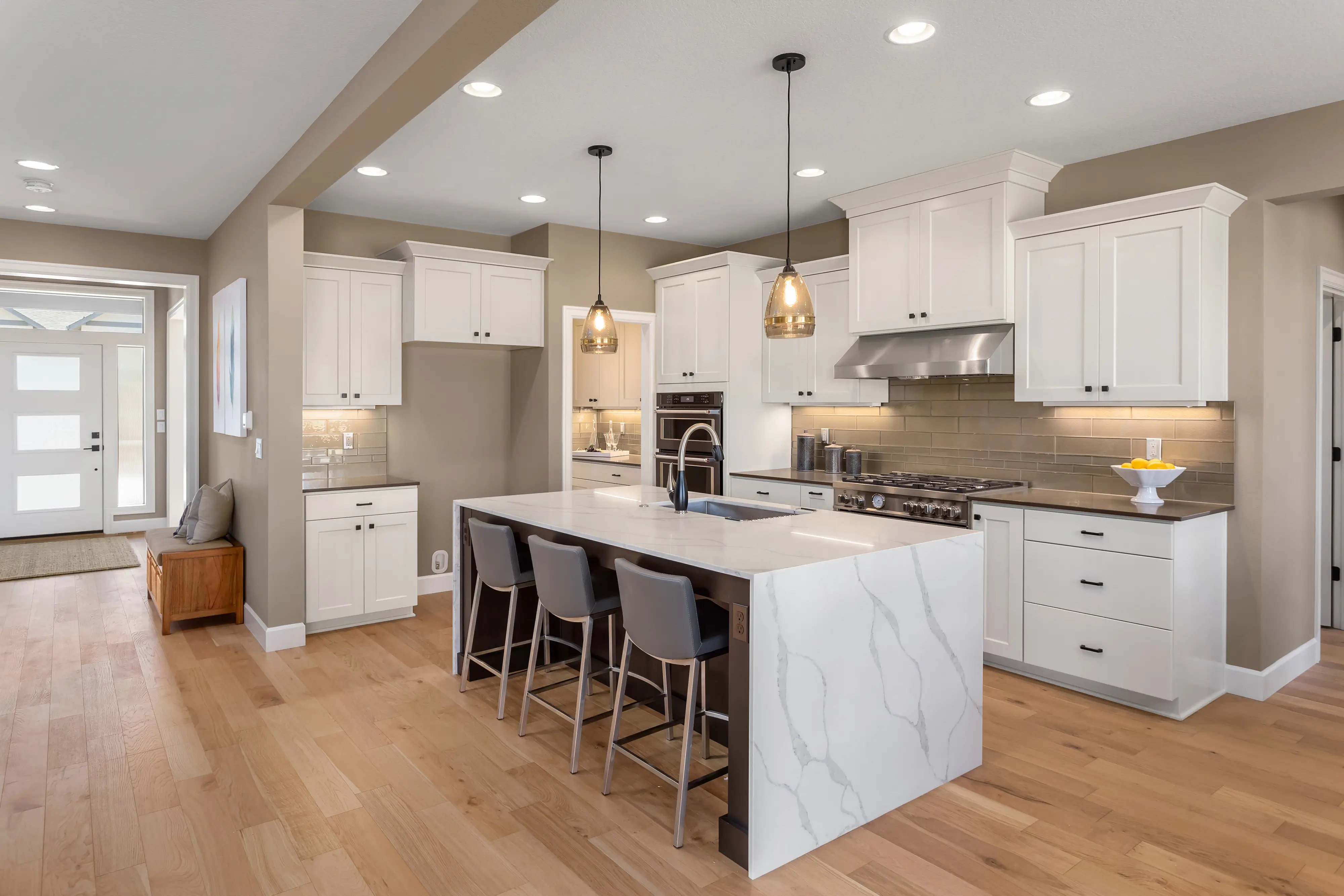
You picked the counters under showroom lights. You’ll live with them under yours. That gap is where most kitchen lighting regret comes from in Naperville, and it shows up about a week after the electrician leaves.
Here’s the pattern we see constantly. A homeowner spends months choosing a white or light gray quartz. They love it in the slab yard. It gets installed, the recessed cans go in at 4000K because someone at the store said 4000K is “kitchen light,” and the first evening in the finished kitchen the counters look gray and a little blue. The wood floor looks flat. The whole room feels like a nice dental office.
Nothing was installed wrong. The color temperature just doesn’t suit what’s under it.
What the showroom did to your sample
Countertop showrooms and big box aisles are lit for one job: making stone look crisp and expensive from ten feet away. That usually means high output fixtures at 4000K or cooler, mounted high, at brightness levels no house has.
Your kitchen is nothing like that. Lower ceilings, less total light, warm cabinet finishes bouncing color around, and most of the hours you spend in it happen after sunset. In January in DuPage County, that’s a lot of hours. Sunset is before 4:30 for weeks, and this is not a sunny stretch of the calendar. From November through February the light coming through your windows is gray more often than not, which means your artificial light is doing more of the work than you think.
So the sample didn’t lie exactly. It was just answering a different question than the one you were asking.
Why quartz in particular reacts this way
Engineered quartz is ground stone held together with a resin binder, plus pigment. It is not a natural slab, and it does not behave like one under changing light.
Whites and light grays are the sensitive ones. Push cooler light at a white quartz and it drifts toward blue-gray. The veining, which you probably chose carefully, loses contrast and starts to look printed rather than deep. Warmer light does the opposite. At 3000K the white reads as white with a little softness in it, the veining separates, and the surface looks more like stone.
Darker quartz and heavily veined slabs are more forgiving. If you picked a deep charcoal or a dramatic marble-look with strong movement, you have more room to go cooler without it falling apart.
The other thing 3000K does well is everything that isn’t the counter. Wood floors, walnut or oak cabinets, brass or bronze hardware, and skin tones all look better slightly warm. Kitchens are also where people eat. Food looks appetizing under warm light and unappetizing under cool light, which is not a small thing in the room where you serve it.
When 4000K is actually the right call
We are not anti-4000K. There are kitchens where it works.
If the whole room is genuinely cool in palette, white cabinets, white or very light gray quartz, stainless everywhere, no wood tone anywhere, then 3500K or even 4000K can hold together. It reads modern rather than clinical because there’s nothing warm in the room fighting it.
North-facing kitchens are the other case. They get cool, indirect daylight all day. Some homeowners want the artificial light to match that rather than clash with it when the sun goes down.
And if the space is doing real work, a serious prep kitchen or a butler’s pantry where you actually need to see what you’re doing, a cooler task layer under the cabinets is defensible. Just make it a deliberate choice rather than a default.
Our honest recommendation for most Naperville kitchens is 3000K in the ceiling. 2700K if the cabinets are warm wood and you want it cozy. 3500K if you want a little more crispness without going cold. 4000K only when the room and the owner both actually want it.
The number that matters more than Kelvin
Color temperature gets all the attention. Color rendering decides more.
Two fixtures can both say 3000K on the box and make your kitchen look completely different, because CCT only describes the color of the light itself, not how well it renders the color of everything it lands on. That second thing is measured by CRI. The Department of Energy’s LED Basics guidance puts the floor for interior lighting at 80 CRI and calls 90 or higher excellent color fidelity. It also flags that CRI is a poor predictor for saturated reds specifically, which is why the supplemental R9 value exists.
R9 is the one that matters in a kitchen. It governs reds. Tomatoes, raw meat, red wine, cherry and mahogany cabinetry, terracotta tile. A fixture can hit 90 CRI with an R9 near zero and every red thing in your kitchen will look dull and slightly brown.
Buy 90+ CRI for a kitchen. If the spec sheet publishes R9, look for something above 50. Cheap recessed cans usually don’t publish it at all, which tells you something.
The failure we get called about most
Not the wrong Kelvin. Mixed Kelvin.
Someone puts 3000K in the recessed cans, then buys under-cabinet strips off a marketplace listing that turn out to be 4000K, then hangs pendants over the island with whatever bulbs came in the box. Three temperatures in one room, all visible at once, and the eye picks it up immediately even when the homeowner can’t name what’s wrong.
Pick one number and hold it across every fixture in the kitchen. Ceiling cans, under-cabinet, in-cabinet, toe-kick, pendants, the light in the range hood. That last one gets missed constantly because it comes with the appliance and nobody checks it.
While you’re at it, check the driver and dimmer pairing before you buy. Mismatched dimmers are the single most common reason under-cabinet LEDs flicker after a remodel, and the same mismatch causes the buzzing and humming people blame on the fixture when the real problem is the control.
How to test this yourself in twenty minutes
You do not need us for this part.
Take your quartz sample home. Buy one 3000K bulb and one 4000K bulb of the same brand and CRI rating, put the sample on the counter where it’s actually going, and look at it under each one at nine o’clock at night with the other lights off. Not at noon. Not in the store.
Do it with a piece of your cabinet door next to it, and put something red in the frame. An apple works. You’ll know within a minute which one you want to live with.
If you’re torn, warm-dim and tunable-white fixtures exist and let you shift the temperature after the fact. They cost more, they add a control layer that can fail, and the very warm end of some dim-to-amber products renders color poorly. Worth considering for a dining area. Usually overkill for kitchen work lighting.
Lock this in before rough-in, not after
Here’s the part that costs money if you get it backwards.
Color temperature is a bulb decision if you’re using screw-in lamps, which means it’s fixable later for the price of a trip to the store. But in most kitchens we wire now, the recessed fixtures are integrated LED. The chip is in the housing. Changing 4000K to 3000K after the ceiling is closed means pulling every trim and swapping every unit.
The layout is even less forgiving. Where the cans land, how they’re switched, and how many zones you get all have to be decided before we cut anything. That’s why we push clients to settle lighting during design rather than during trim, and it’s a standing part of how we handle electrical work on kitchen remodels across Naperville.
While you’re planning, the other thing to sort out early is capacity, because lighting is the easy part. New appliances are what actually strain the panel, and it’s worth knowing how many dedicated circuits a modern kitchen needs before the cabinets are ordered.
If you want a real plan rather than cans in a square, we do lighting design and installation as part of the remodel: layout, spacing, layering, dimmer and driver selection, and a single color temperature across the room.
Common questions
Is 3000K too yellow for a kitchen? Almost never. People confuse 3000K with 2700K, which is noticeably warmer and closer to old incandescent. At 3000K white cabinets still read white. If you’ve only seen warm light done badly, you’ve probably seen a low CRI bulb, not a warm one.
Should under-cabinet lighting be a different temperature than the ceiling? No. Match it. Under-cabinet strips sit directly above the counter, so any mismatch shows on the surface you look at most.
Does the color of my cabinets change the answer? Yes, more than the counter does. Warm wood pushes you toward 2700K to 3000K. All-white or high-gloss modern cabinets tolerate 3500K comfortably.
What about the light inside the range hood? Check it. It comes with the appliance and it’s frequently a different temperature than everything else you installed. Some hoods allow a swap, some don’t.
Get the lighting plan right the first time
Cob Services LLC has been the electrician on kitchen remodels across Naperville and the western suburbs for over ten years, from downtown to the Route 59 corridor. We work in Naperville, Aurora, Lisle, Plainfield, Bolingbrook, Downers Grove, Hinsdale, Burr Ridge and La Grange.
Call (630) 427-5923 for a free estimate, including virtual estimates from photos, or request service online.
Cob Services LLC, 2020 Calamos Ct, Suite 200, Naperville, IL 60563. Illinois license #26-00032356.
About the author: Alexandr Godonoaga is the owner of Cob Services LLC and an Illinois licensed residential and commercial electrician with more than ten years of field experience in Naperville and the western suburbs. He walks every remodel estimate personally and stays the point of contact through final inspection.