
By Alexandr Godonoaga, Owner and Lead Electrician, Cob Services LLC. Illinois Electrical Contractor License #26-00032356. Published December 2025. Rewritten and verified September 5, 2026.
Almost everything written about deck outlets stops at “use a weather-resistant receptacle and a bubble cover.” That is true and it is not enough. It does not tell you whether you are required to have an outlet at all, which cover your inspector will accept, what happens when you put two patio heaters on one circuit, or why the same installation passes in one DuPage County town and gets flagged in the next.
Here is the version with the actual numbers in it.
Do you even need a deck outlet?
Often, yes, and it is not optional. Under NEC 210.52(E)(3), a balcony, deck, or porch that is accessible from inside the dwelling and has a usable area of 20 square feet or more requires at least one receptacle outlet, readily accessible from the deck and not more than 6.5 feet above the walking surface. That has been in the code since the 2008 cycle.
Separately, 210.52(E)(1) requires at least one outdoor receptacle at the front and one at the rear of a one-family dwelling, no more than 6.5 feet above grade.
The practical consequence: if you are building a new deck or replacing an existing one, the outlet is part of the permit, not an upgrade you decide on later. If you have an older deck with no outlet, adding one is usually a voluntary improvement, and it still needs a permit.
The three things that make it legal
GFCI protection. NEC 210.8(A)(3) requires GFCI protection for 125 volt through 250 volt receptacles outdoors at dwellings. The 2020 code cycle went further with 210.8(F), which extends GFCI protection to all outdoor outlets at dwellings on single-phase branch circuits rated 150 volts to ground or less and 50 amperes or less, with limited exceptions.
The word “outlet” is doing real work there. In the NEC, an outlet is any point where current is taken to supply equipment, not just a receptacle. A hardwired deck heater, a pergola ceiling fan, a landscape lighting transformer, the disconnect at your air conditioner: those are outlets. This is the single most misunderstood rule in outdoor residential work, and it catches homeowners and handymen alike.
One timely note. The 2023 code carried an exception releasing listed HVAC equipment from 210.8(F), and that exception was written to expire on September 1, 2026. If your town is on the 2023 cycle and you are having outdoor work inspected this fall, this is worth confirming with your inspector rather than assuming, because it changes what your condenser disconnect needs.
A weather-resistant, tamper-resistant receptacle. NEC 406.9 requires listed weather-resistant devices in damp and wet locations, and 406.12 requires tamper-resistant receptacles in dwelling units. Your inspector will look for the WR and TR markings stamped on the device face. An ordinary indoor receptacle in an outdoor box is an automatic failure, and it is the most common thing we find on homeowner and handyman installs.
The right cover, which depends on wet versus damp. This is where most people go wrong, so it is worth being precise.
The NEC defines a wet location as one exposed directly to weather. A damp location is subject to moisture but partially protected. An open deck with no roof over it is a wet location. A receptacle under a solid roofed porch is generally a damp location.
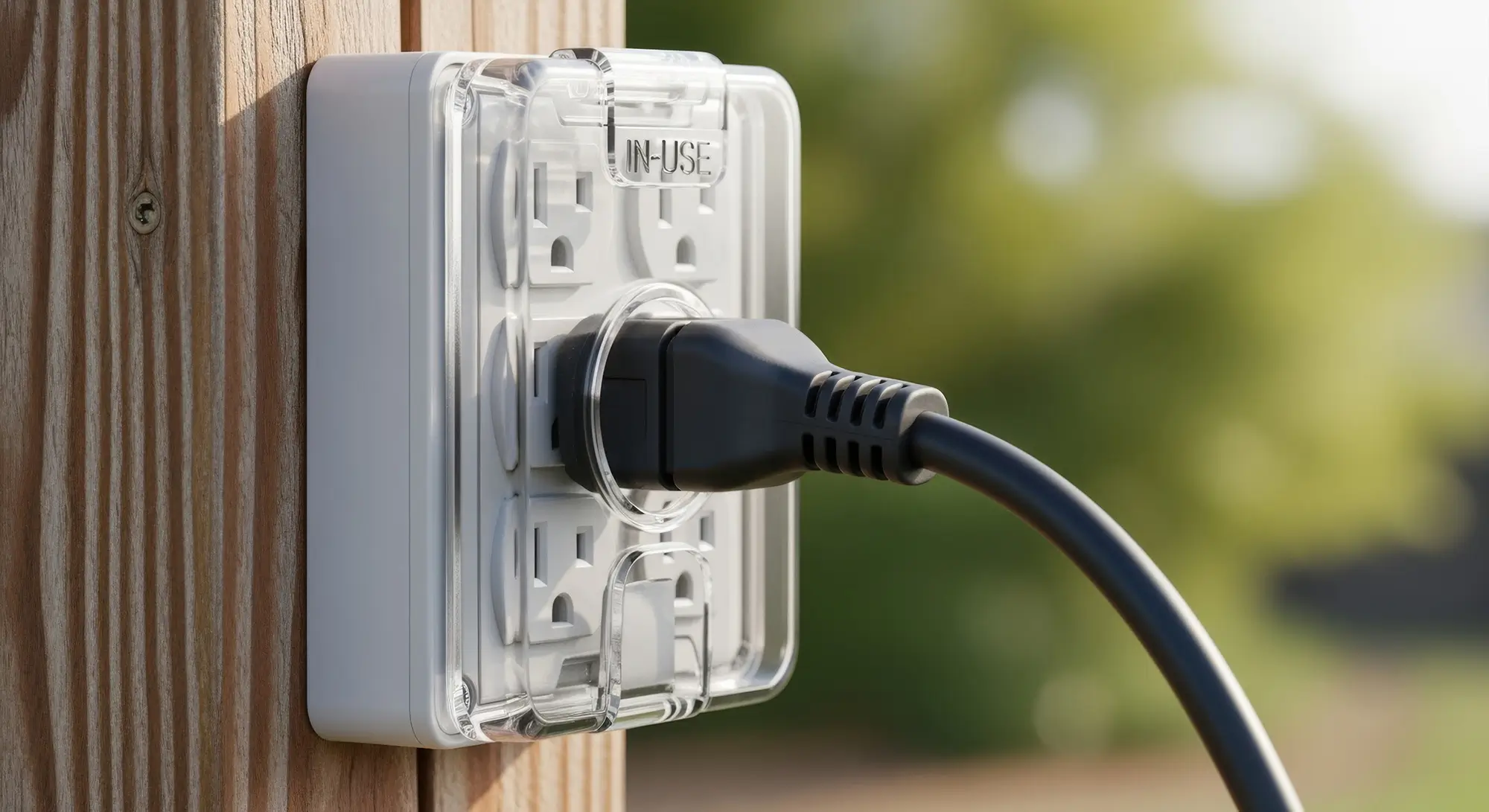
Under 406.9(B)(1), a receptacle in a wet location needs an enclosure that stays weatherproof whether or not an attachment plug is inserted. That is the in-use cover, the deep bubble style. A flip-up cover that only seals when nothing is plugged in does not satisfy this for a wet location, no matter how solid it looks.
In a damp location, a standard weatherproof cover is generally acceptable.
The gray area is the partially covered deck: a pergola with slats, a retractable awning, a roof that covers two thirds of the deck. Slatted pergolas and retractable awnings do not make a location damp. When it is genuinely ambiguous, we install the in-use cover, because the cost difference is trivial and the failed-inspection difference is not.
Which code edition applies to you
This is where advice from a national blog stops being useful. Illinois municipalities adopt the NEC on their own schedules, and neighboring towns are frequently on different editions.
The City of Naperville enforces the 2023 National Electrical Code. The Village of Downers Grove enforces the 2020 NEC with Village amendments. Those are two different rulebooks for the same job, ten miles apart, and local amendments can modify either one.
If a contractor cites a code requirement to you without knowing which edition your municipality enforces, that tells you something about how much work they have permitted in your town.
Permits, in the two towns we work in most
Naperville. The City requires an electrical permit before any electrical work begins, and the work must be performed by a state-licensed electrical contractor who is also registered with the City. Permits go through the City’s Civic Access portal. There is no version of this where you add a deck receptacle legally without a permit.
Downers Grove. Applications and supporting documents are submitted only through the Village’s online permit portal. First review runs about 10 business days. Inspections are scheduled through the portal or by calling 630-434-5529 with 48 to 72 hours notice.
Both towns will inspect the finished work. The inspector checks the GFCI trip test, the WR and TR markings on the device, the cover type against the location, box and conduit rating, and grounding.
That 10 business day review in Downers Grove matters if you are trying to finish a deck before a party or a closing. Start the permit before the decking goes down, not after.
Circuit design, which nobody writes about
The materials question is easy. The circuit question is where installations actually fail in practice.
Do the load arithmetic before you pick a circuit. A typical electric patio heater draws 1,500 watts, which is 12.5 amps at 120 volts. Two of them is 25 amps, and they will not coexist on a 20 amp circuit. Add a string of lights and a small fridge and you are tripping the breaker every cold evening. This is the most common complaint we get about outdoor outlets, and it is a design problem, not a device problem.
Do not tap the bathroom or garage circuit. It is the shortest run and the most tempting, and it means the powder room goes dark when your smoker kicks on. For a deck that will carry heaters, a fridge, or a hot tub, we run a dedicated circuit. For a deck that will carry a phone charger and a string of lights, an extension of an existing circuit is usually fine.
Plan for the load you will have in three years, not today. A second receptacle at the far corner of the deck costs very little while the framing is open and a great deal after the decking is installed.
Long runs and motor loads cause nuisance tripping. GFCI devices respond to small current imbalances, and long cable runs plus motor-driven equipment can produce enough leakage to trip a device that is working exactly as designed. If your deck GFCI trips whenever the pond pump or the fan starts, that is usually a circuit design issue rather than a defective outlet, and swapping the receptacle will not fix it.
What survives an Illinois winter
The Chicago area puts outdoor electrical through a freeze and thaw cycle dozens of times a season, plus road salt, UV in July, and standing snow.
- In-use covers are not equal. Thin covers go brittle in a Naperville February and crack at the hinge. A heavier polycarbonate cover with a metal hinge pin costs a few dollars more and lasts.
- Mount high enough to clear snow. The code sets a maximum height above the walking surface. It does not stop you from mounting a receptacle low on a fascia board where it spends January buried. Think about where the snow actually piles on your deck.
- Orientation matters. A cover has to close fully and shed water, and a cord has to exit the bottom without holding the gasket open. A receptacle mounted sideways to fit a board layout often will not do either.
- Seal every penetration. Every hole through the rim joist or siding is a water path into the wall, and the failure shows up as rot years before it shows up as an electrical problem.
- Use exterior-rated boxes and fittings throughout. PVC or corrosion-resistant metal, with listed weatherproof fittings. An indoor box hidden behind a good cover still fails.
Time it with the deck build
The cheapest version of this job happens before the decking goes on. Wiring routed through open framing, boxes mounted to solid blocking, no fishing, no cutting into finished surfaces.
We coordinate regularly with Wolf Spirit Deck Builders in Naperville so the electrical rough-in lands at the right point in their schedule. If you are working with another builder, the ask is simple: get your electrician on site after framing and before decking, and have the electrical permit in hand by then.
Retrofitting an outlet into a finished deck is entirely doable. It just costs more and takes longer, and sometimes it means pulling a few boards.
Testing, and what to do about it
Press the TEST button on a GFCI monthly. It should cut power. Press RESET and it should restore.
Two things worth knowing. Since 2015, UL 943 has required self-testing GFCI devices, which check themselves periodically and indicate a fault, usually with an LED and a refusal to reset. That does not replace your monthly test, but it does mean a device that will not reset is telling you something rather than being stubborn.
And if a GFCI trips repeatedly with nothing plugged in, stop resetting it. It is detecting a real fault, usually water in the box, a damaged cable, or a failing device. Repeatedly resetting a GFCI that is doing its job is how people get hurt.
Frequently asked questions
Do I need a permit to add an outlet to my deck? Yes, in both Naperville and Downers Grove. Naperville requires an electrical permit before any electrical work begins, performed by a state-licensed contractor registered with the City. Downers Grove requires a permit submitted through its online portal, with a first review of roughly 10 business days.
Is a bubble cover required, or is a flip-up cover acceptable? It depends on whether the receptacle is in a wet or damp location. On an uncovered deck, which is a wet location, NEC 406.9(B)(1) requires an enclosure that stays weatherproof whether or not a plug is inserted, which means an in-use bubble cover. Under a solid roof, generally a damp location, a standard weatherproof cover is typically acceptable.
Does a covered porch or pergola count as a damp location? A solid roof usually makes it damp. A slatted pergola or a retractable awning does not, because rain reaches the receptacle. When it is ambiguous, install the in-use cover.
What is the difference between a WR and a regular GFCI outlet? Weather-resistant devices are built and listed for damp and wet locations, with corrosion-resistant components and materials rated for UV and temperature swings. NEC 406.9 requires listed WR devices outdoors. Look for the WR marking on the device face, along with TR for tamper-resistant.
Does every deck need an outlet? Under NEC 210.52(E)(3), a deck, balcony, or porch accessible from inside the dwelling with a usable area of 20 square feet or more requires at least one receptacle readily accessible from the deck, no more than 6.5 feet above the walking surface.
Why does my outdoor GFCI keep tripping? Common causes are water intrusion in the box or cover, a damaged cord or cable, an overloaded circuit, or cumulative leakage on a long run with motor-driven equipment. Repeated tripping with nothing plugged in indicates a real fault. Stop resetting and have it looked at.
Can I run my deck outlet off the garage or bathroom circuit? Physically yes, practically often no. Sharing means a patio heater or smoker can take out a circuit you need elsewhere. For decks with heaters, refrigerators, or hot tubs, a dedicated circuit is the right answer.
Get it designed before it gets built
If you are adding a deck, replacing one, or trying to fix an outdoor outlet that trips every time you use it, we will look at the panel, run the load numbers, tell you whether you need a dedicated circuit or a circuit extension, pull the permit in our name, and handle the inspection.
We work throughout Naperville, Downers Grove, Lisle, Aurora, Plainfield, Bolingbrook, Hinsdale, Burr Ridge, La Grange, and the rest of DuPage and Will County. Call (630) 427-5923 or request a service visit.
Related: outlet replacement, dedicated circuits, outlet grounding, custom lighting installation, and electrical panel upgrades if your panel has no room for a new circuit.
About the author. Alexandr Godonoaga is the owner and lead electrician at Cob Services LLC, an Illinois-licensed electrical contractor (#26-00032356) working across DuPage and Will County for over a decade. Licensed, bonded, and insured.
Cob Services LLC 2020 Calamos Ct Suite 200, Naperville, IL 60563 (630) 427-5923 Monday through Friday, 9:00 AM to 5:00 PM
Code editions and local amendments change. Requirements described here were verified against the published code adoptions of the City of Naperville and the Village of Downers Grove on September 5, 2026. Your municipality may enforce a different edition or local amendment. Confirm with your building department before relying on any of it.