
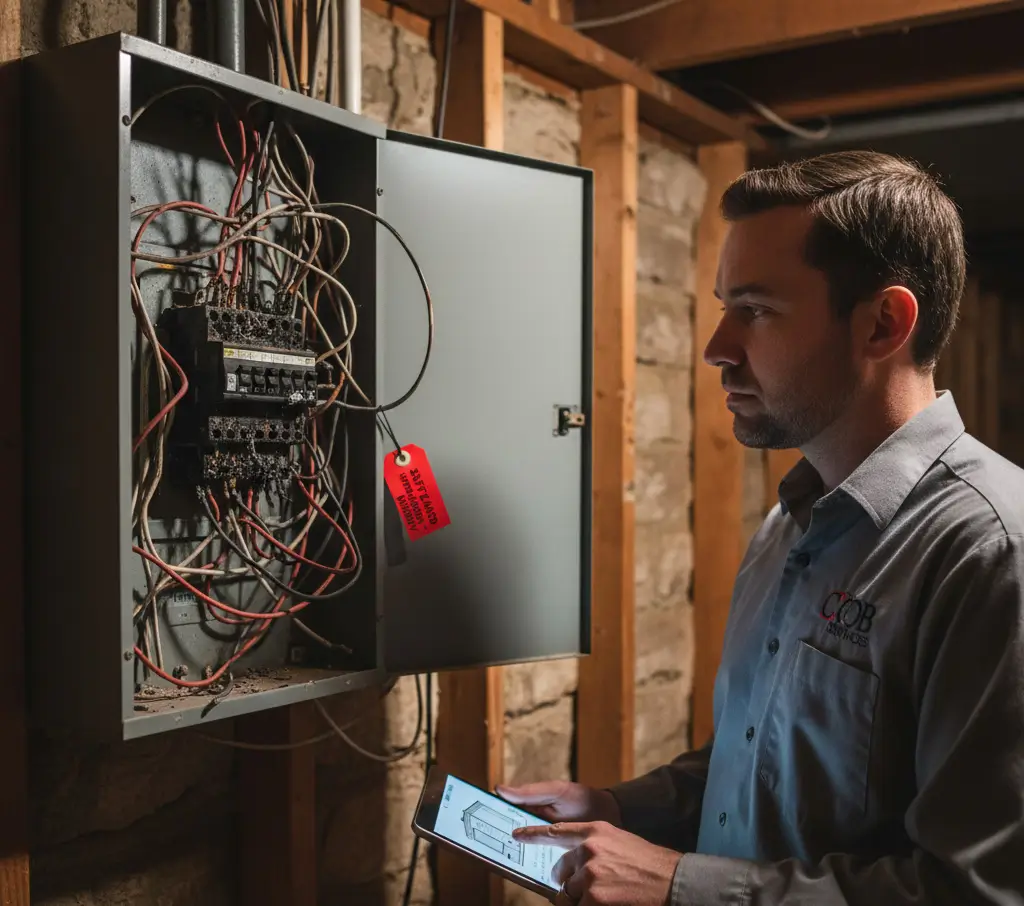
If you’re living in one of Naperville’s classic neighborhoods—think those beautiful builds in Saybrook or Hobson West—you probably take a lot of pride in the character of your home. But here’s the thing: while character is great for curb appeal, it’s not so great for your electrical system.
In our world at Cob Services, we talk about the “30-Year Rule” all the time. Your roof might give you 20 years, and your HVAC maybe 15. But your electrical panel? People assume it lasts forever. It doesn’t. If your home was built before 1995 and you’re still rocking the original breaker box, you’ve officially hit the “red zone” for safety.
It’s Not Just Old—It’s Overloaded
Think back to 1995. The biggest power draw in your house was probably a clunky microwave or a desktop PC. Fast forward to 2026, and we’re asking those same old panels to handle 4K TVs in every room, high-end kitchen appliances, and maybe even an EV charger in the garage.
Most of these older systems were built for 60 to 100 amps. Modern life? That’s a 200-amp job. Trying to run a 2026 lifestyle on a 1995 panel is like trying to merge onto I-88 in a golf cart—it’s just a matter of time before something breaks down.
The “Silent” Failure You Won’t See Coming
The scariest thing about an aging panel isn’t that it stops working; it’s that it keeps working when it shouldn’t.
A breaker’s only job is to “trip” (shut off) when things get too hot. But as these units hit that 30-year mark, the internal parts get brittle or corroded. We’ve seen panels where the breaker refuses to trip even as the wires are literally melting the insulation behind the drywall. You won’t see it, and you won’t hear it—until it’s a much bigger problem.
The “No-Fly List” of Panels
If you open your panel door and see any of these names, stop what you’re doing and give us a call. These aren’t just “old”; they’re famous in the industry for being dangerous:
- Federal Pacific (FPE): Their Stab-Lok breakers are notorious for staying “on” during a surge.
- Zinsco / Sylvania: These have a nasty habit of melting directly to the bus bar.
- Challenger: Known for massive overheating and electrical arcing.
What should you look for?
You don’t need to be an electrician to spot the warning signs. Keep an eye (and an ear) out for:
- The “Hum”: Your panel should be silent. If it’s buzzing or crackling, that’s electricity “jumping” where it shouldn’t.
- Warm to the Touch: Put your hand on the panel cover. If it feels like it’s been sitting in the sun, you’ve got an internal heat issue.
- That Weird Smell: Electrical burns have a distinct, “fishy” or metallic scent. If you smell it near the box, it’s an emergency.
The Bottom Line: We love Naperville’s older homes, but we want to keep them standing. If your home is pushing 30, it’s worth having a pro take a look. It’s a lot cheaper to swap a panel now than to deal with the aftermath of a fire later.