
By the team at Cob Services LLC — Licensed Electricians in Naperville, IL (License #26-00032356)
You go to add one more circuit — a new outlet in the finished basement, a heater in the garage, a hot tub in the backyard — and you open the panel to find there’s nowhere to put it. Every slot is full. That’s the moment a lot of Naperville homeowners first hear the word “subpanel,” usually from an electrician, and usually with a question mark on their face.
Here’s the short version: a subpanel is a smaller second panel fed from your main one, and it exists to give a specific part of your home its own local supply of circuits. It’s one of the most common jobs we do — and one of the most misunderstood. People assume “out of room in the panel” automatically means an expensive main upgrade. Sometimes it does. Often, a subpanel is the cleaner, cheaper, smarter fix.
Let’s walk through what a subpanel actually is, the signs you need one, and how to tell it apart from a full panel upgrade — the honest way, from the crew that installs these every week.
What a subpanel actually is
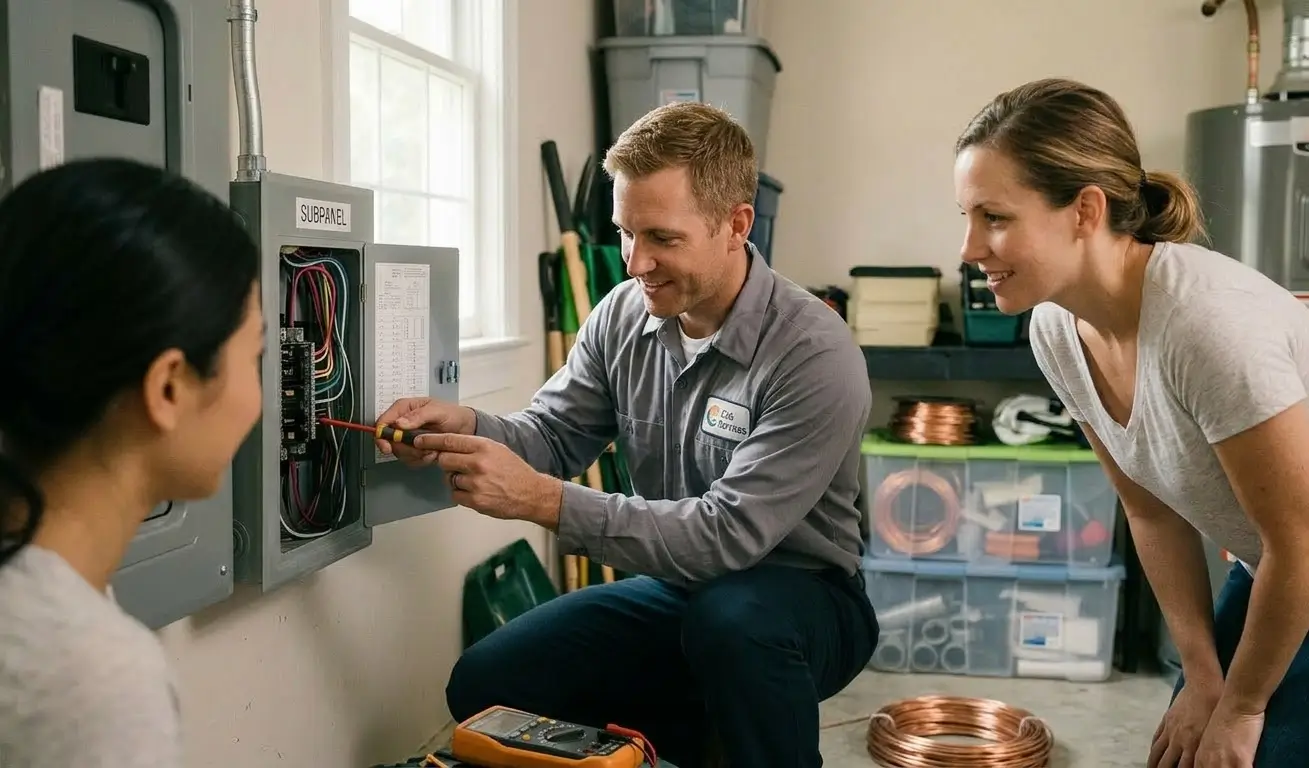
Think of your main electrical panel as the trunk of a tree. A subpanel is a branch: it taps off the main with a single feeder, then splits back out into its own set of breakers serving one area — a garage, a basement, an addition, a workshop, a pool house.
The main panel still controls the whole home’s service. The subpanel just gives one zone its own local hub of circuits, so you’re not running long individual wires all the way back to the main for every new outlet or light.
Two things a subpanel does not do, because this trips people up:
- It doesn’t increase your home’s total power. A subpanel fed from a 200-amp main is still working within that 200 amps. If your actual service is maxed out, a subpanel alone won’t fix that — that’s a main upgrade conversation.
- It’s not a code shortcut. A subpanel is a permitted, inspected piece of work with its own grounding and bonding rules. Done wrong, it’s a hazard. Done right, it’s invisible and reliable for decades.
The signs your Naperville home might need one
Here’s what usually sends homeowners looking for a subpanel:
Your main panel is out of breaker slots. This is the classic one. Every space is used, and you’ve got a new circuit to add. A subpanel gives you room to grow without cramming or “double-tapping” (two wires jammed under one breaker — a common and unsafe workaround we find all the time).
You’re finishing a basement. A finished basement means new lighting, outlets, maybe a bathroom, a wet bar, or a home theater. That’s a cluster of new circuits in one place — exactly what a subpanel is built for. Running them all individually from a main panel on the other side of the house is messy and inefficient.
You’ve got a detached garage, workshop, or shed. A detached structure that needs power is almost always better served by its own subpanel than by dragging a single circuit across the yard. It keeps everything organized and gives that building room for tools, lighting, and a car lift or compressor down the line.
You’re adding a big single load — EV charger, hot tub, pool equipment. A dedicated circuit for one appliance sometimes stands alone, but when you’re powering a whole backyard’s worth of pool gear or a garage EV charging setup plus lighting and outlets, a subpanel out there makes the whole thing cleaner.
You’re building an addition or an ADU. A new wing, an in-law suite, or an accessory dwelling gets its own subpanel so its circuits are grouped and separately manageable.
You keep running long extension cords. If you’re bridging a gap with cords because there aren’t enough outlets where you actually work — a garage, a basement shop — that’s your home telling you it needs more local circuits. The Electrical Safety Foundation International notes that heavy reliance on extension cords is a sign you simply have too few outlets for how you live, and the fix is more circuits, not more cords. Their home safety guidance is a good plain-English read on why.
Subpanel vs. main panel upgrade: which do you actually need?
This is the question that saves — or wastes — real money, so here’s the honest breakdown.
You probably need a subpanel (not a full upgrade) when:
- Your main service is adequate (a healthy 200-amp panel) but you’re out of physical slots
- You’re adding circuits concentrated in one area — basement, garage, addition
- Your total electrical demand still fits comfortably inside your existing service
You probably need a main panel upgrade when:
- Your whole-home demand is genuinely maxed out — the number of amps coming in isn’t enough, not just the slots
- You still have a 60-amp or 100-amp service in a home running modern loads
- Your main panel is old, a recalled brand (Federal Pacific, Zinsco, Pushmatic), or damaged
Sometimes you need both — a main upgrade and a subpanel — if your service is undersized and you’re also concentrating new load in one zone.
The only way to know which bucket you’re in is a load calculation — adding up what your home actually draws against what your service provides. We do that math on-site before we ever quote, because guessing here is how people get sold an upgrade they didn’t need. If a subpanel solves it, that’s what we recommend. If it doesn’t, we’ll tell you straight. You can read more about how we approach panel upgrades and subpanels either way.
The Naperville angle: older homes, modern demand
A lot of homes around Naperville, Lisle, and Downers Grove were wired for a very different era of electricity use. A panel that was plenty in 1990 is now feeding central AC, a home office, a second fridge, maybe an EV in the driveway. The service coming in might still be fine — but the panel filled up years ago, and every “just add one more circuit” project has been a squeeze.
That’s the sweet spot for a subpanel. Your 200-amp service is doing its job; you’ve simply run out of room to organize new circuits. Rather than gut and replace a perfectly good main panel, we add a subpanel where the new demand lives — the basement you’re finishing, the garage you’re powering up — and suddenly there’s headroom again.
It’s also just cleaner wiring. Grouped circuits, a local shutoff for that zone, and labeled breakers the next person can actually read. When we open a panel in an older home and find double-tapped breakers and a tangle of long home-runs, a subpanel is often what untangles it.
How a subpanel installation works
So you know what to expect, here’s the shape of the job:
- Load calculation and planning. We confirm your main service can support the subpanel and map where the feeder runs.
- Permit pull. Subpanel work is permitted with your local jurisdiction — Naperville, Aurora, Plainfield, Lisle, and the surrounding towns. We handle the paperwork.
- Feeder run. We run the correctly sized feeder cable from the main panel to the subpanel location and mount the new panel.
- Grounding and bonding done right. This is the technical heart of a subpanel: in a subpanel, the neutral and ground must be separated, not bonded like they are in the main. Getting this wrong is one of the most common mistakes we find in DIY and hack jobs, and it’s a genuine safety issue. We do it to code.
- Circuits landed and labeled. New breakers installed, circuits connected and torqued to spec, every one labeled.
- Inspection. We schedule it and meet the inspector on-site.
Most residential subpanel installs are a single-day job. The exact number depends on the feeder length, the subpanel size, and how far it sits from the main.
Why homeowners have us do it
- We run the load calculation first — so you get the right fix, not the most expensive one
- We separate neutral and ground correctly — the subpanel detail that’s easy to get dangerously wrong
- We pull the permit and handle the inspection — you don’t file anything
- We size the feeder for your real load — with room to grow, not just scrape by
- We label every circuit — so the next person who opens the cover isn’t guessing
- Licensed (#26-00032356) and insured, owner walks and quotes every job personally
The bottom line for Naperville homeowners
Running out of room in your panel doesn’t automatically mean an expensive main upgrade. A subpanel is often the right-sized answer: it gives a specific part of your home — the finished basement, the detached garage, the new addition, the backyard — its own local hub of circuits, cleanly and to code, usually in a single day.
The key is the load calculation that tells you whether a subpanel is enough or whether your service actually needs upgrading. That’s the part worth getting right before anyone quotes you, and it’s exactly what we do first.
If your panel’s full and you’ve got a project waiting on power, we’ll figure out whether a subpanel or an upgrade is the honest fix — and handle it either way. Serving Naperville, Lisle, Aurora, Plainfield, Bolingbrook, and Downers Grove.
Request service online or call (630) 427-5923 — you’ll talk to an electrician, not an answering service.
Frequently Asked Questions
What is a subpanel and how is it different from a main panel? A subpanel is a smaller secondary panel fed from your main electrical panel, used to add and organize circuits in one area of the home — a basement, garage, or addition. The main panel still controls your whole home’s service; the subpanel just gives one zone its own local set of breakers.
Do I need a subpanel or a full panel upgrade? You likely need a subpanel if your main service is adequate but you’re out of breaker slots, especially if new circuits are concentrated in one area. You likely need a main upgrade if your total electrical demand is maxed out or your panel is old, undersized, or a recalled brand. A load calculation determines which applies.
How much does a subpanel installation cost in Naperville? Residential subpanel installation typically runs in the range of $1,200 to $2,400, depending on feeder length, panel size, and distance from the main. An on-site look and load calculation give you an exact number. Every estimate is walked and quoted personally.
Can I install a subpanel for my EV charger or hot tub? Yes — a subpanel is a common and clean solution for backyard pool equipment, a hot tub, or a garage EV charging setup combined with lighting and outlets. We size the feeder for the actual load and wire it to code.
Is it safe to install a subpanel myself? Subpanel work involves a critical detail — the neutral and ground bus bars must be separated in a subpanel, unlike in the main panel. Getting this wrong is a real safety hazard and a common mistake in DIY jobs. Subpanel installation should be permitted, inspected, and done by a licensed electrician.
Cob Services LLC — Licensed & Insured Electricians in Naperville, IL. License #26-00032356. Serving Naperville, Lisle, Aurora, Plainfield, Bolingbrook, Downers Grove, Hinsdale, Burr Ridge, La Grange, and surrounding DuPage and Will County areas. 2020 Calamos Ct Suite 200, Naperville, IL 60563 · (630) 427-5923 · 24/7 emergency service.