
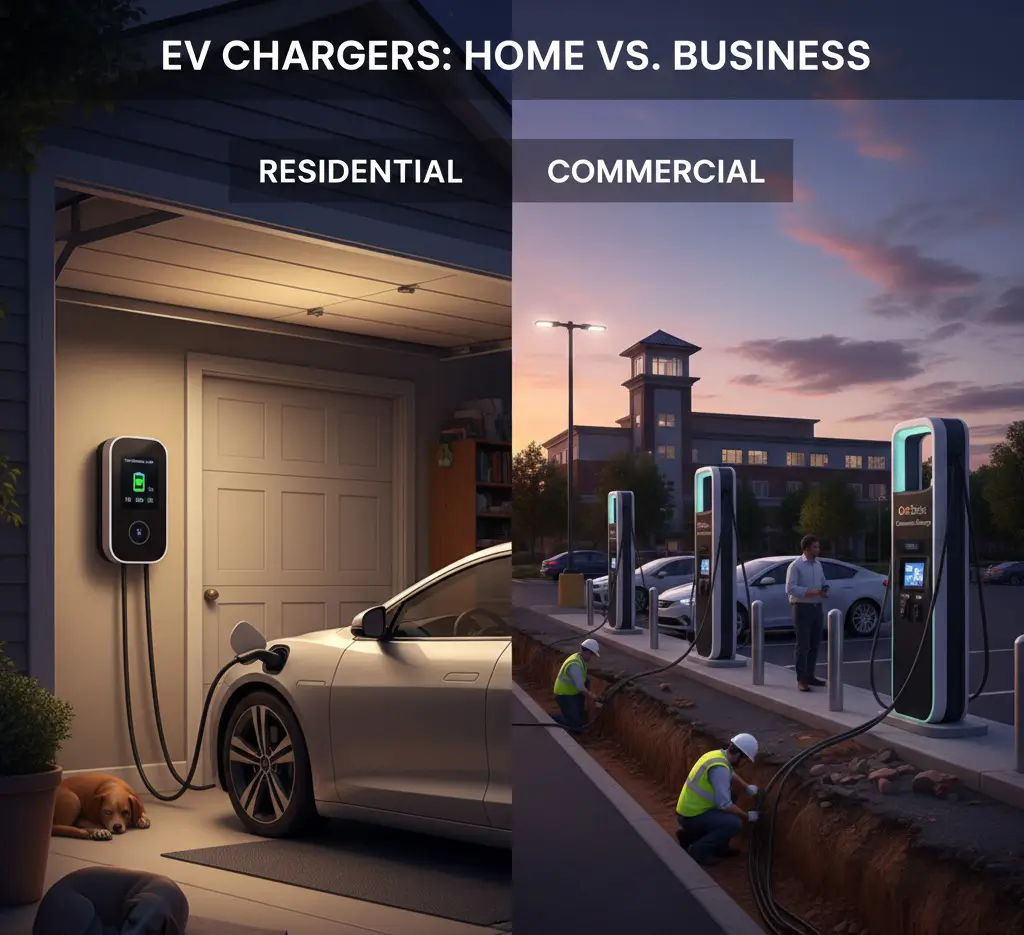
Electric vehicles (EVs) are becoming mainstream — and as more people adopt them, one question keeps coming up: “How do I charge my EV?”
That’s where EV chargers come in — but not all chargers are created equal. There’s a big difference between residential chargers (for your home) and commercial chargers (for businesses, workplaces, and public locations). This guide breaks down what those differences are, how much they cost, how they’re installed, and why regulations matter.
1. What Is an EV Charger?
In simple terms:
- An EV charger is a device that delivers electricity to recharge your electric car.
- They differ mainly in power output — how fast they can charge your car.
Think of it like water hoses:
- A garden hose (residential charger) drips slower.
- A fire hose (commercial charger) delivers a huge amount of water quickly.
2. Types of EV Chargers
Residential EV Chargers
- Installed at homes (garages, driveways).
- Also called Level 1 or Level 2 chargers.
- Level 1: Uses a standard 120V outlet (like your toaster). Slow — adds a few miles of range per hour.
- Level 2: Requires a dedicated 240V circuit (like your oven/dryer). Faster — adds 10–30+ miles of range per hour.
Best for: Daily drivers, overnight charging.
Commercial EV Chargers
- Installed in public places or workplaces.
- Often Level 2 or DC Fast Chargers (Level 3).
- DC Fast Chargers: Convert AC to DC power externally and deliver very high power (typically 50 kW to 350 kW+).
- This can bring many EVs up to 80% charge in 20–40 minutes.
- DC Fast Chargers: Convert AC to DC power externally and deliver very high power (typically 50 kW to 350 kW+).
Best for: Quick top-ups, high-traffic locations, fleets.
3. The Cost Difference
Residential Chargers
| Item | Typical Cost |
| Charger hardware | $300–$1,200 |
| Installation | $300–$1,500+ |
| Total | $600–$2,700+ |
- Most homeowners can install a Level 2 charger for ~$1,000–$2,000 total.
- Lower cost because only one charger is needed and site requirements are basic.
Commercial Chargers
| Item | Typical Range |
| Level 2 Charger | $2,000–$10,000+ each |
| DC Fast Charger | $15,000–$150,000+ each |
| Installation | $5,000–$100,000+ (site dependent) |
| Total | $10,000–$250,000+ |
- Commercial chargers cost far more due to:
- Higher power capacity
- More robust electronics
- Multiple units per site
- Advanced user interfaces and payment systems
- Complex electrical infrastructure
4. Installation: Simple vs Complex
Residential Installation
A licensed electrician typically:
- Evaluates your electrical panel capacity.
- Adds or upgrades a 240V circuit.
- Mounts the charger and connects it.
Time frame: A few hours to one day.
Commercial Installation
This process is significantly more involved:
- Site evaluation
- Determine electrical load capacity.
- Decide on optimal parking layout and power source.
- Utility coordination
- May require transformer upgrades or new service lines.
- Larger power demand must be approved by the utility company.
- Trenching & conduit work
- Runs electrical wiring underground to multiple charging locations.
- May include lighting, signage, and safety systems.
- Installation of hardware
- Multiple charging stations
- Payment interfaces, networking systems
- Testing & commissioning
Time frame: Weeks to months depending on complexity.
5. Commercial EV Charger Rules
Regulations are different in every state, that’s why in this post we took Naperville, IL as an example. When you install chargers for a business or public location in this area:
- Permits and electrical inspections still apply — just like at home.
- Commercial installations often involve multiple charging stations, higher power demands, and more complex electrical upgrades — which increases the regulatory oversight.
- While Naperville’s rebate applies to business chargers too, other regulations may affect commercial sites:
- Local zoning or parking requirements (e.g., dedicated EV parking signage)
- Accessibility standards
- Utility interconnection requirements for high-power equipment
You may need to coordinate with the Naperville Electric Utility early in the planning process to assess load capacity and service upgrades (especially for DC fast chargers).
6. Other Important Differences
Usage Patterns
- Residential: Overnight or long-stay charging.
- Commercial: Short visits, turn-over traffic, quick top-ups.
Durability
- Commercial chargers are built for:
- Higher usage volumes
- Outdoor weather exposure
- Vandal resistance
Residential units are typically simpler, lighter duty equipment.
Benefits for Businesses
Installing commercial chargers can:
- Attract customers
- Support employees who drive EVs
- Increase property value
- Qualify for tax incentives or rebates
7. Summary — Key Differences At a Glance
| Feature | Residential | Commercial |
| Power Level | Up to Level 2 | Level 2 & DC Fast Charging |
| Cost | Lower | Significantly higher |
| Installation | Simple | Complex |
| Regulations | Basic electrical code | ADA, utility, payment systems |
| Usage | Home charging | Public/workplace charging |
| Billing | Typically none | Often paid by users |
Takeaway
If you’re a homeowner, a Level 2 charger installed by a professional electrician will likely meet your needs. If you’re a business owner or planning a public charging site — be prepared for:
- Higher costs
- More complex installation
- Regulatory and utility coordination
But also greater value: increased attraction to EV drivers, potential revenue, and future-proofing your location.
Ready to power up your property with professional EV charging? Whether you’re a homeowner installing a Level 2 charger or a business owner building out a commercial fleet, Cob Services provides the expert panel upgrades and precision installation Naperville demands. As local, ICC-certified specialists, we handle the complex load calculations, city permitting, and utility coordination required to ensure your system is safe, efficient, and eligible for local rebates. Don’t leave your electrical infrastructure to chance—contact Cob Services today at (630) 427-5923 or visit cobservicesil.com to request your free estimate for an EV Charging Station Installation and future-proof your home or business with the area’s most trusted electrical team.