
By Alexandr Godonoaga, Owner and Lead Electrician, Cob Services LLC. Illinois Electrical Contractor License #26-00032356.
Illinois rewrote part of its smoke alarm law because of a chirp.
You know the one. Low battery warning, always at two in the morning, always in the hallway. And what people do about it is stand on a kitchen chair, yank the nine volt out, and go back to bed fully intending to replace it in the morning. The morning comes and goes. Six months later there’s a dead alarm on the ceiling and a battery sitting in a drawer with the takeout menus.
The Illinois Fire Safety Alliance pushed for years to fix that specific human behavior, and in 2017 the General Assembly passed Public Act 100-0200. It gave everyone a five year runway and took effect on January 1, 2023.
I’m writing this up because the version of it that reached homeowners was wrong in both directions. Half the people I meet think they were supposed to replace every alarm in the house three years ago and are now somehow in violation. The other half think it doesn’t apply to them at all. Neither is right, and the difference costs real money at closing.
The rule, and the part everybody gets wrong
Illinois has required smoke alarms in every dwelling since 1988, so that piece isn’t new.
What Public Act 100-0200 added is this: any new smoke alarm you put in a single family or multi family home, if it runs on battery alone, has to have a sealed, non removable, ten year battery. Not a nine volt you can pop out at two in the morning. The battery is built into the unit and you throw the whole thing away in a decade.
Now the part that gets mangled. Alarms that were already on your ceiling before January 1, 2023 do not have to come down. They can stay until one of three things happens to them: they pass ten years from their date of manufacture, they fail an operability test, or they malfunction some other way. Whichever comes first is your trigger, and only then does the replacement have to meet the new standard.
So it isn’t a deadline. It’s a rolling thing tied to the age of the hardware.
What this means in practice is that a lot of Naperville houses drifted out of compliance sometime in 2024 or 2025 and nobody noticed, because the alarms that felt “pretty new” back in 2023 had actually been screwed to the ceiling by the previous owner around 2013.
If you want the state’s own summary rather than mine, the Office of the Illinois State Fire Marshal keeps a short page on it: Illinois Smoke Alarm Law. There’s a link to the statute at the bottom of it.
Nobody checks the date, so here’s how
This is a ten minute job for a whole house and it costs nothing, and you should do it before you call me or anyone else.
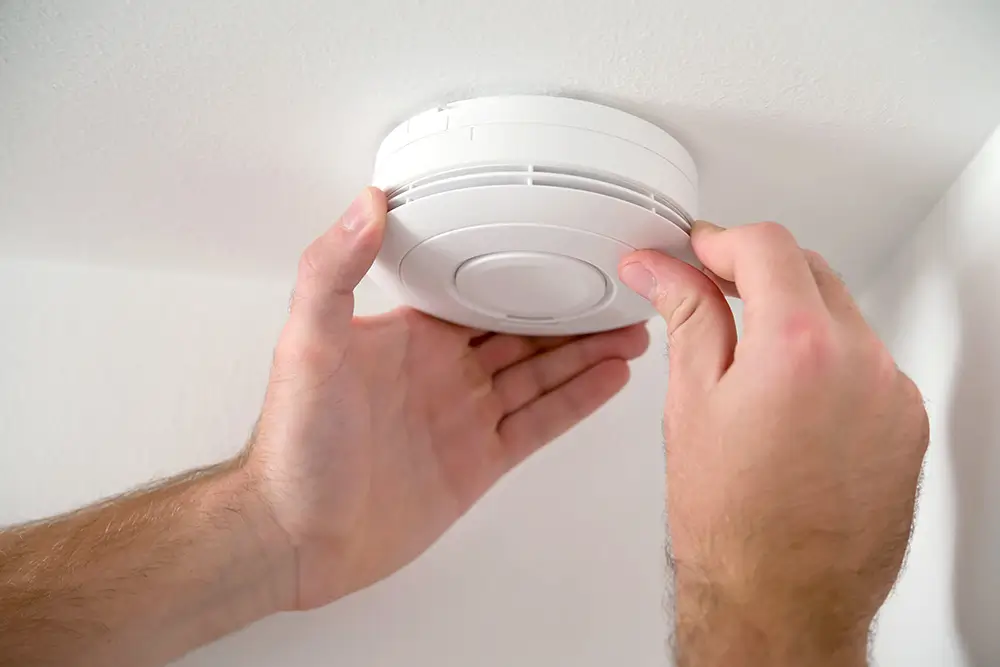
Twist each alarm off its mounting bracket. Flip it over. There’s a label on the back with a manufacture date on it, sometimes a full date, sometimes just a month and year, occasionally a four digit code you have to squint at. Kidde and First Alert both print it legibly on anything current. Older units can be faint, or stamped into the plastic instead of printed, so use your phone light.
Anything more than ten years past that date is finished, and I mean regardless of what happens when you press the test button. The button confirms the horn works and the battery has juice. It tells you nothing about the sensing chamber, which degrades on its own schedule whether the alarm is doing anything or not. A twelve year old alarm that beeps politely when tested is still a twelve year old alarm.
Count them while you’re up there. Illinois wants at least one on every story including the basement, and at least one within fifteen feet of every room used for sleeping. Most houses I walk through are short by one, and it’s nearly always the basement or the top of the stairs in a split level.
Who’s actually exempt
Two situations get you out of the sealed battery requirement, and they’re narrower than people hope.
If your house was built after 1988 and already has hardwired alarms, you’re fine. Hardwired alarms were legal before this law and are legal after it. The whole sealed battery provision was aimed at battery only installations, which is the population where the two in the morning chair incident happens.
The second exemption covers wireless integrated alarms, the kind that communicate by low power radio frequency, Wi-Fi, or another wireless local area network. If yours are interconnected so that one going off triggers all of them, or they push notifications to an app, they qualify.
Chicago is carved out of the state act entirely, which sounds like a loophole until you learn Chicago passed its own ordinance doing roughly the same thing. Naperville is squarely under the state act.
Carbon monoxide is a completely separate law
People merge these two in their heads constantly and I don’t blame them, since the devices often live in the same plastic housing.
The Carbon Monoxide Alarm Detector Act is its own statute with its own rules. If your home has any fossil fuel equipment at all, meaning a gas furnace, gas water heater, gas range, or a fireplace, or if it has an attached garage, you need a CO alarm within fifteen feet of every sleeping room.
Combination smoke and CO units are genuinely convenient and we install a lot of them. The thing to keep in your head is that a combo unit has to satisfy both laws at once, and CO sensors usually wear out sooner than smoke sensors do, often somewhere between seven and ten years depending on the model. Two dates to read on the same device.
Interconnection is the part I’d actually spend money on
New construction and gut renovations in Naperville already get hardwired, interconnected alarms with battery backup, because that’s the building code rather than the Smoke Detector Act. Our crews wire it into every new construction job and most remodeling and renovation projects that touch a bedroom.
For an existing house, though, interconnection is optional under state law, and I think that’s the wrong place to save money. Standalone alarms mean a fire starting in the basement sets off exactly one alarm, in the basement, at three in the morning, with the door closed and everyone asleep two floors up. Interconnected alarms all go off together. That’s it, that’s the whole argument, and I’ve never heard a rebuttal that held up.
You have three ways to go about it in a finished house.
Standalone sealed battery alarms are the cheap road, roughly twenty five to forty five dollars a unit at any hardware store on Ogden. Legal, and about as much protection as the law will let you get away with. In a small ranch where every alarm is within earshot of every bedroom, honestly, that’s defensible.
Wireless interconnected battery alarms run maybe forty to sixty a unit and they talk to each other over radio without anyone opening a wall. This is what I end up recommending to most homeowners, and I went back and forth on it for a while before landing there, because I’m generally suspicious of anything with a radio in it. The reliability has gotten good enough. One catch worth knowing: cross brand interconnection basically doesn’t work, so buy them all at the same time, all the same product line, and don’t mix in the one you already had in the garage.
Hardwired and interconnected is what I’d put in my own house, and it’s the one that costs money. In an existing finished Naperville home we’re usually quoting somewhere between $250 and $450 per location, and $1,800 to $3,500 for a whole house running six to nine alarms. Access drives that number more than anything else. Plaster walls, no attic to work from, a finished basement ceiling, any of those and you’re at the top of the range or above it. If you’re already doing wiring updates or a whole house rewire, adding alarms is close to free by comparison, since we’re in the walls anyway.
Those are ranges, not a quote. We walk the house and put a number in writing before anybody starts.
What happens when you sell
Sellers are usually relieved to hear the first half of this and annoyed by the second.
The first half: Illinois does not require you to replace compliant, working alarms as a condition of closing. If yours predate 2023, still function, and haven’t hit ten years, the Act doesn’t make you touch a thing to sell the house.
The second half is that your buyer’s home inspector doesn’t care what the Act requires. He cares what he sees, and he writes all of it up. The findings I get shown after the fact are boringly consistent: alarms past their manufacture date, a missing alarm on a floor (basement, always the basement), no alarm within fifteen feet of a bedroom, a bare mounting bracket and a capped wire where somebody took one down and never put it back, a battery pulled out, or a 1990s house with six hardwired alarms where three of them no longer answer the test button. Combination CO units past their sensor life show up plenty too.
None of that kills a deal by itself. What it does is turn into a credit request, and credit requests get negotiated in round numbers that never round in your direction. Replacing eight alarms on a Saturday costs you a couple hundred dollars. Conceding it at the table costs more than that, every time.
One more wrinkle. Whatever you install to clear an inspection item has to meet the current standard. You cannot patch a flagged alarm with the twelve dollar unit that takes a nine volt, which is exactly what people grab when they’re in a hurry two weeks before closing.
If you’re prepping a house to list, the alarms are one item on a longer list. We went through what an inspector actually opens and pokes at in what a Downers Grove electrical inspection checks, and the same six things come up on this side of the county line.
In older houses around here, the alarms aren’t the real story
If you’re in something from the fifties or sixties near the historic district, or one of the subdivisions that went up between 1965 and 1973, what’s on your ceiling is less interesting to me than what’s behind your walls.
Houses from those eras often have cloth insulated wiring or aluminum branch circuits, and frequently a panel that aged out a long time ago. A perfect set of smoke alarms is early warning for a fire you’d rather never start. When we’re in a house that vintage for alarm work, we open the panel and pull a couple of receptacles while we’re already there. Costs ten extra minutes and it has redirected the conversation more than once.
Permits, plus one Naperville specific thing worth knowing
Swapping a battery alarm one for one needs no permit and no electrician. Buy them, put them up, done.
Adding new hardwired alarms, running a circuit, or interconnecting existing ones is permitted electrical work. It goes through the City’s Civic Access portal, and inspections get scheduled in advance rather than same day. Building Permits will tell you exactly what your scope needs at (630) 420-6100, option 2.
Here’s the thing I’d want to know if I were hiring somebody. Naperville requires electricians working in the city to register as an Electrical Contractor with the city, on top of holding a state license. It’s a separate registration, and plenty of outfits working the western suburbs don’t bother with it. If you’re calling around to residential electricians near me and one of them can’t tell you their registration status without checking, that’s useful information. We hold Illinois Electrical Contractor License #26-00032356 and pull permits in Naperville, Lisle, Aurora, Plainfield, and Downers Grove on a regular basis.
Questions we get asked
Do I have to replace all my smoke alarms in Illinois right now? No. Alarms installed before January 1, 2023 can stay until they pass ten years from their manufacture date, fail an operability test, or malfunction. Whatever you install after that point needs a sealed ten year battery, unless your home falls under an exemption.
Are hardwired smoke alarms still legal in Illinois? Yes. The sealed battery requirement only applies to alarms running on battery alone. Hardwired alarms are fully compliant, and homes built after 1988 that already have them are exempt from the sealed battery rule.
What’s the penalty for non compliance? The Act provides for a 90 day warning to correct the violation, and fines of up to $100 per day per violation if it isn’t corrected in that window.
Where do smoke alarms legally have to go? At least one on every story including the basement, and at least one within fifteen feet of every room used for sleeping. New construction and major renovations answer to the building code instead, which also requires an alarm inside each bedroom, hardwired and interconnected with battery backup.
What does it cost to hardwire and interconnect alarms in a Naperville home? For an existing finished home we’re typically quoting $250 to $450 per location, or $1,800 to $3,500 for a whole house with six to nine alarms. Access to the space above and below drives the price more than anything else. We give you a written estimate after walking the house.
Do smoke alarms expire even if they beep when I test them? They do. The test button verifies the horn and the battery, not the sensing chamber, and the chamber degrades on its own timeline. Ten years from the manufacture date is the working life for smoke sensors, and often less for carbon monoxide sensors.
Does Illinois make me upgrade alarms to sell my house? The Smoke Detector Act doesn’t require replacing compliant, working alarms as a condition of sale. Your buyer’s inspector will flag aged and missing ones regardless, and anything you install to resolve a flagged item has to meet the current standard.
If you’d rather not do it yourself
Some people are happy to spend a Saturday on a stepladder and some people would rather not, and there’s no wrong answer. If you want alarms hardwired and interconnected properly, we’ll walk the house and put a written estimate in your hands with no obligation attached to it. We’re residential electricians in Naperville, IL and we’ve been doing this locally for over ten years.
Call (630) 427-5923 or request service online.
Cob Services LLC 2020 Calamos Ct Suite 200, Naperville, IL 60563 (630) 427-5923 Illinois Electrical Contractor License #26-00032356 Monday through Friday, 9:00 AM to 5:00 PM. Emergency service 24/7.
Serving Naperville, Lisle, Aurora, Plainfield, Downers Grove, Bolingbrook, Hinsdale, Burr Ridge, and La Grange. See all service areas, or read more from our Naperville electricians on the blog.
Alexandr Godonoaga is the Owner and CEO of Cob Services LLC, a licensed electrical contractor serving Naperville and the western Chicago suburbs. He runs every estimate personally and stays your point of contact through final inspection.