
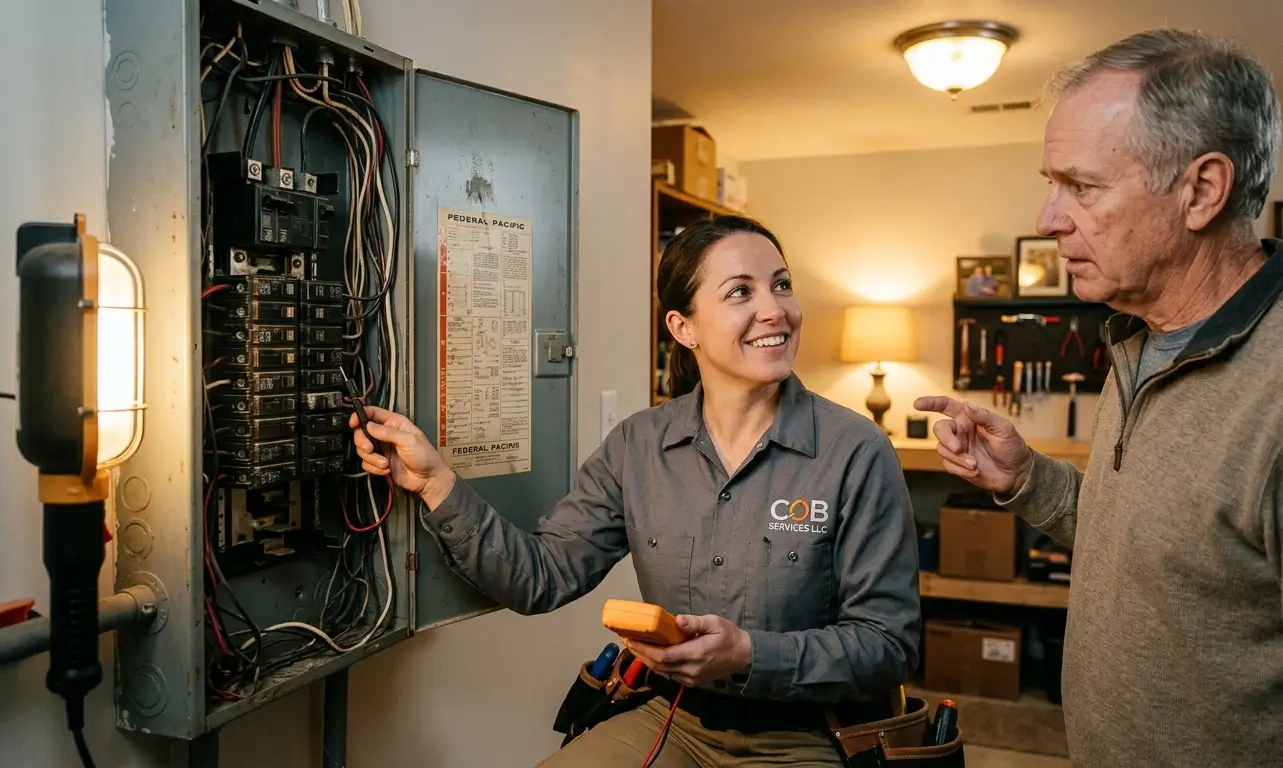
Most homeowners never look at their panel. It lives behind a gray metal door in the basement or the garage, the kids stack boxes in front of it, and as long as the lights work nobody thinks about it. Then one day the dishwasher and the microwave can’t run at the same time, or the panel starts feeling warm, and suddenly it’s the most important box in the house.
We pull old panels out of Naperville homes almost every week. Some are genuinely dangerous. Some have another five years in them. Knowing which is which is the whole question.
Here is what we actually look at when a homeowner asks if their panel is past its prime.
You still have fuses, not breakers
If your “panel” is a metal box with screw-in glass fuses, you are running on technology from before the moon landing. Fuses are not unsafe in themselves. The problem is what gets done to them. Almost every fuse box we open in Naperville has at least one fuse that has been swapped for a higher-amperage one because the original kept blowing. That is how electrical fires start.
A fuse box also caps you out at around 60 amps of service in most of the houses we see. You cannot put an EV charger on that. You cannot run a modern AC condenser plus a kitchen plus a home office without something giving. A fuse box is usually where the conversation about whether your Naperville home has enough power for modern living starts.
The panel is older than 25 years
Panels do not have a sticker that expires. But the breakers inside them, the bus bar they clip onto, and the lugs where the service wires land all age. The springs in old breakers weaken, which means the breaker may not trip when it should. The bus bar can develop oxidation where breakers seat, which means a high-resistance connection that runs hot under load.
We generally tell homeowners that 25 years is the point where a panel deserves a real inspection, and 40 years is where most of them should be replaced regardless of how they look. If you bought your house and the previous owner said “the panel is original to the home” and the home is from 1985, you have a 1985 panel. That is old.
Breakers trip, and you have learned to live with it
There is a homeowner muscle memory that develops in older Naperville homes. You know which breaker pops when you run the toaster and the microwave at the same time. You know not to run the space heater in the guest room while the dryer is going.
That is not normal. Modern panels with appropriately sized circuits do not require you to plan your morning around them. If you are flipping breakers more than two or three times a year, something is undersized — either the panel itself, or the individual circuits feeding the rooms that keep tripping. Sometimes the fix is just adding a dedicated circuit for the appliance that keeps causing the trip. Sometimes the panel is full and there is no room to add one.
Lights dim when something kicks on
Watch your kitchen lights when the AC compressor starts on a hot day. A small dip is normal. A noticeable dim, or lights that flicker for a half-second every time the fridge cycles, is not.
That is your panel telling you the inrush current from a big motor is pulling the voltage down across the whole house. Sometimes the cause is loose lugs at the panel. Sometimes it is an undersized service feeding too many big loads. Either way, the test is free: watch the lights, see what happens, and if you are noticing it without trying to notice it, get someone out.
The panel is warm or smells like burning plastic
This is the one we treat as urgent every time. If your panel cover is warm to the touch, if you smell ozone or burning plastic when you open the closet it lives in, or if there are visible scorch marks on the breakers or the surrounding drywall, that is an arcing fault inside the panel.
Stop reading. Cut the main breaker if you can do it safely. Call us. The warm-panel question gets its own walkthrough in is a warm breaker panel normal, but the short version is: most warm panels are a problem, and the ones that are not still need looked at.
This is also what emergency electrical service is actually for. We answer the phone after hours for exactly this kind of call.
You have 100-amp service
A lot of the older Naperville neighborhoods — parts of east of Washington, the older blocks near the river, and a chunk of the homes built in the late 60s and early 70s — were built with 100-amp service. That was generous in 1972. It is tight today.
A 100-amp panel can usually run a modern home if you do not have an EV, do not have central AC plus electric appliances, and do not have a finished basement adding load. Add any one of those and you start running the math. Add two and you are almost certainly out of headroom.
Most new Naperville homes today are wired for 200 amps. Some larger homes go to 400. We size the upgrade based on what is in the house now plus what the homeowner is likely to add over the next ten years. An EV in the driveway changes the math, and our EV charger panel self-assessment guide walks through exactly how we run those numbers.
The brand on the panel door is one of these
Some panels were dangerous when they were new and have not improved with age. The three names we open the panel hoping not to see:
Federal Pacific (FPE / Stab-Lok). Sold in millions of homes from the 1950s through the early 80s. Independent testing found that the breakers fail to trip during overload and short-circuit conditions at significantly higher rates than other panels. The Consumer Product Safety Commission investigated them in the 80s, the company eventually folded, and the panels are still in plenty of Naperville homes. If you have one, replace it. We do not repair Stab-Lok panels because there is no fix for the underlying breaker design.
Zinsco / Sylvania-Zinsco. Same story, different decade. The aluminum bus bars in Zinsco panels corrode at the breaker contact points and develop hot spots. Breakers can weld themselves into the on position. We see them mostly in homes built in the late 60s and 70s.
Challenger. Less notorious than the other two, but the half-inch breakers Challenger made in the 80s have a known overheating issue and were subject to a CPSC alert. If you have a Challenger panel with the original breakers, that is a replacement, not a repair.
If you want to read the technical history on Federal Pacific specifically, the International Association of Certified Home Inspectors has a thorough writeup that goes deeper than I can fit here.
You have a project on the calendar
This is the one homeowners forget. Even if your panel is fine right now, ask what you are about to ask of it.
A finished basement adds twenty circuits. An EV charger adds a 50A or 60A continuous load. A hot tub adds another. A heat pump conversion adds two more. A home addition is its own thing entirely. We have had homeowners call us in a panic three weeks before a basement reveal because the panel cannot accept the new circuits the contractor needs.
The cheapest time to upgrade a panel is before the project starts, not during. We almost always know within the first ten minutes of a site visit whether the existing panel can carry what is being added. If it cannot, doing the upgrade first means one permit, one inspection, and a clean handoff to whoever is doing the rest of the work.
What a panel upgrade in Naperville actually involves
If you have been quoted a panel upgrade and want to know what you are paying for, here is the work:
A 200-amp upgrade in Naperville generally runs $2,800 to $4,500 installed. That covers the new panel, the new breakers, the labor to transfer every existing circuit, the City of Naperville permit, the ComEd disconnect coordination so the linemen can pull the meter while we work, and the final inspection.
The number goes up if the meter base also needs replacing, if the service line is overhead and needs a new mast, or if the panel is being moved to a new location. It goes down a little if the existing panel is in good shape mechanically and we are essentially just swapping the guts.
Most upgrades are a one-day job. Power is off for somewhere between four and seven hours in the middle. We schedule the ComEd disconnect so the linemen show up the same morning we do.
When to call
If you have any one of these situations, it is worth a free site walk:
A fuse box. A panel older than 25 years. Repeated breaker trips. Lights dimming on AC startup. A warm panel or burning smell. 100-amp service with modern loads. A Federal Pacific, Zinsco, or Challenger label. A project on the calendar.
We can usually tell you over the phone whether what you are describing is an emergency, a “fix it this month” situation, or a “we should plan this for next spring” conversation. As residential electricians in Naperville, we have replaced enough panels in this town to know which neighborhoods still have Stab-Lok in them and which ComEd inspectors run a tight tape on the meter base height.
Call (630) 427-5923. The site walk is free, and if your panel is fine we will tell you it is fine.