
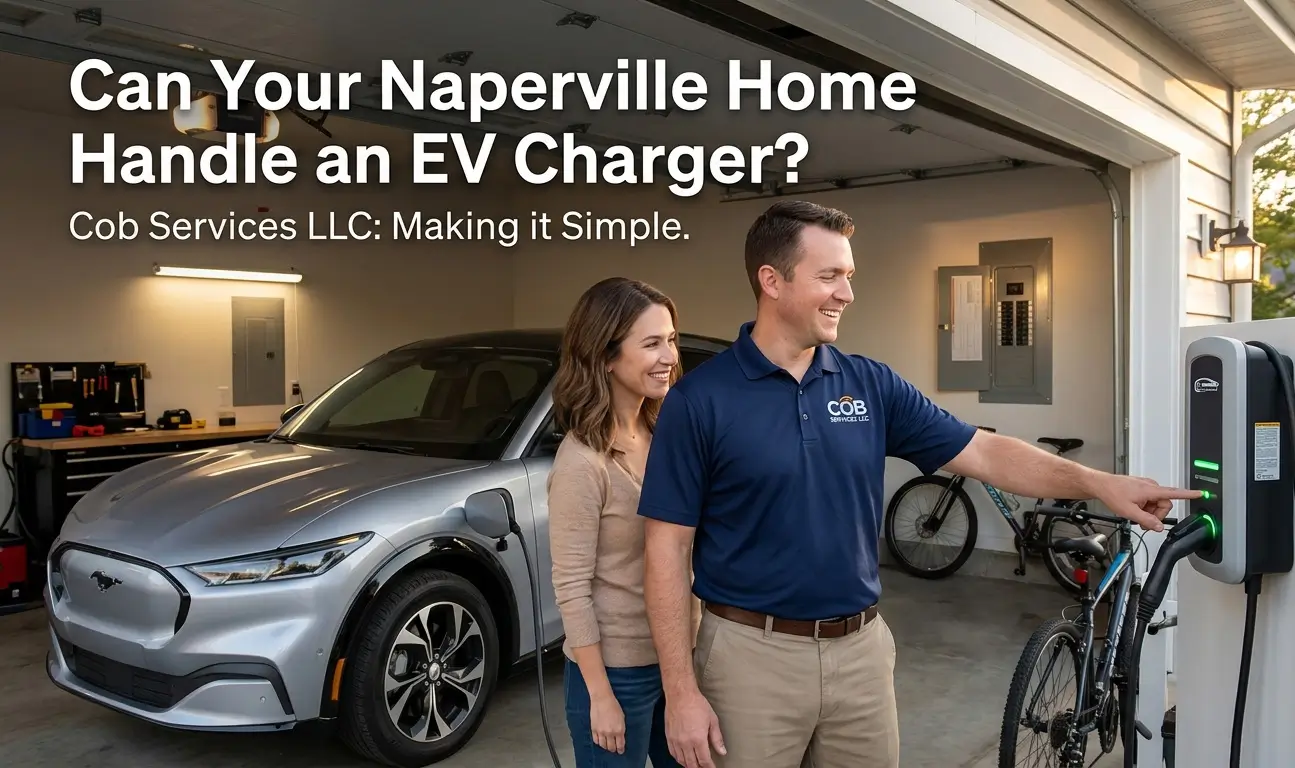
Finally pulling that new EV into your driveway feels amazing. It’s quiet, it’s sleek, and you’re officially done with gas station lines. But then comes the “now what?” moment. You look at that standard wall outlet in the garage and wonder, “Is this actually going to work, or am I going to wake up to a half-charged car and a tripped breaker?”
At Cob Services LLC, we live and work right here in Naperville. We’ve seen everything from historic North-side beauties with “vintage” wiring to brand-new builds in Ashwood Park. The truth is, your home’s electrical system is a lot like a backpack—it can only hold so much before the straps start to creak.
Here’s the plain-English guide to figuring out if your home is ready for an EV charger.
1. The “Big Appliance” Reality Check
Most of us want a Level 2 charger. It’s the difference between waiting 40 hours for a full charge (Level 1) and being ready to go in a few hours.
Think of a Level 2 charger like adding a second electric oven or a massive commercial dryer to your house. It pulls a lot of “juice”—usually between 30 to 60 amps. That’s a significant ask for any electrical system.
2. Peek Inside Your Metal Box (The Panel)
Your electrical panel is the heart of your home. If you live in one of Naperville’s more established neighborhoods, you might have 100-amp service. While that was plenty in 1975, it struggles today.
Signs your house is saying “Help!”:
- Your lights flicker when the AC kicks on.
- Your panel is packed tight with no empty slots.
- You’re still rocking an old-school fuse box.
If you’re at 100 amps, we’ll likely need to talk about an upgrade to 200 amps. It’s like widening a one-lane road into a highway; everything just flows better.
3. Doing the “Power Math”
It’s not just about the car. It’s about the car plus the Sunday roast in the oven, plus the kids’ gaming PCs, plus the AC humming during a humid July night.
Before we install anything, we perform a load calculation. We look at your home’s “appetite” for power to make sure adding a charger won’t push it over the edge. We’d rather tell you the truth now than have you lose power in the middle of a Vikings-Bears game.
4. The Garage Layout: Hidden Hurdles
Where is your panel located? If it’s in the basement on the opposite side of the house from the garage, we’ve got some “scenic” wiring to do.
- Finished vs. Unfinished: We try to be as non-invasive as possible, but running wire through finished drywall is a different beast than an open garage wall.
- Indoor vs. Outdoor: Planning to charge in the driveway? We’ll need weather-rated gear that can handle an Illinois winter.
5. Thinking Five Years Ahead
If you’re getting one EV now, will you be a two-EV household by 2028? We see it happen all the time. Instead of doing small, expensive incremental fixes, it’s often cheaper and smarter to future-proof your system today. Whether it’s solar prep or a larger panel, doing it once is always better than doing it twice.
The Cheat Sheet: Is My Home Ready?
| If your home has… | The Likely Story |
| A 200-amp panel | You’re probably golden. Let’s get to work! |
| A 150-amp panel | It’s a “maybe.” We’ll need to crunch the numbers. |
| A 100-amp panel | You’ll likely need an upgrade to stay safe. |
| An old fuse box | Definitely time for an update (for safety alone!). |
Why Local Expertise Matters
Naperville has its own set of rules and permit requirements. We don’t just “hook it up”—we make sure everything is code-compliant and officially inspected. This isn’t just about red tape; it’s about making sure your home insurance is valid and your family is safe.
Ready to see where you stand? Don’t guess when it comes to high-voltage electricity. Give us a shout at Cob Services LLC. We’ll come out, take a look at your setup, and give you a straight-up answer. No jargon, no pressure—just honest advice from your Naperville neighbors.