
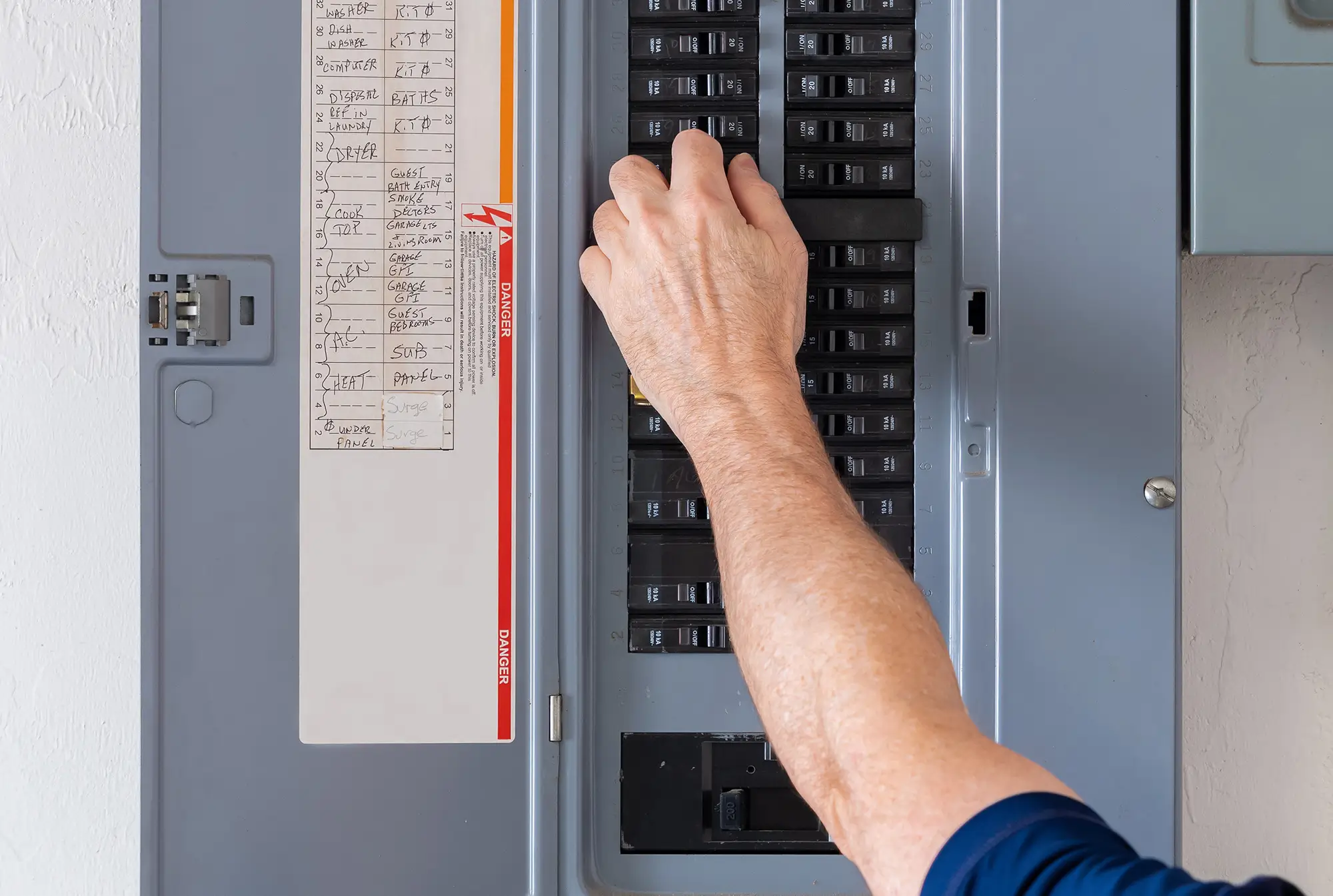
When people picture a panel upgrade, they picture an electrician swapping a box on the wall. That part’s true. But it skips the piece that actually runs your day: ComEd has to cut your power at the meter before any of it can start, then come back to turn it on. That’s the disconnect and reconnect, and most homeowners have never had it laid out for them.
I’m Alexandr Godonoaga. I own Cob Services LLC (License #26-00032356), and I’ve coordinated this back-and-forth with ComEd on a lot of panel upgrades around Downers Grove. Below is how the day really goes, where the utility fits in, and what decides whether your power’s off for a few hours or a few weeks.
Why ComEd has to be involved at all
Your home’s electrical system has an owner line running right through the meter. Everything from the meter into the house is yours, and that’s what your electrician works on. Everything from the meter back to the pole, or back to the underground line, belongs to ComEd, and by law nobody else touches it.
A panel upgrade sits on your side of that line. The catch is that working on the panel safely means the power feeding it has to be dead, and the only safe way to kill it is at the meter, which is ComEd’s. So even though the upgrade itself is entirely our work, we can’t start until ComEd pulls the meter or cuts the drop, and the job isn’t truly finished until they reconnect. ComEd spells out the rules both sides follow in its Service and Meter Requirements, and knowing those rules before the truck shows up is half of what keeps a job on schedule.
The two ways the day can go
A panel upgrade day comes in two flavors, and which one you get depends on whether your service is staying the same size or getting bigger.
Same service size: meter pulled for the day
Swapping an old 100-amp panel for a new 100-amp panel, or pulling a failed Federal Pacific box and dropping in a modern panel of the same rating, doesn’t change the service. In those cases ComEd will often just pull the meter for the day so we can work, then reset it once we’re done. Power’s out for the working hours, usually six to eight, and back on that same evening. This is the version most people are hoping for, and it’s common for a straight electrical panel upgrade that isn’t adding capacity.
Bigger service: a full scheduled disconnect and reconnect
Going from 100-amp to 200-amp, or 200 to 400, is more than a new panel. It usually means a new meter base, a heavier service cable, and sometimes work on ComEd’s own equipment running back to the pole. That kicks off a scheduled disconnect and reconnect, and ComEd’s lead time for it is the thing that turns a one-day job into a multi-week item on the calendar. ComEd’s own materials put a typical residential disconnect and reconnect at roughly four weeks for overhead service, a bit longer underground. The hands-on work is still a single day. The waiting is all in the scheduling.
That gap catches people off guard, so I raise it before we start anything. If you’re putting in 200-amp service to feed an EV charger plus a finished basement, the scheduling end of this deserves as much attention as the wiring.
What the day looks like, hour by hour
This is a same-day meter pull, which is where most residential jobs in Downers Grove land.
By early morning the permit is already pulled and the inspection is already on the Village’s calendar. We confirm the ComEd disconnect, and power comes off at the meter. Old panel comes off the wall. Before anything else, every existing circuit gets labeled so nothing goes back in the wrong slot. New panel goes up next, with a new main breaker, new bus bars, and a fresh neutral and ground. We run new grounding conductors out to the rod and the water main where code requires it. Every circuit gets re-landed, torqued to spec, and labeled. AFCI and GFCI breakers go in wherever current code calls for them. Then power’s back on, we test each circuit live, and the surge protection gets commissioned.
Start to finish it’s usually one day, with your power out for somewhere around six to eight hours. Worth planning around: your fridge and freezer are dark for that window too, so skip the big grocery run the day before.
The inspection piece
A panel upgrade in Downers Grove gets inspected through the Village, same as any service work. The inspector goes through grounding, bonding, breaker sizing, labeling, and the rest. If you want the full picture of what they check, I wrote a separate piece on what a Downers Grove electrical inspection looks for. For a panel job specifically, it comes down to this: a clean, correctly labeled panel with continuous grounding passes without any fuss.
Where the timeline actually goes wrong
When a panel upgrade runs long, the wiring is almost never the reason. It’s the coordination. The ComEd disconnect got scheduled too late. A service increase needed utility-side work nobody flagged early. The meter base location didn’t meet ComEd’s spec and had to be moved. Every one of those is avoidable when the person running your job has done it before and opens the ComEd conversation on day one, not the morning of.
That’s the real reason to hire someone who works in town. We know which jobs ComEd will let us do on a same-day meter pull and which ones need the four-week scheduling, and we’ll tell you which one you’re facing before you commit to anything. If you want it handled end to end, that’s the work we do as residential electricians in Downers Grove.
And if your panel isn’t a planned upgrade but a problem happening right now, say a warm panel, a burning smell, or breakers that won’t reset, that’s not a scheduling conversation. Call it in as an emergency and we’ll make it safe first.
Alexandr Godonoaga Owner and CEO at Cob Services LLC License #26-00032356 Call (630) 427-5923