
We’ve all been there: You’re halfway through making toast, someone starts the microwave, and suddenly—click—the kitchen goes dark. It’s annoying, sure, but it’s also your home’s way of tapping you on the shoulder and saying, “Hey, I can’t keep up with all this.”
At Cob Services LLC, we see this a lot in Naperville. Our homes were often built for a different era—a time before air fryers, dual home offices, and EV chargers. If you’re tired of playing “musical outlets” or resetting breakers, here’s a down-to-earth guide to figuring out if your home has finally outgrown its wiring.
What Exactly is a “Circuit” Anyway?
Think of a circuit like a dedicated lane on a highway. Its job is to carry electricity from your main panel to a specific area of your house. Every “lane” has a safety guard (the breaker) that shuts things down if too many “cars” (your appliances) try to squeeze through at once.
In a modern, stress-free home, you usually have dedicated lanes for:
- The Heavy Hitters: Your fridge, stove, and laundry.
- The Splash Zones: Bathrooms (which need special GFCI protection).
- The Comfort Makers: Your AC and furnace.
- The Basics: General lighting and the outlets where you charge your phone.
The more gadgets we buy, the more “lanes” we need to keep things moving safely.
6 Red Flags That You’re Running Short on Power
Your house is pretty good at communicating; you just have to know what to look for. Check if any of these sound familiar:
- The “One-at-a-Time” Rule: If you can’t run the vacuum while the space heater is on without a trip to the basement to flip a switch, your circuits are overloaded.
- Mood Lighting (That You Didn’t Ask For): Do your lights dim or flicker the second the AC kicks in? That’s a classic sign of a shared circuit being pushed to its limit.
- The “Extension Cord Jungle”: If your living room looks like a spaghetti factory of power strips and orange cords, you don’t have enough outlets—which usually means you don’t have enough circuits to support them.
- Warm Touch: Go ahead and touch your outlet covers. If they feel warm or look slightly discolored (brownish/charred), stop using them. That’s a sign of heat buildup that shouldn’t be there.
- The Mystery Hum: A buzzing sound coming from your breaker panel is basically your electrical system screaming for help.
- The Vintage Factor: If your home still has a 60-amp or 100-amp panel, it was designed for a world of tube TVs and incandescent bulbs, not the high-tech life we live today.
How to Play Detective (No Tools Required)
You don’t need to be an expert to get a feel for your home’s health. Try these three steps:
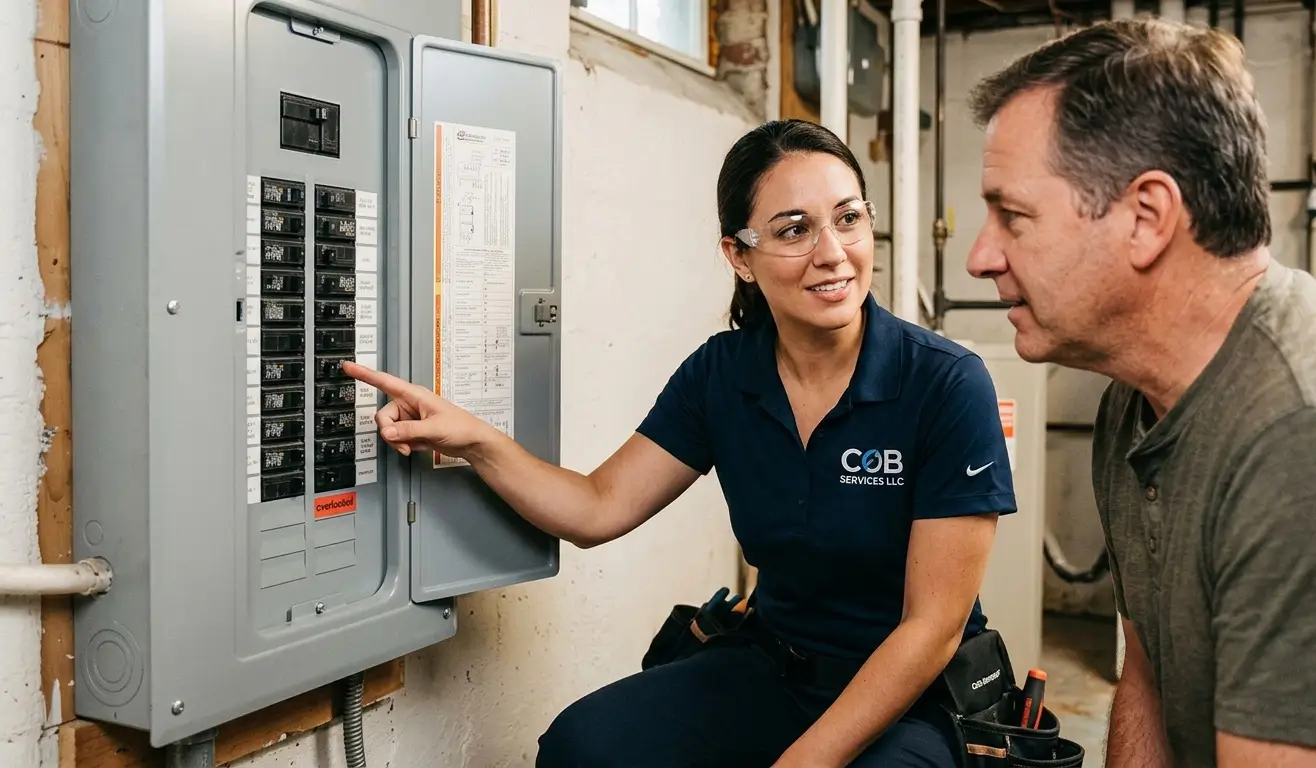
- Step 1: The Label Check. Open your breaker panel. Are the switches labeled? If you see one breaker labeled “Kitchen, Living Room, and Garage,” that’s a lot of weight for one circuit to carry.
- Step 2: The “Who Goes Where?” Test. Have someone stand in the kitchen while you flip a breaker. If half the house goes dark, your circuits are stretched way too thin.
- Step 3: The Daily Stress Test. Just pay attention tomorrow. Do you find yourself avoiding certain outlets? Do you worry about “blowing a fuse” during your morning routine? If your electrical system is a source of daily stress, it’s underpowered.
Why Does This Actually Matter?
It’s easy to ignore a flickering light, but “circuit capacity” is really just another way of saying fire safety.
When a circuit is asked to do too much, the wires inside your walls get hot. Over time, that heat can degrade the insulation, leading to sparks or even a fire. Beyond the safety aspect, “dirty” or inconsistent power can actually fry the sensitive motherboards in your expensive smart fridge or laptop.
When to Call in the Pros
If you’re in Naperville and your home is showing these symptoms, give us a shout. A quick inspection by Cob Services LLC can tell you exactly what’s going on under the hood. We generally recommend a pro look at things if:
- Breakers trip more than once a month.
- You’re planning to buy an EV or remodel the kitchen.
- Your panel is “full” (no more room for new switches).
- Your home is 30+ years old and has never been updated.
The Good News: There’s Always a Fix
Upgrading doesn’t always mean tearing down walls. Sometimes it’s as simple as:
- Adding one or two dedicated lines for your home office or kitchen.
- Doing a panel swap to give your home a higher “energy ceiling.”
- Installing a sub-panel to take the pressure off the main one.
Bottom Line: Your home should work for you, not the other way around. If you’re tired of the flickering and the tripping, let’s get your power back on track.
Need a hand? Cob Services LLC is here to keep Naperville homes bright, safe, and fully powered. Let’s chat!