
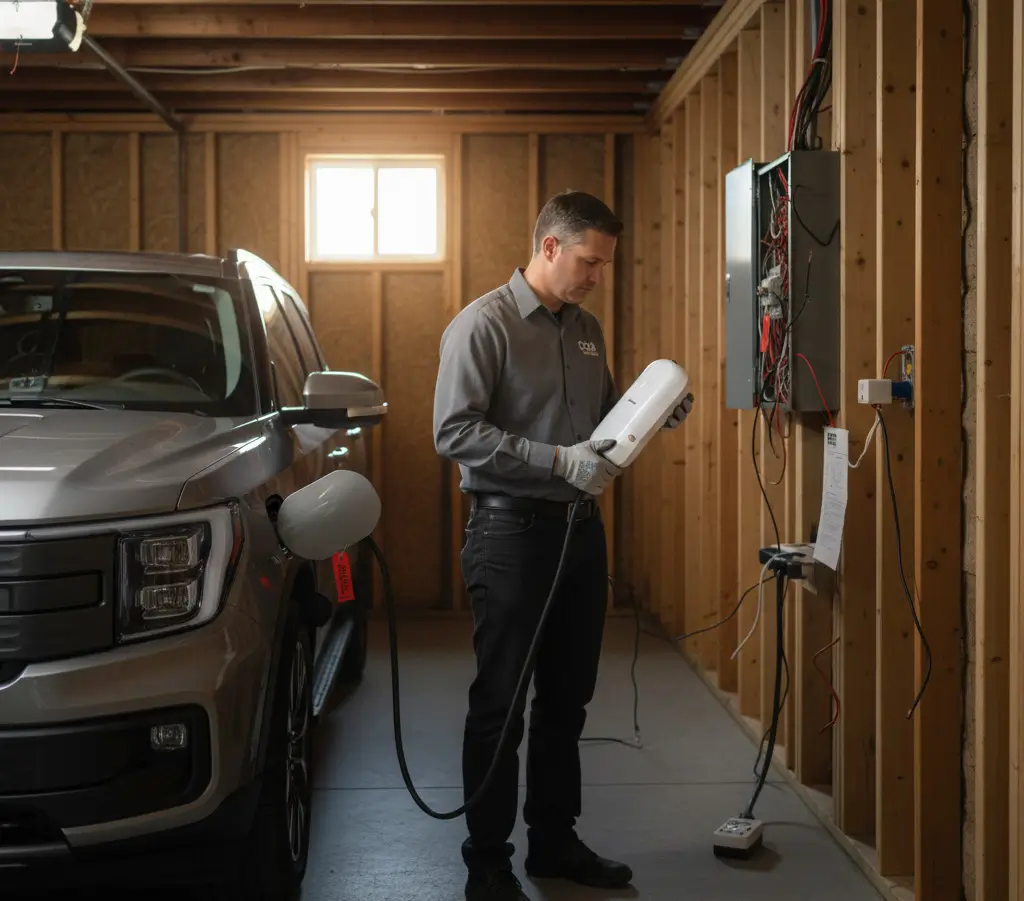
Look around your street in Ashbury or Riverwalk. A few years ago, seeing a Tesla was a “spot the car” game. Now? Between the Rivians, the Lightnings, and the new 2026 models hitting the lots, it feels like every other driveway has a charging port.
But here’s the conversation I keep having with homeowners: Buying the car is the easy part. Powering it is where the headache starts.
If you’re planning to bring home an EV this year, you need to look at your garage as more than just a place to park. You’re essentially adding a second kitchen’s worth of power demand to your house.
The “Trickle Charge” Trap
Most people start by plugging their car into a standard 120V wall outlet—what we call “Level 1” charging. If you only drive three miles a day to the Naperville Metra station, that’s fine. But for everyone else, Level 1 is a joke. It’s like trying to fill a gas tank with an eye-dropper.
To actually get a full charge overnight, you need a Level 2 setup (240V). This isn’t just a different plug; it’s a dedicated heavy-duty line. The problem? Most Naperville homes built in the ’80s or ’90s weren’t designed with a spare 50-amp circuit just hanging out in the garage.
Can Your Panel Handle the “2026 Stress Test”?
Before you fall in love with a car, go look at your electrical panel.
- The 100-Amp Struggle: If your home is running on 100-amp service, you’re on thin ice. If the AC kicks on while the oven is preheating and the car is charging, you’re going to be sitting in the dark.
- The 200-Amp Standard: This is the “sweet spot.” It gives you the “headroom” to charge fast without worrying if your house can handle a load of laundry at the same time.
Don’t Leave $500 on the Table
One thing I always tell our local customers: Naperville is actually pretty cool about EVs. The city offers a rebate (usually around $500) for installing a Level 2 charger.
But there’s a catch that trips people up—you have to be signed up for the city’s Renewable Energy Program. It’s a tiny monthly fee, but if you don’t have your ducks in a row before the inspector signs off, you might miss out on that credit.
Why “Good Enough” Wiring is Dangerous
I’ve seen some “handyman specials” lately where people try to tap into a dryer outlet or use undersized wire to save a buck. Don’t do it. An EV charger pulls a massive, continuous load for 8+ hours. If a connection is even a little loose, it creates heat. Heat leads to melting, and melting leads to a garage fire. This isn’t like a toaster that’s on for two minutes; this is a marathon for your wires.
The Bottom Line: If you’re leveled up to a 2026 EV, make sure your house can keep up. It’s worth having us come out for a quick “load calculation” before you bring the car home. It’s a lot cheaper than finding out your panel can’t handle the heat at 2:00 AM.