
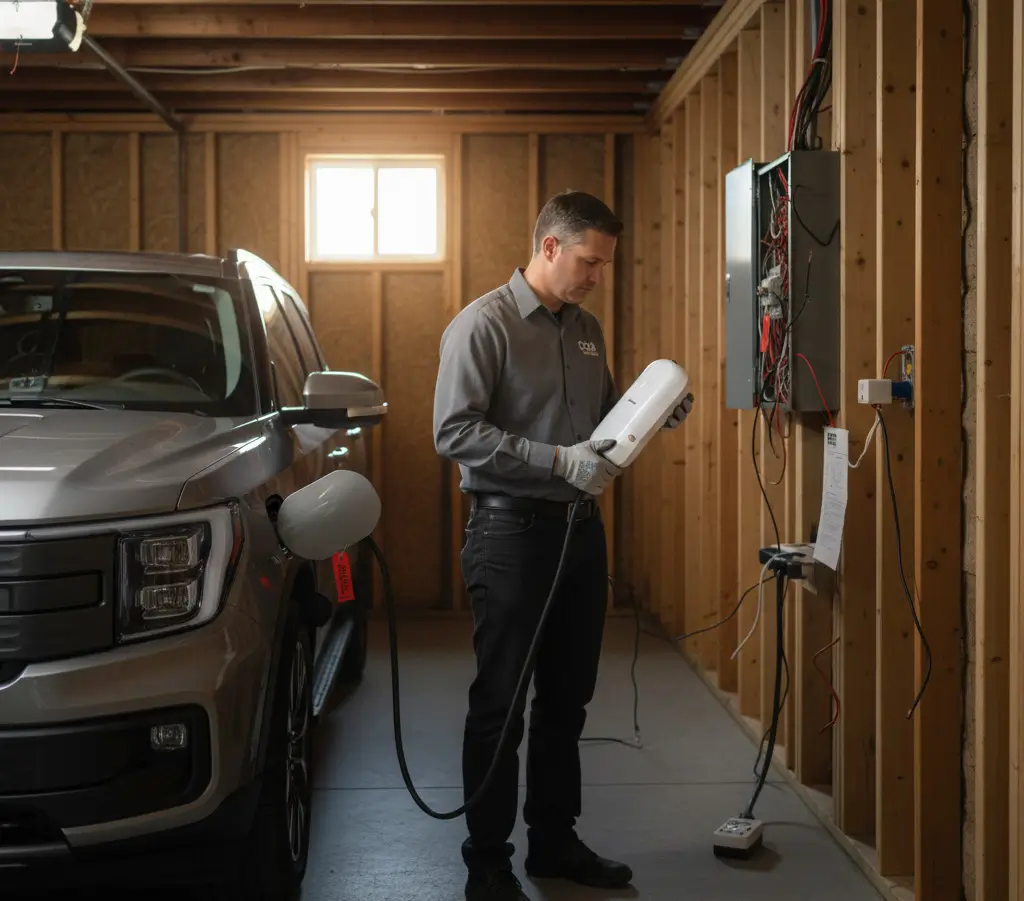
You bought the car, or you’re close to it. The one thing nobody warns you about is that the garage you’ve parked in for fifteen years might not be set up to charge it. That’s the part homeowners in Naperville call us about after the fact, usually a little frustrated, sometimes a lot.
So here’s the honest rundown of what actually makes a garage EV-ready, what usually gets in the way, and how to tell where your house stands before you spend a dime. We’ve wired hundreds of these across Naperville, Lisle, Aurora, and the rest of DuPage County, so this comes from the trucks, not a brochure.
First, the short answer
A garage is ready for an EV when three things line up: your electrical panel has room for a dedicated 240-volt circuit, the run from the panel to where the car parks is manageable, and the outlet or hardwired charger is installed to code with the right protection. If all three are in good shape, you can be charging the same night. If one of them isn’t, that’s the piece we fix first.
Most people assume the charger is the hard part. It usually isn’t. The panel is.
Start with your panel — it’s the real gatekeeper
Walk over to your electrical panel and look at the main breaker. It’ll have a number on it: 100, 150, or 200. That number is your home’s total electrical budget, and everything in the house draws from it.
Here’s why it matters. A Level 2 home charger — the kind that gives you a full charge overnight instead of trickling for three days — wants a dedicated circuit in the 40 to 60 amp range. On a 200-amp panel in a home built after 2000, that’s usually no problem. On an older 100-amp Naperville panel that’s already feeding a furnace, AC, water heater, and everything else, there often isn’t room to spare.
The fix, when it’s needed, is a panel upgrade — commonly from 100-amp to 200-amp service. It sounds like a big deal, and it’s real work, but it’s routine for us and we handle the ComEd meter coordination as part of the same job. What you don’t want is someone jamming an EV circuit onto a maxed-out panel and hoping. That’s how you end up with breakers that trip every cold morning, or worse.
If you can’t tell what your panel can handle just by looking — and most people can’t, that’s normal — a load calculation settles it. That’s a real math check of what your home already pulls versus what’s left over. We do it during the site walk before quoting anything.
Level 1 vs. Level 2: know which one you actually need
Level 1 is the cord that came in the trunk. It plugs into a standard wall outlet and adds roughly 3 to 5 miles of range per hour. If you drive a short commute and the car sits all night, it can technically be enough. For most households it’s painfully slow.
Level 2 runs on a 240-volt circuit, the same kind your dryer uses, and adds around 20 to 40 miles of range per hour. This is what most people mean when they say “home charger.” It’s the difference between waking up to a full battery and waking up to a quarter tank.
If your garage already has a 240-volt outlet — say, from an old workshop tool or a previous owner — you may be closer to ready than you think. If it only has standard 120-volt outlets, you’re looking at running a new dedicated circuit, which is very doable.
Where the car parks vs. where the panel lives
This is the quiet detail that changes a quote. The farther your parking spot is from the panel, the longer the wire run — and long runs need heavier wire to avoid voltage drop, which is basically electricity losing steam over distance.
An attached garage with the panel on a shared wall? Easy, short, clean. A detached garage across the yard, or a panel buried in a finished basement on the opposite side of the house? Still very doable, just a bigger run and a little more planning. Neither is a dealbreaker. It’s just worth knowing that “how far apart are they” is one of the first questions we’ll ask, because it’s honest pricing rather than a surprise on the invoice.
Safety and code — the part that isn’t optional
An EV charger pulls serious, sustained current for hours at a time. That’s not a knock — it just means the install has to be done right. In a garage, that means proper grounding, the correct breaker, GFCI protection where required, and a permit pulled through the City of Naperville’s building department for residential installs over 30 amps.
We pull that permit in our own contractor name, submit the load calculation the city expects, and schedule the inspection so it doesn’t stall your project. Permits aren’t red tape here — they protect your home’s resale value and your insurance coverage. Skipping them to save a few days is the kind of shortcut that costs people later.
If your garage wiring is older, or you’ve got outlets without those “Test” and “Reset” buttons near where water shows up, we’ll flag it. Better to know before the charger goes in than after.
A quick self-check before you call anyone
Run through this and you’ll already know more than most homeowners on the block:
- Find your main breaker number. 200-amp is roomy, 100-amp may need an upgrade.
- Look for an existing 240-volt outlet in the garage. If it’s there, you’re ahead.
- Measure the rough distance from your panel to where the car parks.
- Check your outlets near the garage for GFCI protection (Test/Reset buttons).
- Note your daily driving. Short commute might survive on Level 1; most people want Level 2.
None of this requires touching the panel yourself — please don’t. It just tells you which conversation you’re about to have.
What it usually costs, roughly
For a Level 2 home install that doesn’t need panel work, most Naperville jobs land in the $800 to $2,500 range. If a panel upgrade is part of it, you’re typically looking at $2,500 to $5,500 all in. Real numbers depend on your panel, your run length, and your charger, which is exactly why we do a free site walk before quoting instead of guessing over the phone.
And worth knowing: eligible homeowners can tap the ComEd EV rebate program when pairing a Level 2 charger with a time-of-use rate plan, and some households in eligible census tracts may qualify for a federal tax credit. We’re on ComEd’s eligible installer list, so we hand you the documentation instead of leaving you to chase it. Final tax eligibility is a question for your CPA — we’re electricians, not tax advisors — but we know what paperwork each program needs from our side.
The bottom line
Most garages are closer to EV-ready than their owners expect, and the ones that aren’t usually just need a panel with a little more headroom. The way to know for sure isn’t a guess or a forum thread — it’s a load calculation and a look at your actual setup.
If you’re weighing a charger, or you just want to know whether your panel can take one before you buy the car, that’s exactly the site walk we do for free. You can read more about our EV charger installation work, or reach out for an estimate — you’ll talk to a licensed electrician, not an answering service.
Cob Services LLC — Licensed & Insured · Illinois License #26-00032356 · Serving Naperville and the western suburbs. Request Service or call (630) 427-5923.