
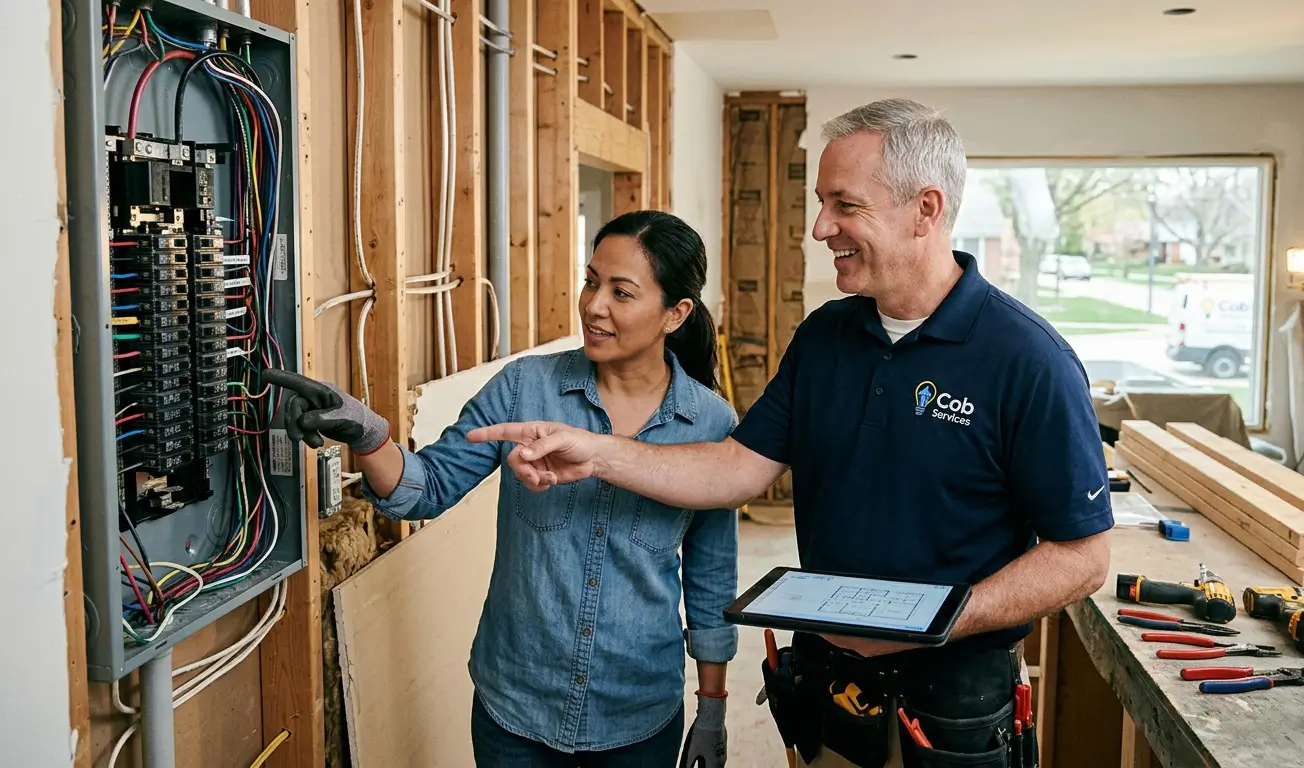
By Alexandr Godonoaga, owner, Cob Services LLC. Illinois electrical contractor license #26-00032356.
Most of the electrical advice written for homeowners assumes a single family house. Four exterior walls you own, an attic you can crawl, a basement you can drill through, a panel you can move to the other side of the utility room if that makes the job cheaper.
Townhomes break about half of that.
We work on a lot of them in Naperville, and the same conversation happens every time. A homeowner has a quote from somewhere else, or a plan they sketched out themselves, and it depends on running wire through the wall they share with their neighbor. That wall is usually the one wall in the building we are not allowed to touch.
Here is what actually constrains the work, in the order it tends to come up.
The party wall is not a wall you can work in
The wall between you and your neighbor is a fire separation. It is not a partition that happens to have a neighbor behind it.
Residential code gives builders two ways to do it. Some townhome rows were built with a single common wall rated for two hours. Others were built with two separate one hour rated walls, one belonging to each unit, usually with an air gap between them. Which one your building used decides what is possible.
If you have the two wall detail, the code language is blunt: piping, ducts, vents, wiring and other construction are not permitted to penetrate those walls at all. No outlet box. No switch box. No fishing a cable up through it to feed the floor above. Nothing.
If you have the single common wall rated for two hours, limited penetrations can be made, but every one of them has to be firestopped so the assembly keeps its rating, and the inspector will want to see how it was done. That is a real option, not a loophole, but it is slower and more expensive than people expect, and we do not recommend it for anything you could route another way.
In older Naperville townhome rows the party wall is often masonry. Solid block, sometimes brick. Builders furred out the block with thin strapping and hung drywall on it, which gives you a cavity of about three quarters of an inch. A standard device box needs closer to two and a half. That is why you will notice the original builder put almost no receptacles on that wall, and why adding one there is a bigger job than it looks.
What that means when you rewire
Lose the party wall and you lose your best horizontal path.
In an end unit you still have one exterior wall, plus interior partitions and whatever chase the builder left for plumbing and HVAC. In an interior unit you have party walls on both sides and everything has to move through the middle of the house.
Practically, a townhome rewire looks like this. Home runs go vertical, in interior partitions or in the mechanical chase, and then spread out through floor and ceiling cavities on each level. We open more drywall in hallways and closets than we would in a detached house, and less in the rooms themselves. Attic access, where it exists, is often limited to the unit’s own footprint and stops at a firewall that runs up through the truss space.
That last point catches people. In many townhome rows the fire separation continues into the attic and cuts it into per unit compartments. So the attic route that would let us cross the whole house in a detached home ends at a wall four feet in.
None of this makes a townhome rewire impossible. We do them. It does mean anyone quoting you the same price per circuit they would quote on a ranch in Cress Creek has not looked at your building.
Panel moves and the meter bank
Second question we get: can we move the panel.
Inside your unit, sometimes yes. Panels in Naperville townhomes usually sit in the garage, in a closet under the stairs, or in a basement mechanical room. Relocating one within the unit is ordinary work, though the closet installs often fail on clearance before anything else. You need thirty inches of width and thirty six inches of depth in front of the panel, kept clear, and a lot of under stair closets were built without it. If your panel is behind a coat rack and a vacuum cleaner, that is a code problem today regardless of what else you are doing.
Moving the meter is a different animal.
Plenty of townhome rows built in Naperville in the seventies and eighties have the meters ganged together on one end wall or one side of the building, four or six or eight of them in a row, fed by a single service lateral into a common trough. Your meter is one slot in a piece of equipment that serves your neighbors too. That equipment is almost always a common element belonging to the association, not to you.
You cannot relocate your slot. The association cannot easily relocate the bank either, because doing so means a new lateral from ComEd and every unit in the row losing power for the day.
Newer townhome developments, generally the ones built from the late nineties onward, more often gave each unit its own meter on its own exterior wall. If that is what you have, a service change is a much more normal job.
Service upgrades: the part your association controls
Most townhomes we open in Naperville were built with 100 amp service. The oldest ones sometimes have less.
For a house that runs a furnace, a water heater, a range and a dryer, 100 amps was a sensible number in 1978. It gets tight once you add central air, an induction range, a finished basement and someone charging a car overnight.
Whether you can go to 200 amps depends on something outside your unit. In a ganged meter arrangement the bank, the trough and the service lateral were all sized for the calculated load of the whole row using the demand factors in the code. Pull one unit up to 200 amps and that calculation changes for everyone. Sometimes there is headroom and it is a straightforward swap. Sometimes the bank itself is the limit and the honest answer is that your row cannot support it without a project that involves the association, ComEd and every one of your neighbors.
We check this before we quote, because it is the difference between a normal service upgrade and a conversation that takes eight months.
EV chargers and what Illinois law actually gives you
This is where I see the most bad information circulating, so I want to be careful about it.
The Illinois Electric Vehicle Charging Act took effect on January 1, 2024. As originally written it applied only to newly constructed homes and buildings. It was amended in December 2023, and that amendment extended Sections 30 and 35 of the Act to all Illinois condominium associations, new and existing.
Read that again, because the word is condominium.
A large number of Naperville buildings that look like townhomes and get called townhomes are condominium associations. You own from the drywall in, your garage and driveway are limited common elements, and the structure belongs to the association. If that describes your ownership, Section 30 applies to you and it gives you a real right to install a charging system serving your designated parking space.
Other Naperville townhomes are fee simple. You own the lot your unit sits on, with a homeowners association handling the roofs, the lawns and the private drives. That is a different legal animal, and the December amendment named condominium associations specifically. Whether your association is covered is a question for your declaration and, if it comes down to it, an attorney. I install chargers, I do not practice law, and I am not going to pretend the distinction does not exist just because it is inconvenient.
For owners who are covered, the terms are worth knowing before you write to your board:
Your board has to approve the application if you agree to the Act’s conditions, and the application gets processed the same way as any other architectural modification request. If the board does not issue a written denial within sixty days of a complete application, approval is deemed granted, unless the delay came from a reasonable request for more information. You have to use a licensed and insured electrical contractor. You have to carry liability coverage on the charging system, renew it annually, and within fourteen days of approval provide a certificate of insurance naming the association and its officers and directors as additional insured. You pay for the installation, for any damage caused by it, and for the electricity, either through a submeter or a reasonable calculated estimate.
Boards can still impose reasonable restrictions. Under the Act, reasonable means a restriction that does not significantly increase the cost of the system or significantly reduce its performance. Anything in your governing documents that effectively prohibits an EV charging system in your parking unit or limited common element space is void.
We hand our clients the certificate of insurance and the license number as a matter of course, because those are two of the four things the board is going to ask for and it moves the sixty day clock along.
When the service will not support a charger
Say the load calculation comes back short and a service upgrade is off the table because of the meter bank. That used to be the end of the conversation.
It is not anymore. The code allows an energy management system to limit the total load on the service, which lets a Level 2 charger live on a 100 amp service that could not otherwise carry it. Two ways we do it. Either a load control device installed ahead of the panel that sheds the charger when the rest of the house draws too much, or a charger with a current transformer clamped on the service conductors that throttles its own output the same way.
You end up charging a little slower during dinner. Overnight you get full output, which is when the car is plugged in anyway.
Cost wise this comes in at a fraction of a service upgrade, and in a ganged meter building it is frequently the only path that exists. If an installer tells you a 100 amp townhome cannot take a Level 2 charger, get a second opinion before you accept it.
Recessed lighting and shared ceilings
Stacked townhome units, where someone lives above or below you, have a fire rated floor and ceiling assembly between you.
Recessed cans and wafer lights both penetrate that ceiling membrane. Depending on the assembly, that means fire rated housings, a rated enclosure built above the fixture, or in some cases not putting lights there at all. It is the same problem as the party wall in a different plane, and it is the reason a kitchen lighting plan that works in a detached house sometimes needs redrawing in a stacked unit.
Side by side townhomes with no unit above you do not have this issue in the ceiling, only in the party wall.
Two approvals, not one
Every townhome project has two tracks.
The City of Naperville permit is the one you expect. Panel work, service changes, EV chargers and rewires all need one, we pull it in our contractor name, and we handle the rough in and final inspections.
The association architectural approval is the one people forget until it delays them. It is a separate submission on a separate calendar, boards often meet monthly, and for anything touching a common element it comes first. We have watched a charger install sit for two months because the homeowner submitted to the city and assumed the association would follow along behind it.
Start the association side the week you decide to do the work.
What we ask for before quoting a townhome
Four things, and you can gather all of them in about fifteen minutes:
A photo of the panel with the door open and the cover on, so we can read the main breaker rating and count the spaces. A photo of where your meter is, and whether it sits alone or in a row with your neighbors’. Your declaration or association rules, or at minimum the name of the association so we can figure out whether it is a condominium or fee simple. And a rough idea of where the party walls run, which is usually obvious from the floor plan.
With that we can tell you over the phone whether what you want is straightforward, whether it needs load management, or whether it needs your board before it needs us.
Questions we get
Can I put an outlet on the wall I share with my neighbor?
Usually not, and in buildings with the two wall separation detail, definitely not. Cutting a box into that wall breaks a fire assembly you both depend on. Where the wall is a single two hour common wall, a properly firestopped penetration can sometimes be made, but we would look at moving the outlet to an adjacent wall first almost every time.
My townhome has 100 amp service and I want to charge an EV. Do I have to upgrade?
Not necessarily. Run the load calculation first. If it comes back short, an energy management system will often let you install a Level 2 charger without touching the service, which matters a great deal in buildings where the service cannot be upgraded one unit at a time.
Does my HOA have to let me install a charger?
If your association is a condominium association, the Illinois Electric Vehicle Charging Act gives you a right to install one serving your designated space, subject to conditions including using a licensed contractor and carrying insurance. If your townhome is fee simple under a homeowners association rather than a condominium association, the answer depends on your governing documents, and that is worth asking a community association attorney rather than an electrician.
Can I move my electrical panel?
Within your unit, often yes, subject to clearance requirements. Moving the meter is usually not possible in buildings where the meters are ganged together on a shared bank, because that equipment belongs to the association and serves your neighbors.
Will a townhome rewire cost more than a house of the same size?
Generally yes, because the routing is harder. Fewer usable wall cavities, per unit attic compartments, and more drywall opened in hallways to get circuits where they need to go. The square footage is not what drives the number.
Talk to someone who has opened these walls
We have been doing residential electrical work in Naperville and the western suburbs for over ten years, and townhome rows are a regular part of that. If you want a straight answer about whether your project is possible before you spend money finding out, call us at (630) 427-5923 or send over the four photos above.
Estimates are free, there is no trip charge, and you will be talking to a licensed electrician rather than a call center.
Learn more about our residential electricians in Naperville, IL, our EV charging station installation, our electrical panel work, and whole-house rewiring.
Cob Services LLC, 2020 Calamos Ct Suite 200, Naperville, IL 60563. Licensed, bonded and insured. Illinois license #26-00032356.