
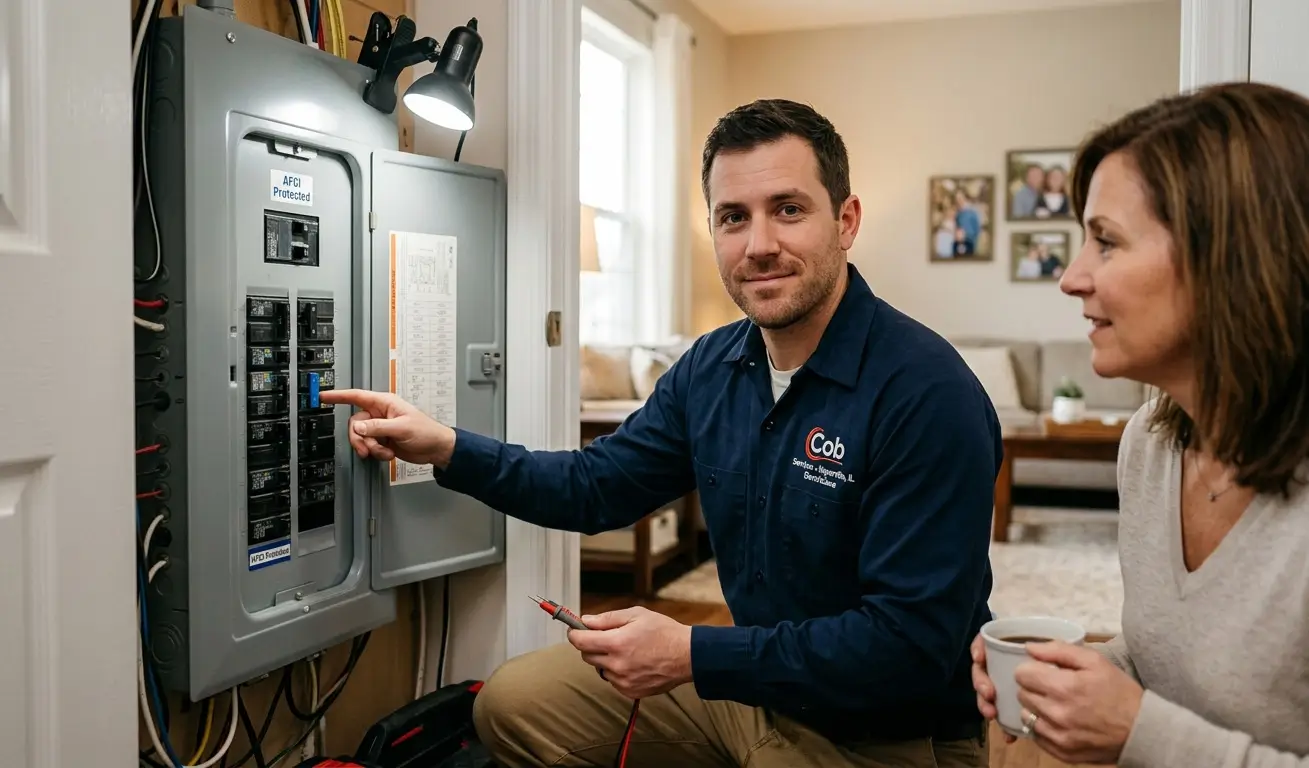
If you own a home here in Naperville, you probably have a mental “to-do” list: clean the gutters, check the furnace, maybe swap out those old smoke detector batteries. But there is one safety device sitting in your electrical panel right now that could be the difference between a quiet night’s sleep and a devastating house fire.
It’s called an AFCI breaker, and honestly? Most people have no idea what it does until they actually need it.
What is an AFCI, Anyway? (And why isn’t a “normal” breaker enough?)
Most of us grew up with standard circuit breakers. They’re great at one thing: shutting off the power if you plug in too many hair dryers and “overload” the circuit.
But there’s a deadlier problem that standard breakers usually miss: Arcing.
An Arc Fault (AFCI) happens when electricity “leaks” or jumps between damaged wires. It creates a localized heat spike—think of it like a miniature lightning bolt inside your wall—that can reach over 10,000°F. A standard breaker won’t trip because the total power draw hasn’t “overloaded,” but that heat is more than enough to ignite wood studs or insulation.
How Your Wires Get Damaged (Without You Knowing)
You’d be surprised how easily an arc fault starts. It’s rarely a massive explosion; it’s usually something boring and accidental:
- The “Gallery Wall” Fail: You drive a nail into the drywall to hang a family photo, and it accidentally nicks the insulation on a wire.
- The Furniture Squeeze: A heavy dresser is shoved against a plug, bending the cord until the copper inside starts to fray.
- The Family Pet: A puppy decides a lamp cord looks like a chew toy.
- Settling Homes: As older Naperville homes settle, wires can occasionally rub against metal plates or bolts, wearing down their protection over decades.
AFCI vs. GFCI: Which One Do You Need?
We get asked this all the time. Here’s the “human” version:
- GFCI (Ground Fault): Protects people. These are the outlets with buttons you find near water (kitchens/baths). They stop you from getting electrocuted.
- AFCI (Arc Fault): Protects property. These are usually in your breaker panel. They stop your house from catching fire.
The Bottom Line: In a modern, safe home, you actually need both.
Is Your Home Up to Speed?
Electrical codes in Illinois have gotten much stricter over the last decade for a good reason—they save lives. If your home was built before the mid-2000s, you’re likely running on “old school” protection.
Upgrading to AFCI breakers is one of the smartest investments you can make. It’s not just about “being up to code” for a future home sale; it’s about knowing that if a wire starts sparking behind your daughter’s bedroom wall, the power will cut out in a fraction of a second—long before a fire can start.
Why Calling a Pro Matters
We love a good DIY project as much as anyone, but the electrical panel is where we draw the line. Swapping in AFCI breakers requires a deep understanding of how your specific home is wired (especially “shared neutrals” found in older Naperville builds), or you’ll end up with “nuisance tripping” that drives you crazy.
At Cob Services, we live and work right here in the Naperville community. We aren’t just looking to swap a part; we’re looking to make sure your family is safe.
Curious if your home is protected? We’d be happy to take a look. Give us a call at Cob Services, and let’s make sure your electrical system is as safe as it can possibly be.