
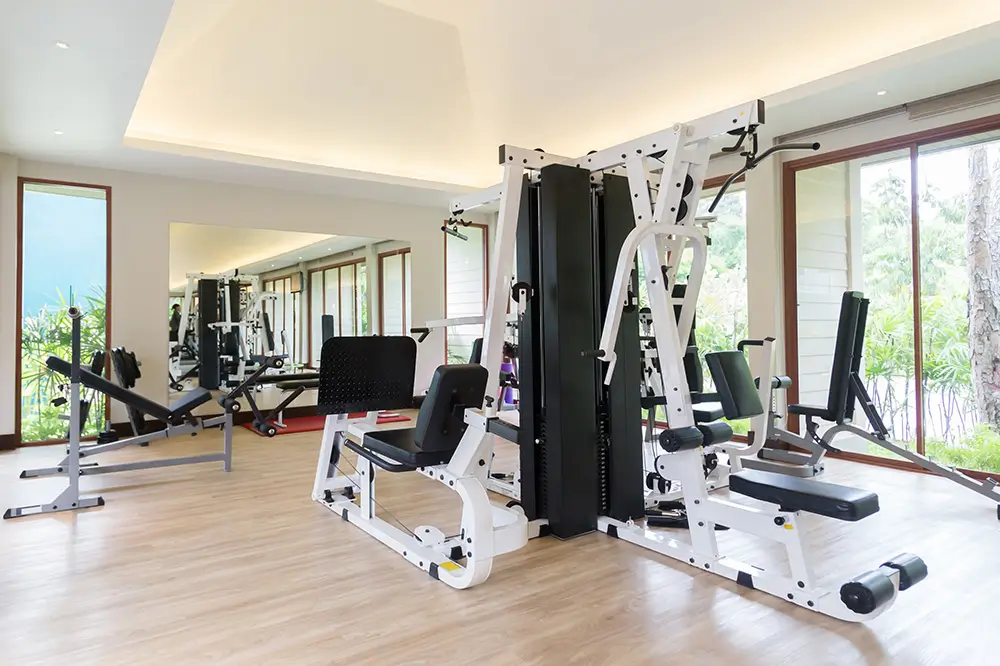
The basement gym has quietly become one of the more common jobs we quote in this town, and it is the one where the electrical scope is most often wrong on the first pass.
The reason is simple. The room gets designed as a room. Somebody plans lighting, flooring, a mirror wall, maybe a mini-split. Then the equipment gets bought separately over eighteen months, one piece at a time, on sale. Nobody ever adds the equipment up, and by the time a sauna and a cold plunge have joined the party, the four receptacles we roughed in two years ago are not the plan anymore.
So this is the list I go through with homeowners before we put a single wire in a wall.
The gym is rarely “just outlets”
Start with what actually draws power, because most of a home gym draws nothing at all.
Racks, benches, dumbbells, barbells, kettlebells, bands, a manual curved treadmill, a rower with a flywheel: zero. You can put a very serious gym in a room with one circuit and be fine.
What draws power is the equipment with a motor, a compressor, or a heating element in it.
Motorized treadmills are the big one. Plenty of residential treadmills say right in the manual that they want a dedicated 20-amp circuit, and higher-end and light-commercial units are stricter than that. Some are 240 volt. Read the nameplate on the specific model rather than assuming a treadmill is a treadmill, because sharing that circuit with a dehumidifier is how you end up calling us about a breaker that trips forty minutes into a run.
A mini-split for heating and cooling is a dedicated 240-volt circuit with its own disconnect. In a Naperville basement it is often the difference between a room you use in February and a room you do not.
A dehumidifier runs long hours down here and deserves its own circuit rather than sharing with the sound system.
Then screens, a speaker system, fans, and phone chargers, which are trivial individually and add up to about one more circuit collectively.
For most basement gyms we end up somewhere around two to three general 20-amp circuits plus whatever the mini-split, sauna, and plunge need. If you want the reasoning on why things get their own circuit, we wrote up when and why a dedicated circuit is required.
Where the receptacles go, which nobody thinks about until the rack is bolted down
This is the part of the job that has nothing to do with code and everything to do with whether you like the room.
Put receptacles high. Somewhere in the 42 to 48 inch range works well, because at standard height every outlet in a gym ends up behind a rack, under a bench, or blocked by stacked bumper plates. You do not want to move a 300-pound rack to plug in a fan.
Skip floor boxes under rubber flooring. They collect dust and sweat, the covers get stepped on and cracked by dropped plates, and the flooring never sits right over them. If you need power in the middle of the floor for a plunge or a treadmill, we would rather bring it down a wall nearby and plan the layout around it.
Plan one receptacle specifically for the treadmill at the spot the treadmill will actually live, and tell us which wall the mirror is going on so we do not put a box behind it.
Basement gyms also need AFCI protection like any other finished living space, and any part of the basement left unfinished needs GFCI. That is standard, we handle it, and it is worth knowing it is not optional. The broader code picture for these rooms is in our basement finish electrical guide for Naperville, including ceiling height and egress, which I am not going to repeat here.
Lighting, and the ceiling problem
Overhead press, pull-ups, and jump rope all happen in a vertical space that basement ceilings do not really have.
Before we lay out a single fixture, tell us where the rack is going and whether anyone in the house presses overhead. Then we keep the fixtures out of that column. Recessed cans sit flush and are usually fine. Pendants, exposed bulbs, and surface fixtures with glass in them are asking to be destroyed by a barbell or a jump rope handle.
Second thing: gyms want more light than a family room, and they want it even, not moody. Two rows of recessed lighting on a dimmer beats four cans in the middle of the room every time. Mirrors bounce light around and change the math, so mention them early. We do this layout work as part of custom lighting installation.
Saunas: two completely different electrical jobs
People say sauna and mean one of two things, and the wiring is nothing alike.
An infrared cabin is the lighter of the two. Most one and two-person units run on 120 volts and want a dedicated 15 or 20-amp circuit. Larger infrared rooms go to 240. It is a real circuit but it is not a big deal.
A traditional electric sauna heater is a different animal. Sizing starts with the room, roughly one kilowatt of heater per 45 to 50 cubic feet of interior volume, and then the heater nameplate governs the circuit. In practice a 4.5 kW heater usually lands on a 240-volt 30-amp circuit, a 6 kW heater on 40 amps, and an 8 kW heater on 50. These heaters are hardwired. There is no plug.
Send us the heater model before you buy the cabin. Sauna kits get sold on interior dimensions and wood species, and the electrical requirement is a line in the back of the manual that nobody reads at the showroom.
Inside the hot room
A few things that separate a sauna install done right from one that fails inspection or fails in three years.
No receptacles inside the sauna. There is nothing in there that should be plugged in, and the environment is wrong for it.
The light fixture has to be listed for the temperature and moisture. Sauna-rated fixtures are usually vapor-tight, mounted low or on a side wall away from the heater, and often shaded. A standard can light in a sauna ceiling is a fixture failure waiting to happen.
Ordinary cable is not rated for the temperatures inside a hot room. The wiring runs outside the insulation and behind the vapor barrier, and the final connection into the heater uses high-temperature conductor per the manufacturer’s instructions.
Those foil vapor barriers matter. Every electrical penetration through one has to be planned and sealed, which means we need to be on site at the right point in the sauna builder’s sequence rather than after the cedar goes up. Coordinate the two trades. It costs nothing to do and it is expensive to undo.
Interlocks, disconnects, and the safety pieces
This is the part that gets skipped by people who install their own kits.
Residential sauna heaters listed for household use have a built-in timer that limits how long the heater runs unattended, commonly capped around an hour, plus a high-limit cutout that kills the heater if the room overheats. Both are part of the listing. If a heater arrives without them, or somebody suggests bypassing the timer, that is the end of the conversation for me.
The control unit on most traditional heaters mounts outside the sauna, not inside it. Some models integrate the control into the heater body. Which one you have changes where the wiring lands, so it is another reason to settle on a model early.
There also has to be a disconnecting means. For a permanently connected appliance like this, the breaker itself can serve as the disconnect if it is within sight of the heater or can be locked in the off position. In a basement sauna twenty feet from the panel, that usually means a breaker lockout or a local disconnect. Inspectors look for it, and it is there so nobody is standing in front of an energized heater trusting that somebody upstairs will not flip something back on.
One open question worth asking before you buy: whether the heater goes on a GFCI. Some manufacturers specifically warn that GFCI protection causes nuisance tripping on their units, and some inspectors want it anyway. The answer depends on the model’s listing and how your plans examiner reads it. Ask us and we will ask them, because finding out at final inspection is the wrong time.
Cold plunges, which are the new hot tub
Chillers have shown up in maybe a third of the gym jobs we have quoted in the last two years, and they get treated as an appliance you plug in. Mostly they are, but the water changes the rules.
Smaller residential chillers typically run on 120 volts, and larger ones step up. Either way you are putting a compressor next to a tub of water in a finished room, so GFCI protection and a properly located receptacle are not negotiable, and the manufacturer’s clearance requirements around the unit are real because it needs to reject heat somewhere.
If your plunge lives outdoors, the requirements start looking a lot more like spa wiring, and we covered that fully in our post on Naperville hot tub and spa wiring, GFCI, and disconnect distance.
Adding it up before you find out the hard way
Take a fairly typical build: mini-split, 6 kW sauna, chiller, treadmill on its own circuit, dehumidifier, lighting, and general receptacles. That is a meaningful block of load landing on a house that in a lot of Naperville neighborhoods still has a 100-amp service and a full panel.
Two things usually happen from there. Either we run a feeder to a subpanel in the gym, which is cleaner than pulling six home runs across the basement and leaves room for whatever gets bought next year, or the load calculation says the service itself needs to come up.
Which one applies to you is a calculation, not a guess. We cover what a subpanel is and when you need one, what size panel a Naperville home actually needs, and why so many houses here no longer have enough service for how people live separately.
Worth saying plainly: if there is also a car charging in your garage, or one arriving, the gym and the charger are competing for the same service. Bring both up in the same conversation.
Garage gyms are their own thing
Attached garage, unheated, concrete floor, door open half the year.
Receptacles in a garage need GFCI protection. Heating is usually a mini-split or a hardwired unit heater on its own 240-volt circuit, and either one is a real load. Lighting has to work at 20 degrees, which rules out some cheap LED strips that flicker or fail in the cold.
And in the attached garages around here, the gym is very often sharing the room and the panel space with an EV charger. That is a load-sharing conversation.
Detached garage or a shop out back is a bigger project, since you are looking at a buried feeder and a subpanel. We wrote that up in wiring a detached garage or workshop in Naperville.
Permits and sequence
Finishing a basement into a gym is an alteration, and Naperville is direct about it. The city states that before beginning any addition or alteration to an existing residential building, including basement build-outs, residents must obtain the necessary building permits. Electrical work carries its own permit on top of that, and the contractor has to be registered with the city.
The order that works: settle equipment models first, run the load calculation, pull the permits, rough in everything including the circuits for gear you have not bought yet, pass rough inspection, then let the drywall and the sauna builder go. Roughing in a spare 240-volt circuit while the walls are open costs a fraction of what it costs to add one afterward, and in this particular room I have never once had a customer regret the spare.
Pricing on this kind of work is scoped by project rather than by the piece, and we break down how that looks in our Naperville remodeling electrician cost guide.
Frequently asked questions
Can I put a sauna in a basement with a standard ceiling height? Usually yes, since sauna cabins are built shorter than the room. The bench height and the heater clearances are set by the manufacturer, and the room around the cabin still has to meet the basement code requirements for habitable space.
Do I need a separate circuit for every machine? No. Anything with a motor or a heater generally does. Everything else can share. The treadmill is the one people get wrong most often.
My gym is in a spare bedroom upstairs. Different answer? Mostly the same equipment logic, harder wiring access. Running a new 240-volt circuit to a second-floor room in a finished house is more work than running one across an open basement, and it changes the number.
Will a sauna wreck my electric bill? A 6 kW heater running an hour uses about as much as running a clothes dryer for an hour. Most people use it a few times a week. It is noticeable and it is not dramatic.
Can I install the sauna kit myself and just have you do the hookup? You can build the cabin. The heater circuit, the disconnect, and the connection are permitted electrical work in Naperville and have to be done by a registered contractor. We are happy to work alongside whoever assembles the room, as long as we are talking before the vapor barrier goes up.
Planning a gym, a sauna, or both?
Send us a rough sketch of the room and the model numbers of anything with a plug or a heating element. We can tell you the circuit count, whether your panel takes it, and whether a subpanel makes more sense than individual runs, usually without a site visit for the first pass.
More on the range of work we do is on our page for licensed residential electricians in Naperville, or start at Cob Services LLC if you want the overview first.
Call (630) 427-5923. Free estimates, no trip fee, no dispatch fee, and a licensed electrician answers rather than a call center.
Cob Services LLC 2020 Calamos Ct Suite 200, Naperville, IL 60563 (630) 427-5923 Monday through Friday, 9:00 AM to 5:00 PM. Emergency line 24/7. Illinois license #26-00032356. Licensed, bonded and insured. Serving Naperville, Lisle, Aurora, Plainfield, Bolingbrook, Downers Grove, La Grange, Hinsdale, and Burr Ridge.
About the author
Alexandr Godonoaga is the owner of Cob Services LLC and an Illinois-licensed electrician with over ten years of residential experience in Naperville and the western suburbs. He works under Illinois license #26-00032356, is ICC-certified for EV charger installation, and walks every residential estimate personally. Connect on LinkedIn.