
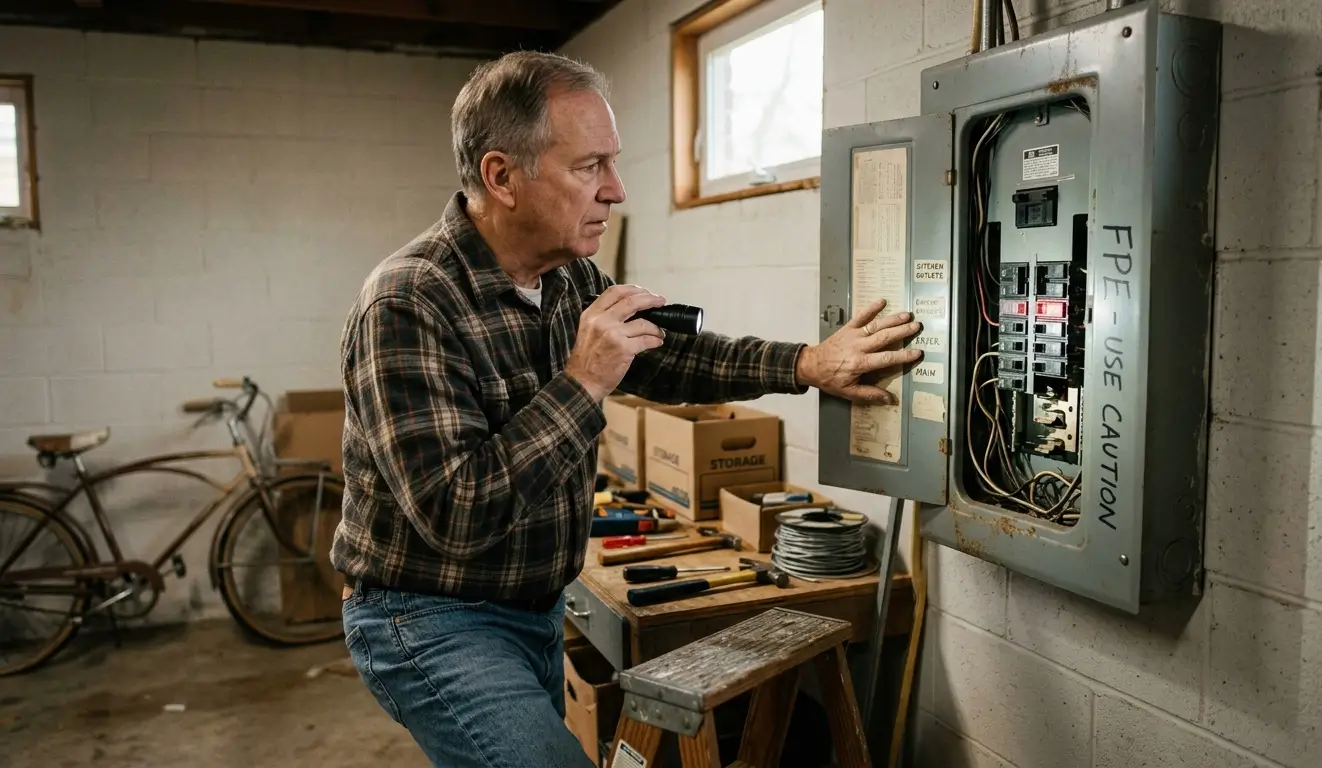
For most Naperville houses the answer is 200 amps, and it has been for about twenty years. But that is the default, not the diagnosis. A 1,400 square foot ranch with gas heat, a gas range and a gas water heater can be genuinely fine on 100 amps. A 3,600 square foot house with a heat pump, an induction range and two cars in the garage can need 400. The way you find out which one you are is a load calculation, and it is not complicated enough that you have to take anybody’s word for it.
Here is how the number actually gets worked out, with two real examples run start to finish.
First, find out what you have now
Three places to look, in order of reliability.
The main breaker at the top of your panel has a number stamped on it. That is your service size. If it says 100, you have 100 amp service. If there is no main breaker and you are unscrewing round glass fuses, you almost certainly have 60 amps, and that is its own conversation.
The number of slots in the panel is not your service size. I say this constantly. A 100 amp panel with forty slots is still a 100 amp panel. People call me because they are out of room for breakers and assume they need a service upgrade, when what they need is a subpanel and an afternoon.
The meter and the service cable outside also tell a story, but they are the least reliable of the three because a previous owner may have upgraded one and not the other. I have opened panels labeled 200 amps that were fed by a cable rated for considerably less.
The math, without the mystery
Article 220 of the code gives a couple of ways to do this. The optional method for a one-family dwelling is the one most electricians reach for, and it goes like this.
Start with 3 volt-amps per square foot of living space for general lighting and receptacles. Add 1,500 VA for each of the two required small appliance circuits in the kitchen, plus 1,500 for the laundry circuit. Then add the nameplate rating of every fixed appliance: range, dryer, dishwasher, disposal, microwave, water heater.
Take that whole pile. The first 10,000 VA counts at full value. Everything above 10,000 counts at 40 percent, because the code writers correctly assumed you are not running the self-cleaning oven, the dryer and the dishwasher simultaneously at three in the afternoon. Then add your heating or cooling, whichever is larger, at full value. Divide the total by 240 volts and you have your minimum amps.
Example one: the small gas house
A 1,400 square foot ranch. Gas furnace, gas range, gas dryer, gas water heater, three ton air conditioner.
General lighting comes to 4,200 VA. Small appliance and laundry circuits add 4,500. Dishwasher, disposal and microwave together are about 3,600. That is 12,300 VA total. First 10,000 at full, the remaining 2,300 at 40 percent, gives 10,920. The AC pulls roughly 18 amps at 240 volts, so add 4,320.
Total: 15,240 VA, or 63.5 amps.
That house is fine on 100 amp service with room to spare. If somebody tries to sell that homeowner a 200 amp upgrade because the panel “looks old,” ask them for the calculation.
Example two: the same house, electrified
A 2,400 square foot two-story. Electric range at 12 kW, electric dryer at 5 kW, electric water heater at 4.5 kW, plus the usual dishwasher, disposal and microwave. Four ton air conditioner.
General lighting is 7,200 VA. Small appliance and laundry add 4,500. Appliance nameplates total 25,100. Sum: 36,800 VA. First 10,000 at full, remaining 26,800 at 40 percent, gives 20,720. Add 5,760 for the AC.
Total: 26,480 VA, or 110 amps.
That house is over 100 amp service before anyone has plugged in a car. Add a 48 amp EV charger, which counts at 125 percent of its rating because it is a continuous load, and you are adding another 60 amps of calculated demand. Now you are at 170 amps and 200 amp service is the obvious answer.
One honest note on method. The optional calculation above uses the range’s full nameplate. The standard method in Table 220.55 gives a household range under 12 kW a demand allowance of 8 kW instead, which produces a friendlier number. Both are legitimate and a plans reviewer will take either. I mention it because homeowners sometimes get two different calculations from two different electricians and assume one of them is lying. Usually they just used different methods.
What actually pushes a house over the line
In order of how often I see them cause a service upgrade in this town:
An EV charger, by a wide margin. It is counted at full continuous rating with no demand credit, which makes it the heaviest single thing most people add. A 48 amp charger is the equivalent of adding a second small house.
A heat pump, especially with electric backup strip heat, which is what usually blows the calculation rather than the compressor itself. We wrote up what a heat pump needs from your panel separately because the disconnect and circuit details matter as much as the load number.
An electric tankless water heater. These are brutal. A whole house unit can want 100 to 150 amps by itself, which is why the circuit usually costs more than the appliance.
A finished basement, which adds square footage to the calculation on top of whatever circuits the inspector expects to see down there.
A gas to induction kitchen conversion, though this one is gentler than people fear thanks to the range demand allowance. The details are here.
A detached garage or workshop, which usually wants its own subpanel and a trench more than it wants a bigger service.
When 400 amps is real and when it is a sales pitch
400 amp residential service exists and I install it, but it is genuinely uncommon. In practice it shows up on houses over roughly 4,000 square feet that are fully electric, or on properties with a pool, a detached shop and two chargers, or where somebody is planning a serious backup generator and battery setup.
What it usually looks like physically is two 200 amp panels fed from a 400 amp meter enclosure, not one enormous panel. The cost jump is significant because the utility side of the work gets involved.
If your calculation lands at 210 amps, you do not need 400 amp service. You need to look at whether one load can be managed instead. Which brings me to the option that gets skipped.
The upgrade you might not need
The 2023 code recognizes energy management systems, and they change the math on a lot of these jobs. The device monitors what the house is drawing and sheds a designated load, almost always the car charger, when total demand climbs. Because the charger can be guaranteed to back off, it no longer has to be counted at full value in the calculation.
I have kept several 100 amp services alive this way for people who were quoted a full upgrade elsewhere. It is not the right answer every time. If the panel is a Federal Pacific Stab-Lok or a Zinsco, I am replacing it regardless of the load numbers, because those breakers have a documented history of not tripping during a fault and no amount of clever load management fixes that. But if the panel is healthy and the calculation is the only constraint, ask about it before you spend three thousand dollars.
Same logic applies if you are out of physical slots but not out of capacity. That is a subpanel, and our panel and subpanel page covers where that makes sense.
The Naperville part
Two things here are specific to this city and both catch people out.
Naperville runs its own municipal electric utility rather than being served by ComEd, so a service change involves the city’s electric department rather than an outside utility. That is usually a smoother process than people expect, but it is a different process, and contractors from outside the area sometimes schedule it wrong.
Second, the permit. A permit is required before any electrical work inside city limits, and the work has to be done by a state-licensed electrical contractor who is registered with Naperville specifically. Being licensed in Illinois is not sufficient on its own. Permitted work is now inspected against the 2023 National Electrical Code, which is a recent change. If you are reading an older guide that says 2017, including some of the cost articles floating around, it is out of date.
There is a wrinkle worth knowing if you are submitting your own paperwork. The city publishes a residential load calculation worksheet for exactly this purpose, described as a way to determine the minimum service size for an existing dwelling adding load. The posted worksheet is built on Article 220 of the 2017 code, while inspections run against 2023. It is not a contradiction that will sink your permit, but it is worth confirming with the plans examiner which version they want on the submittal rather than assuming.
What it costs
Real ranges from work we have done in the area during 2025 and 2026:
| Job | Typical range |
|---|---|
| 100A to 200A residential panel upgrade | $2,200 to $3,800 |
| 200A to 400A service upgrade with utility coordination | $5,500 to $9,500 and up |
| Subpanel installation, 60A to 100A | $1,200 to $2,400 |
| Federal Pacific or Zinsco panel replacement | $2,400 to $4,200 |
What moves those numbers is panel location, whether the meter has to be relocated, the length of the new feeder, and whether the existing grounding electrode system meets current code. Our fuller breakdown of residential electrician pricing in Naperville has more.
A 200 amp swap is typically six to eight hours from power off to power back on, and we almost always finish in a day.
Frequently asked questions
Is 100 amp service enough for a house in Naperville? It can be. For a smaller home with gas heat, a gas range and a gas water heater, 100 amps is often comfortable. It stops being enough once you add a car charger, electric heat or an electric water heater. Run the calculation before assuming either way.
Do I need 200 amp service to install an EV charger? Not necessarily. A 48 amp charger adds about 60 amps of calculated demand, which a lot of 100 amp services cannot absorb. But a load management device or a lower amperage charger can often make it work without touching the service. See our EV charging installation page for how we approach it.
How do I know what size panel I currently have? Read the number stamped on the main breaker at the top of the panel. Ignore the number of breaker slots, which tells you nothing about capacity.
Does the panel need replacing just because it is old? Age alone is not the trigger. Capacity, condition and brand are. A clean 1998 panel with room in the calculation can stay. A Federal Pacific or Zinsco panel should go regardless of age or capacity.
Can I do the load calculation myself? You can absolutely run it to know roughly where you stand, and the arithmetic above is the whole method. The one that gets submitted with the permit needs to come from the licensed contractor doing the work.
Should I check this before buying a house? Yes, and it takes about ten minutes. We put together a walk-through to do before you make an offer.
Get the actual number for your house
Tell us your square footage, whether your range, dryer, water heater and furnace are gas or electric, and what you are planning to add. We can usually give you a real answer over the phone without anyone coming out, and tell you honestly whether you need an upgrade or whether you are being sold one.
Call (630) 427-5923 or request service online. Free estimates, no trip fee, no dispatch fee, and a licensed electrician on the phone rather than a call center. More on what we do at our residential electricians in Naperville page.
Cob Services LLC, 2020 Calamos Ct Suite 200, Naperville, IL 60563. Monday through Friday, 9:00 AM to 5:00 PM, emergency line 24/7. Serving Naperville, Lisle, Aurora, Plainfield, Bolingbrook, Downers Grove, La Grange, Hinsdale and Burr Ridge.
About the author
Alexandr Godonoaga is the owner of Cob Services LLC and an Illinois-licensed electrician with more than ten years of residential experience in Naperville and the western suburbs. He works under Illinois license #26-00032356, is ICC-certified for EV charger installation, and walks every residential estimate personally.