
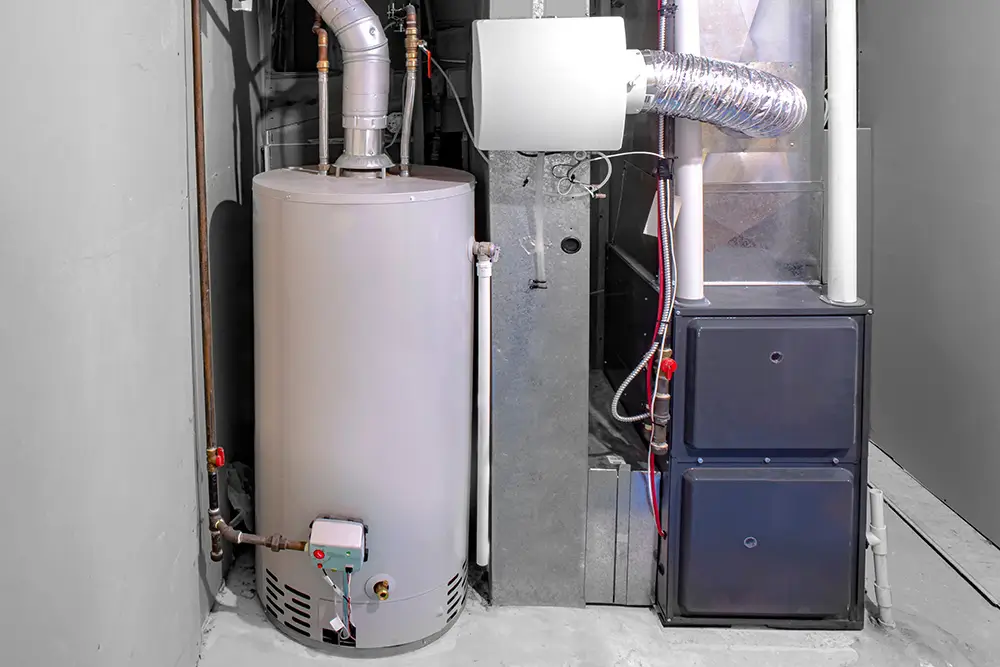
A homeowner in south Naperville called me last winter with a whole-house electric tankless unit already sitting in his basement. He had bought it online for under a thousand dollars, which felt like a bargain against the quotes he had been getting for a new tank.
Then he asked what it would cost to wire.
I gave him the number and there was a long pause on the phone. The wiring was going to run several times what the appliance cost, and that was before we got to whether his service could carry it, which it could not. The unit went back.
I am not against electric tankless. I have installed them. But this is the one appliance category where the electrical scope regularly dwarfs the equipment, and almost nobody finds that out before they buy.
Why northern Illinois is the hard case
Tankless means no storage, which means the unit has to heat water to temperature as fast as you can pull it through. The power required comes down to two numbers: how many gallons per minute you want, and how far you have to raise the temperature.
Our incoming water in the depths of winter sits somewhere in the low 40s. A comfortable shower is around 105 degrees, and a tap or dishwasher wants closer to 120. So you are asking the unit for a temperature rise somewhere in the 65 to 80 degree range, in January, at whatever flow rate the shower head puts out.
Run that math and a 27 kW unit, which is a common whole-house size, delivers roughly 2.6 gallons per minute at a 70 degree rise. A 36 kW unit gets you to about 3.5. That is one decent shower, in winter, with nothing else running. Not two showers. Not a shower and the dishwasher.
The same unit performs beautifully in Phoenix, where the incoming water is 30 degrees warmer, which is where a lot of the glowing online reviews come from.
What that actually looks like at the panel
Here is the part that stops projects.
A 27 kW unit at 240 volts draws about 112 amps. That is more than the entire service on a lot of Naperville houses. A 36 kW unit draws about 150.
Because no reasonable single breaker handles that, these units split their elements across multiple circuits. A 27 kW model typically calls for three double-pole breakers in the 40 to 50 amp range, each with its own 8 AWG feed. A 36 kW model usually wants four. Every double-pole breaker eats two slots, so you are looking at six to eight spaces in the panel before anything else.
So the job is not one circuit. It is three or four home runs from the panel to the utility room, three or four breakers, and enough physical room in the box to land them. In houses where the water heater sits at the far end of a finished basement from the panel, the copper alone is a real line item.
Then there is the disconnect. Those breakers have to be grouped and identified, and a permanently connected appliance like this needs a disconnecting means the code recognizes. It is straightforward work, it is just more of it than people picture.
The load calculation, which is kinder than the nameplate but not kind
People see 112 amps and assume a 200-amp service is instantly gone. It is not quite that bad, because the standard residential calculation applies demand factors rather than stacking every nameplate at full value.
But it is still a very large addition. Put a whole-house electric tankless next to central air, an electric range, a dryer, and a car charger, and a 200-amp service starts running out of room in a hurry. On a 100-amp service, which is still what a lot of pre-1995 Naperville houses have, a whole-house electric tankless is simply not happening without a service upgrade first.
The only way to know which side you are on is to run the numbers for your house. We go into what drives that in what size electrical panel a Naperville home actually needs and why so many homes here no longer have the service for how people live.
If the service has capacity but the panel is physically full, a subpanel near the water heater is often the cleaner answer than trying to shoehorn eight spaces into a box that does not have them. That is covered in what a subpanel is and when you need one.
And if your existing panel is a Federal Pacific or a Zinsco, this whole conversation collapses into a different one, because I am not adding 112 amps of load to a panel I would be replacing anyway. Our guide on how to tell if your Naperville panel is outdated covers what to look for.
One Naperville detail that trips up out-of-town contractors
If this project turns into a service upgrade, the utility coordination happens with the City of Naperville, not with ComEd.
Naperville runs its own municipally owned electric utility, serving roughly 63,000 customers, with its own crews, its own rates, and its own scheduling for meter and service work. Natural gas is Nicor, but the electric side is the city.
This matters practically. The meter pull, the service drop, and the reconnect get scheduled through the city, on the city’s calendar, and anyone quoting you a service upgrade in Naperville while talking about calling ComEd has not done one here recently. It is a small tell and it is worth listening for when you collect quotes.
The alternative I bring up on almost every one of these calls
If the goal is to get off a failing tank and use less energy, a heat pump water heater usually beats electric tankless on every axis that matters, and the electrical difference is enormous.
A heat pump water heater typically runs on a single 240-volt 30-amp circuit. One breaker. Two slots. One wire run. Against three or four circuits and 112 amps of connected load, that is not a close comparison, and it is frequently the difference between needing a service upgrade and not needing one.
The tradeoffs are real and I will name them. A heat pump water heater needs air volume to work, generally in the range of 700 to 1,000 cubic feet or ducting to bring air in, so a sealed mechanical closet is a problem. It produces condensate, so it needs a drain or a pump. It cools and dehumidifies the room it sits in, which in a Naperville basement is genuinely a feature in July and a non-issue the rest of the year. And it is a tank, so it takes floor space that tankless would have freed up.
The other alternative, if you are keeping gas service anyway: a gas tankless unit. The electrical requirement drops to a single 120-volt circuit for the controls and the venting becomes the hard part instead of the wiring. That is a plumbing and venting conversation rather than mine, but it belongs on the list.
Where electric tankless is genuinely the right call
I do not want to talk anyone out of these categorically, because there are situations where they are the obvious answer.
Point of use is the big one. A small 3.5 to 6 kW unit under a sink at the far end of the house, or serving a single fixture in an addition or a finished attic, runs on one dedicated circuit and solves the problem of waiting ninety seconds for hot water to travel from the basement. That is a clean install and the electrical is proportionate.
Whole-house electric tankless makes sense in a house with no gas service, in an all-electric new build where the service was sized for it from day one, or in a smaller house with modest simultaneous demand and a 200-amp service that has room. In those cases it works fine and I will install it.
What does not work is retrofitting one into a 1970s Naperville split-level with a full 100-amp panel because the unit was on sale.
Permits and sequence
Electrical work in Naperville needs a permit and a registered contractor, and this project needs a plumbing permit too. Both trades, both inspections.
The order that saves money: pick the unit, send us the spec sheet, let us run the load calculation and price the electrical, and only then buy anything. Reversing those steps is how the unit ends up going back to the retailer, minus shipping.
Skipping the permit is worse here than usual, because a future buyer’s inspector will absolutely notice three unpermitted 40-amp circuits feeding an appliance. We wrote about that pattern in why DIY electrical work fails Naperville city inspections.
For how this kind of work gets priced generally, our Naperville residential electrician cost guide has current numbers, and when a dedicated circuit is required covers the underlying logic. Panel work itself is on our electrical panels service page.
Frequently asked questions
Can I run a whole-house electric tankless on 100-amp service? No. The connected load alone approaches or exceeds the service. You would be upgrading to 200 amps first, at which point the tankless is the smaller half of the project.
The listing says it only needs a 60-amp breaker. Is that wrong? It is probably a smaller unit than you need for this climate, or the rating assumes a warm inlet temperature. Check the kilowatt rating and the temperature rise chart in the manual, not the headline. A unit that is undersized for a 70 degree rise will work in September and disappoint you in February.
How much of a difference does winter really make? Roughly a third of the capacity. A unit that gives you comfortable flow in October can drop to a trickle of usable hot water in January, and the phone calls about that always come between Christmas and March.
Is a heat pump water heater loud? It runs a compressor and a fan, so it makes about as much noise as a window air conditioner while it is heating. In an unfinished basement, nobody notices. Under a bedroom, plan for it.
Can you just add one more circuit to what is already there? Not for a whole-house unit. The elements are designed to be split across separate circuits, and the manufacturer’s wiring diagram is not optional. For a point-of-use unit, yes, one circuit is usually the whole job.
Price the electrical before you buy the unit
Send us the model number of whatever you are looking at and tell us where your panel is relative to the water heater. We will tell you the circuit count, whether your service takes it, and whether a heat pump water heater would get you the same result for a fraction of the electrical work. That first pass usually does not need a site visit.
You can see the rest of what we handle on our page for residential electrical work in Naperville, or browse our website for the full range of services.
Call (630) 427-5923. Free estimates, no trip fee, no dispatch fee, and a licensed electrician on the phone rather than a call center.
Cob Services LLC 2020 Calamos Ct Suite 200, Naperville, IL 60563 (630) 427-5923 Monday through Friday, 9:00 AM to 5:00 PM. Emergency line 24/7. Illinois license #26-00032356. Licensed, bonded and insured. Serving Naperville, Lisle, Aurora, Plainfield, Bolingbrook, Downers Grove, La Grange, Hinsdale, and Burr Ridge.
About the author
Alexandr Godonoaga is the owner of Cob Services LLC and an Illinois-licensed electrician with over ten years of residential experience in Naperville and the western suburbs. He works under Illinois license #26-00032356, is ICC-certified for EV charger installation, and walks every residential estimate personally. Connect on LinkedIn.