
By Alexandr Godonoaga, Owner and CEO at Cob Services LLC — License #26-00032356
I’ve been getting this question almost weekly since the windstorm in late February knocked out power across parts of west Naperville for a day and a half. A homeowner calls, says they’re done with the ComEd roulette, and asks: should I put in a Generac, or one of those Tesla Powerwall setups?
The honest answer is, it depends on your house, your gas service, your panel, and what you’re actually trying to back up. There’s no universal winner. I’ll walk you through how I help my own clients decide, with the real numbers I’m quoting in Naperville this year and the parts of the install most homeowners don’t see coming. If you’ve been searching for residential electricians near me and trying to figure out who can actually answer this question without a sales pitch, this is the breakdown I wish someone had given me before my first install.
What each system actually is (in plain English)
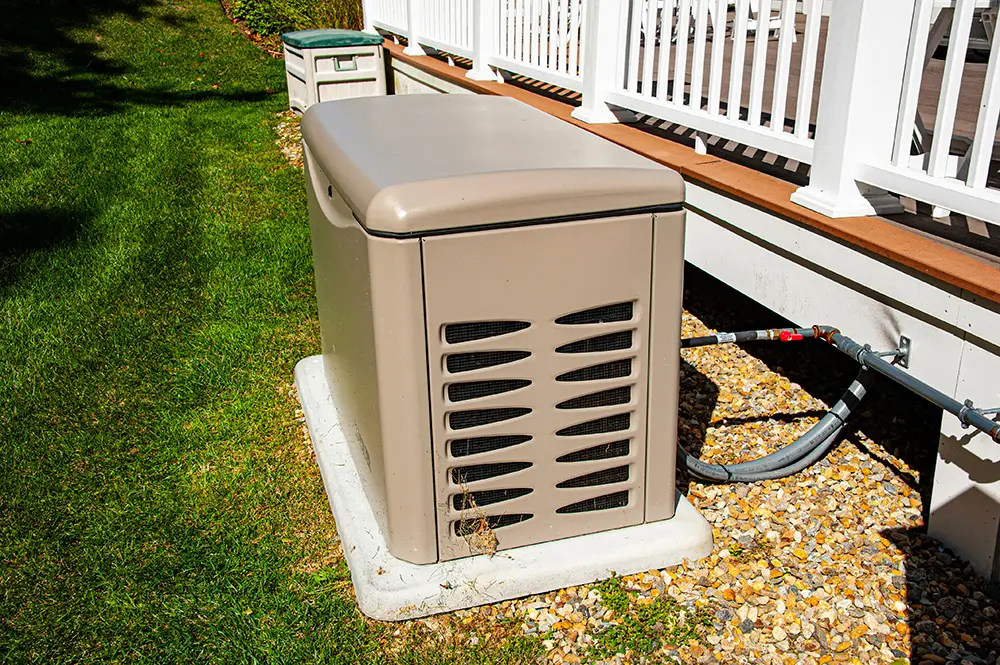
A standby generator is a permanently installed engine that sits outside your house, usually on a small concrete pad next to your AC condenser. When ComEd drops, it senses the loss, fires up on natural gas or propane, and feeds power back into your panel through an automatic transfer switch. In Naperville, almost every install I do runs on natural gas because the gas mains are already there.
A whole-home battery backup is a wall-mounted lithium-ion unit (or two, or three, stacked) that sits in your garage, basement, or on an exterior wall. It charges off the grid or off solar panels during normal times, and when the power goes out, it switches over silently in under a quarter second. Most of my clients are putting in Tesla Powerwall 3 or FranklinWH. A few have asked about Enphase.
Both systems need a transfer switch to do their job safely, which is a whole topic by itself. If you want to understand why, I wrote about it here: What Is a Transfer Switch? (And Why Your Generator Is Paperweight Without One).
The cost conversation I have with every homeowner
I’ll give you the ranges I’m actually quoting in Naperville in 2026, not the manufacturer brochure numbers.
Standby generator, installed and permitted:
- 14kW Generac or Kohler, whole-home coverage on a typical 2,500-3,500 sq ft Naperville house: $9,500 to $13,000
- 22kW unit for larger homes with two AC units and an EV charger: $13,500 to $17,500
- 26kW unit, top of the residential line, usually for homes over 4,500 sq ft or with electric heat: $16,000 to $21,000
That includes the unit, the concrete pad, the gas line tap from your meter, the automatic transfer switch, the Naperville permit, and the inspection. It does not include having Nicor run a bigger gas service if your existing line can’t supply enough volume, which happens more than people think on older homes south of 75th Street.
Whole-home battery backup, installed and permitted:
- One Tesla Powerwall 3 (13.5 kWh, ~11.5 kW continuous): $14,500 to $17,000 installed
- Two Powerwalls for true whole-home coverage including AC: $26,000 to $32,000 installed
- FranklinWH aPower 2 (15 kWh): $15,500 to $18,500 for one, double that for whole-home
- Three-unit setups for big homes with 200A+ panels: $38,000 to $50,000
Worth noting: the 30% federal residential clean energy tax credit still applies to batteries with at least 3 kWh of capacity, so the net cost of a two-Powerwall setup drops to around $18,000 to $22,000 after you file. Generators get zero federal credit. That’s the single biggest financial difference between the two paths.
For context, EnergySage’s 2026 cost analysis shows national averages roughly in line with what I’m seeing here, though Naperville installs tend to run a bit higher because of permit fees, inspection scheduling, and the labor market in DuPage County.
What I actually like and don’t like about each one
Standby generators: what they do well
They run as long as the gas is flowing. That matters in Naperville. We had a stretch in early 2024 where a derecho took out power for three days in parts of South Naperville. A 22kW Generac on natural gas ran the entire time without anyone touching it. A battery backup, even a two-Powerwall setup, would have been done in 12 to 18 hours on a house running heat, fridge, and a couple of office circuits.
Cold weather is also their friend. Lithium batteries lose usable capacity below 32°F, and we’ve been hitting single digits in January every year I can remember. A natural gas generator just hums along.
Standby generators: what bugs me about them
They’re loud. Even the quiet-rated Generac Guardian models sit around 65 to 68 dB at 23 feet, which is dishwasher-loud running 24 hours a day. Your neighbors will notice. I’ve had two clients in older Naperville subdivisions get noise complaints from HOAs during multi-day outages.
They also need to be exercised weekly, which is the engine running for about 12 minutes every Wednesday at noon (or whenever you set it). It’s not a problem until your bedroom is on that side of the house and the schedule defaults to 7 a.m.
Maintenance is real, too. Oil changes, a starter battery that dies every couple of years, air filters. If you stay on top of it, budget $250 to $400 a year. If you don’t, expect a no-start the one time you actually need it.
Battery backup: what it does well
It’s silent. Totally silent. My own house has a Powerwall and I genuinely don’t know it’s running unless I check the app.
The switchover is instant. Generators take 8 to 20 seconds to start and stabilize, which means your Wi-Fi router reboots, your sump pump cycles, and your computer crashes. A battery never gives the house a chance to know the grid went down.
If you’ve been thinking about solar anyway, or you already have it, batteries are a different conversation entirely. You’re not just buying backup, you’re buying a way to use your own solar at night and dodge ComEd’s time-of-use peak rates. I have a few clients who are saving $80 to $140 a month on their bill with that combination, completely separate from the backup function.
And the tax credit. I keep mentioning it because it’s not small. On a $30,000 install, you’re getting $9,000 back. That changes the math.
Battery backup: what bugs me about it
Runtime. A single Powerwall 3 will run a typical Naperville house for 8 to 14 hours if you’re conservative with the AC. Two will get you 18 to 30 hours. If you want to ride out a 48-hour outage without solar to recharge, you’re looking at three units minimum, and the cost climbs fast.
AC compressors are the killer. Most batteries can start a single residential AC unit, but if you have two units (common in larger Naperville homes), or a really old 5-ton unit with a high inrush current, the battery may not be able to start it without a soft-start kit. I add those routinely now, but it’s an extra $400 to $800 part.
EV charging during an outage is also tricky. If you have a Level 2 charger pulling 40 amps and the grid goes down, the battery will not charge your car at full speed. Most setups force the charger down to 16 amps or off entirely. Your car becomes a sometimes-EV during a long outage.
How I actually help homeowners decide
Here are the questions I ask, in the order I ask them.
1. How long are your outages, usually? Pull up the ComEd outage map history for your address if you can. In most of Naperville, you’re getting 2 to 6 outages a year, and 90% of them are under 4 hours. If that’s you, a single Powerwall is probably overkill on capacity and a generator is definitely overkill. A smaller partial-home battery setup might be all you need.
2. Do you have solar, or are you going to within 5 years? If yes, battery is almost always the right answer. The tax credit, the time-of-use savings, and the recharge-during-outage capability all stack. If you have no plan for solar, the math is closer.
3. What absolutely has to stay on? Medical equipment, a sump pump in a finished basement, a home office that pays the mortgage, a fish tank. Make the list. Then we calculate the load. I had a client in Wheaton who thought he needed a 22kW generator until we ran the numbers and realized his actual critical load was 4.2 kW. A single Powerwall would have done it for half the price.
4. What’s your panel? This is where a lot of homeowners get blindsided. Both systems need a panel that can handle the integration. If you’re on a 100A service from 1978, or you have a Federal Pacific panel, neither install is going to pass inspection until that gets handled. I usually have to do panel work first on about 40% of these jobs. (If you’re not sure where your panel stands, the self-assessment guide I wrote for EV charger readiness covers most of the same checks.)
5. Where would the equipment go? Generators need outside placement with specific setback distances from windows, doors, and property lines. Naperville code requires 5 feet from any opening and usually 3 feet from the lot line. Batteries can go indoors (garage is most common) but need ventilation and clearance from combustibles. Some HOAs won’t allow exterior-mounted batteries on front-facing walls. We figure this out before you sign anything.
The hybrid option nobody talks about
I’m going to say something most installers won’t push you toward, because it costs more: the best setup for some homeowners is both. A battery handles the short outages instantly and silently. A small generator (or even a portable with an inlet box) covers the rare multi-day events when the battery runs out.
It’s expensive. For clients with big houses, frequent travel, and basically zero tolerance for being inconvenienced, it’s also what I’d put in my own house if I were building from scratch today.
What I’d do in your shoes
If your outages are short and infrequent and you have any interest in solar: one or two Powerwalls, take the 30% credit, and call it done.
If you’re in an older Naperville home with no solar plans and you’ve had a couple of 24+ hour outages in the last few years: a 22kW natural gas Generac with a whole-home transfer switch. It’s not the exciting answer, but it’s the right one.
If you’ve got a big house, a home office, medical equipment, or a basement that floods when the sump quits: look hard at the hybrid setup, or at least size a battery system big enough that you’re not sweating hour 16.
If you’re not sure which way to go, get someone who installs both to walk your house and check your panel before you commit. The right answer usually lives in the details of your specific setup.
One last thing about installers
Both of these systems involve high-voltage work tied directly into your main panel. They need a Naperville permit and an inspection from the city. They need a licensed electrician (License #26-00032356 in my case) who will pull that permit in their own name, not in yours. If anyone tells you they can do it cash, off the books, no permit, walk away. I’ve been called in to fix two of those in the last year and both ended up costing the homeowner more than doing it right the first time.
This is also why I tell people to be careful about who shows up when they search for residential electricians Naperville IL online. A lot of the top results are lead-generation sites that sell your call to whoever paid for the slot that day. You want someone local, licensed in Illinois, and willing to walk your house before they quote you. That’s true whether you end up going with a battery, a generator, or neither.
If you want me to take a look at your house and tell you straight what makes sense, give us a call or send a message. I don’t charge for the conversation and I’ll tell you if you don’t need either system.
— Alexandr Godonoaga
Owner and CEO, Cob Services LLC
License #26-00032356