
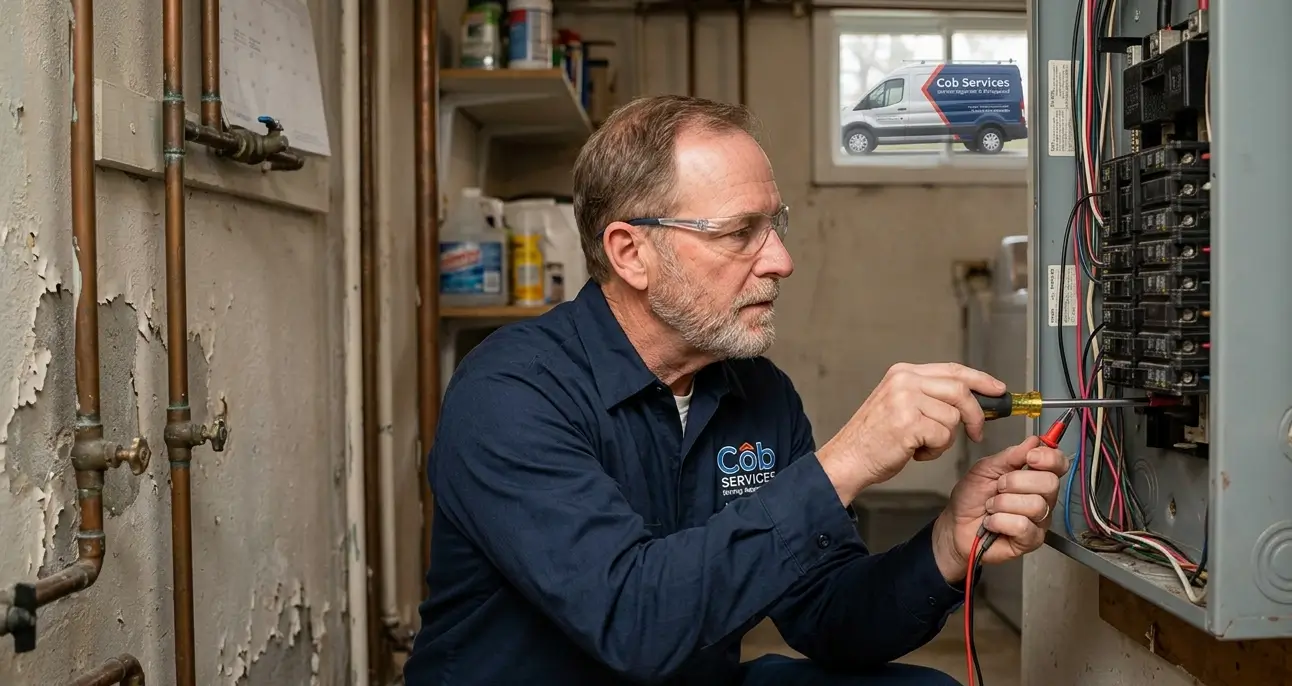
By Alexandr Godonoaga, Owner and Lead Electrician, Cob Services LLC. Illinois Electrical Contractor License #26-00032356. Published March 2026. Rewritten September 5, 2026.
If you are reading this because your panel is making a noise right now, skip everything else and read this section first.
Start here
Stop and act now if the sound comes with any of these:
- A burning smell, hot plastic, or an acrid metallic odor near the panel
- Scorch marks, discoloration, or melted plastic on or around the panel
- Visible smoke or sparks
- A panel cover that is hot to the touch
- Sizzling, frying, crackling, or popping rather than a steady tone
If you smell burning or see smoke, get everyone out and call 911. Do not open the panel. Do not try to shut anything off if that means standing in front of it.
If there is no smoke but you have a burning smell or a hot cover, and you can safely reach the main breaker, switch it off and then call an electrician. Understand what that does and does not do, which I explain below.
Call today, do not wait for the weekend if you have:
- A buzzing that gets louder when a large appliance runs
- A steady hum plus a panel cover that feels warm
- A breaker that buzzes and will not stay reset
- Any noise at all from a Federal Pacific Stab-Lok or Zinsco panel
- Lights across the house that flicker or brighten when something switches on
Mention it at your next service visit if you have a faint hum you can only hear with your ear near the panel, the cover is cool, nothing smells, and nothing else in the house behaves oddly.
Not every hum is an emergency
You will read elsewhere that a panel should be completely silent and that any noise means danger. That is not accurate, and overstating it does not help you, because it makes every homeowner either panic or tune it out.
A faint sixty-cycle hum is not unusual. Breakers carry alternating current, alternating current produces mechanical vibration in metal parts, and some breakers are simply louder than others. AFCI and GFCI breakers contain electronics and a few of them hum audibly by design. A dead front cover with a loose screw will buzz against the enclosure at exactly the same pitch as something far more serious.
What matters is not whether there is a sound. It is which sound, how loud, whether it changes with load, and whether the panel is warm.
Here is the taxonomy we use:
A faint, steady hum. Audible only up close, constant, cool panel. Usually benign. Worth mentioning, not worth an emergency call.
A louder hum that rises and falls with load. The panel is working near its limits, or a specific breaker is. Gets an appointment.
A buzz. Rougher than a hum, often at one spot rather than the whole panel. Frequently a loose connection. Gets an appointment quickly.
Sizzling, frying, crackling, or popping. That is arcing. Arcing is current jumping a gap, and the gap is hot enough to melt copper. This is the emergency category.
If you cannot tell which you have, treat it as the more serious one.
What actually causes it
Loose connections. The most common cause and the reason panel noise deserves respect. A screw terminal backs off slightly over years of thermal cycling. The looser joint has resistance, resistance makes heat, heat causes more expansion and more looseness. The buzz is the audible stage of a process that ends in melted insulation or a fire. This is also why the noise often tracks with load: more current through a marginal joint means more heat and more vibration.
A failing breaker. Breakers are mechanical devices with a finite life. One that hums, feels warm, or trips inconsistently is telling you it is at the end of it. In a panel with known trip-failure issues, a noisy breaker is more serious, because the protection you are counting on may not operate.
A circuit running at or near capacity. Worth being precise about what actually loads a panel, because a lot of writing on this blames the wrong things. A 75-inch television draws somewhere around 100 to 150 watts, about the same as a couple of old light bulbs. It is not stressing anything. The loads that matter are central air conditioning, electric ranges and dryers, heat pumps, and EV chargers. If your noise started after you added one of those, that is the lead to follow, and the answer is a load calculation rather than a guess.
Aluminum at the service lugs. Aluminum service entrance conductors are normal and permitted, but the terminations need correct torque and the right compound, and they loosen over decades. This is a common source of buzzing at the top of older panels.
A loose dead front or enclosure. Sometimes the cheapest fix in the trade. Something is vibrating against something else. We still want to confirm that is all it is.
Something that is not the panel at all. A dimmer, a transformer, a fluorescent ballast, or a bathroom fan can transmit noise through framing. The pad-mounted transformer outside your house hums normally. Basements carry sound strangely, and we have traced more than one panel buzz to a device two rooms away.
The one that is not your problem to fix
There is a failure that produces a hum plus a very specific set of symptoms, and it is worth knowing because the fix is not an electrician’s job.
If your lights flicker throughout the house, or lights in one part of the house brighten when a large appliance starts somewhere else, or bulbs keep burning out early in the same fixtures, that pattern suggests a problem on the service side, possibly a loose or failing neutral. It is dangerous, it can destroy electronics across the house, and it sits on the utility’s side of the meter.
Who you call depends on which utility bills you, and in this area that is not obvious.
If you are inside Naperville city limits, your electric utility is almost certainly the City of Naperville, which has run its own municipal electric utility since 1899 and serves more than 62,000 customers. Report it to Naperville’s Customer Care Center at (630) 420-6060, staffed 24 hours a day, seven days a week.
If you are in Downers Grove, Lisle, Aurora, Plainfield, Bolingbrook, Hinsdale, Burr Ridge, La Grange, or unincorporated Naperville Township, you are a ComEd customer. Call 1-800-EDISON-1 (1-800-334-7661), also staffed around the clock. Spanish-speaking customers can call 1-800-95-LUCES (1-800-955-8237).
Check the name on your electric bill if you are not sure. A Naperville mailing address does not settle it.
Why turning off the main does not make the panel safe
The original version of this article said not to tighten screws yourself because “there is still live power in that box.” True, but the reason matters, and knowing it is what keeps people from trying.
Your main breaker interrupts power going out to the branch circuits. It does not interrupt power coming in. The service conductors from the utility, the lugs they land on, and the line side of the main breaker itself all stay energized with the main switched off. There is no switch inside your house that kills them. Only the utility can, at the meter or the pole.
So the part of the panel where loose service connections buzz most often is exactly the part that stays live no matter what you flip.
Add to that: the cover you would have to remove is a dead front, meaning it is the barrier between you and energized parts. Removing it is not a homeowner task, and doing it while something is arcing behind it is worse.
Three things not to do:
- Do not remove the panel cover.
- Do not repeatedly reset a breaker that trips. It is detecting something. Resetting it in a loop is how a manageable fault becomes a fire.
- Do not decide it is normal because the lights still work. Every panel fire we have been called out after was working fine right up until it was not.
What happens when we come out
We open the panel under controlled conditions and check the whole system rather than chasing the noise:
- Torque check on the main lugs and every breaker terminal to manufacturer specification, because both under-tightened and over-tightened connections fail
- Thermal check for hot spots that have not started making noise yet
- Load balance across the two legs, since a badly unbalanced panel runs hotter than it needs to
- Whether the panel or breaker brand has known failure issues
- Grounding and bonding, which is where we find problems more often than in the grounding itself
- A load calculation if the noise started after you added a major appliance or a charger
Sometimes the answer is a fifteen-minute fix. Sometimes it is a breaker. Sometimes the panel needs to be replaced, and we will show you why rather than assert it. If a panel replacement is on the table, our electrical panel page covers what that work involves, including permits and the utility disconnect.
Frequently asked questions
Is it normal for an electrical panel to hum? A faint sixty-cycle hum, audible only up close, with a cool panel and no other symptoms, is often normal. Alternating current vibrates metal parts, and AFCI and GFCI breakers contain electronics that can hum by design. Buzzing, sizzling, crackling, or popping is not normal and indicates a problem.
What does it mean if my electrical panel is buzzing? Most often a loose connection. A loose terminal has higher resistance, which generates heat, which loosens it further. The buzz is an audible stage of a process that can end in melted insulation or fire. A failing breaker or a circuit running near capacity can also produce it.
Should I turn off the main breaker if my panel is buzzing? If you have a burning smell or a hot cover and can reach it safely, yes, then call an electrician. Understand that the main breaker does not de-energize the service conductors, the lugs, or its own line side. Those stay live until the utility disconnects them. If you see smoke or sparks, leave and call 911 rather than approaching the panel.
My lights flicker throughout the house and the panel hums. What is that? That combination, especially if lights brighten in one area when an appliance starts elsewhere, can indicate a service-side problem such as a failing neutral. That is the utility’s responsibility. In Naperville call the City at (630) 420-6060. In ComEd territory call 1-800-EDISON-1.
Can a buzzing panel start a fire? Yes. Loose connections and arcing are recognized causes of electrical fires, and audible arcing means the temperatures involved are already high. This is why sizzling or crackling is treated differently from a faint hum.
Why does my panel only buzz when the air conditioner runs? Noise that tracks with a large load points to a connection or breaker that cannot carry that current cleanly, or to a circuit near capacity. It is a useful clue, because it tells us where to look.
How much does it cost to diagnose a buzzing panel? It depends on what we find, which is why we look before quoting. Many are resolved in a single visit. We give you the finding and a written price before doing the work.
If your panel is making noise
Do not sit on it, and do not panic about a faint hum either. Both extremes cost you.
We work throughout Naperville, Downers Grove, Lisle, Aurora, Plainfield, Bolingbrook, Hinsdale, Burr Ridge, La Grange, and the rest of DuPage and Will County. Call (630) 427-5923 during the day, or use our emergency electrical service line after hours. You can also request a service visit.
Related reading: how to tell if your panel is outdated, dedicated circuits for loads that keep tripping a shared breaker, wiring updates, and residential electricians in Naperville.
About the author. Alexandr Godonoaga is the owner and lead electrician at Cob Services LLC, an Illinois-licensed electrical contractor (#26-00032356) working across DuPage and Will County for over a decade. Licensed, bonded, and insured.
Cob Services LLC 2020 Calamos Ct Suite 200, Naperville, IL 60563 (630) 427-5923 Monday through Friday, 9:00 AM to 5:00 PM
This article is general guidance and not a substitute for an inspection. Utility contact numbers were verified on September 5, 2026 against the City of Naperville and ComEd published information. If you believe you have an active electrical emergency, call 911.