
By Alexandr Godonoaga, Owner and Lead Electrician, Cob Services LLC — Illinois License #26-00032356
There’s a moment that happens on a lot of my EV charger estimates. I’m standing in front of someone’s panel, they’re hopeful, the new car is in the driveway, and I have to tell them the charger isn’t the expensive part. The panel is.
It’s the news nobody wants. A panel upgrade can add a couple thousand dollars to a job that the homeowner thought would be under a grand. So I understand why people get quiet when I bring it up, and I also understand why some of them go looking for an installer who won’t mention it at all.
Here’s what I tell them, and what I’ll tell you: sometimes the upgrade is genuinely necessary, and sometimes it isn’t. The trick is knowing which situation you’re in before you spend the money. This post covers what a panel upgrade actually costs in Naperville in 2026, when you truly need one, and the cases where you can skip it entirely and still charge at home safely.
What a panel upgrade costs in Naperville right now
A full service panel upgrade in the Naperville area in 2026 generally runs $2,500 to $4,500. The spread depends on a handful of things: whether you’re going from 100 to 200 amps, whether the meter and service entrance need work, and whether ComEd or the Naperville Electric Utility has to get involved to reconnect your service.
Here’s a real one from a 1970s home off Washington Street, broken out so you can see where the money goes:
- Permit (panel upgrade plus the EV circuit): $295
- 200-amp panel and main breaker: $1,150
- Service entrance cable and new meter socket: $390
- Labor, including utility disconnect and reconnect coordination: $1,850
- New grounding and bonding to current code: $240
- EV breaker and wire (the actual charger part): $130
- Inspection (rough and final): $50
- Total: $4,105
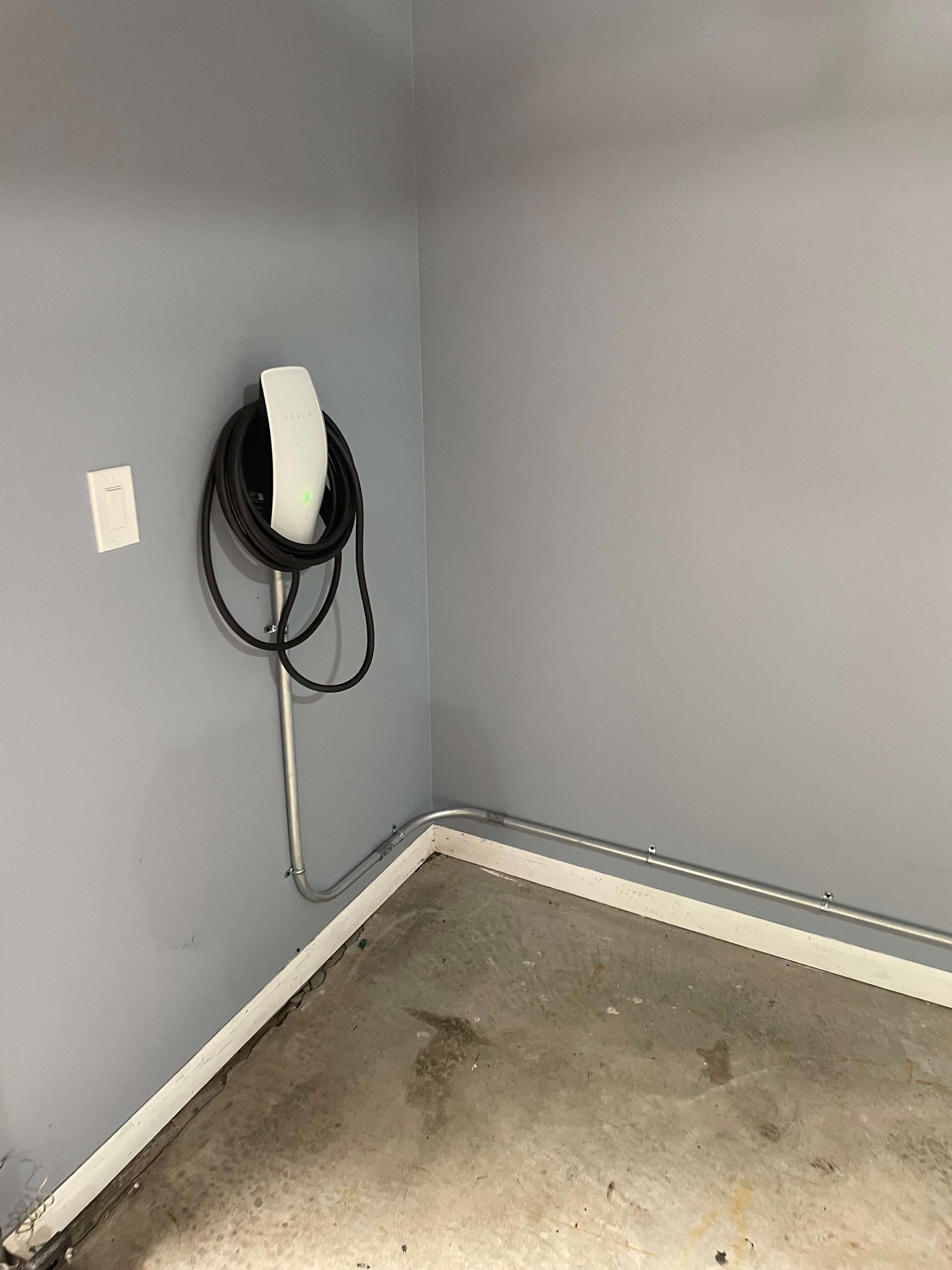
Look at that last group of EV-specific lines. The charger circuit itself was about $180 of a $4,100 job. The other ~$3,900 is a panel this house needed regardless of whether an EV ever showed up. That’s the framing I want you to hold onto, because it changes how you feel about the cost. You’re not overpaying for a charger. You’re finally addressing a service that was already undersized for how people use electricity now, something I get into in why a lot of Naperville homes don’t have enough power for modern living.
A cheaper version exists too. If your panel is in good shape but simply full, sometimes the fix is a subpanel rather than a full service upgrade, which can land closer to $1,200 to $1,800. More on that below.
When you genuinely need the upgrade
I’m not going to pretend upgrades are always avoidable. Here are the situations where I won’t install a charger until the panel is handled, because doing otherwise would be unsafe or wouldn’t pass inspection.
Your load calculation comes up short. This is the real test, not how the panel looks. Naperville requires a residential load calculation worksheet with the permit, and it adds up everything your home draws against your service capacity. If adding 40 or 48 amps of EV charging pushes you past what your 100-amp service can carry, the math says upgrade. No way around it. You can read the city’s own requirement for this on the City of Naperville’s electric vehicle charging page.
Your panel is full and can’t take tandem breakers. Some panels accept tandem or half-height breakers to free up space. Plenty of older ones don’t, or they’re already packed with them. If there’s no room for the new circuit and no slot to make room, the panel has to grow.
You’ve got a hazardous panel. If you have a Federal Pacific Stab-Lok, a Zinsco, or certain old Pushmatic panels, I’ll recommend replacement no matter what you’re plugging in. These have documented failure problems, and an EV charger is a continuous heavy load that’s exactly the wrong thing to hang off a breaker that may not trip when it should. If you’re not sure what you’ve got, how to tell if your panel is outdated will help you identify it.
Your panel runs hot or shows damage. A panel that’s warm to the touch, has discolored breakers, or smells faintly of melted plastic is telling you something. Adding load to it is the opposite of what it needs. I wrote separately about whether a warm breaker panel is normal, and the short version is that it’s worth a look before anything else gets added.
When you can skip the upgrade (and the math still works)
This is the part competitors tend to leave out. “You might not need the expensive thing” is a strange sentence to put on a sales page. But it’s true more often than people expect.
Your load calculation has room. The single most common reason I tell someone they don’t need an upgrade: the worksheet shows headroom. A 200-amp service in a typical Naperville home, even one running central air and an electric range, often has plenty of capacity left for a Level 2 charger. A panel can look intimidatingly full and still be well within its load. Slots and capacity are two different things. Before you assume the worst, the honest first move is a real panel assessment for an EV charger, and I also put together a guide on what size panel you actually need.
You can dial the charger down. Most Level 2 chargers let you set the amperage. A driver doing 30 miles a day does not need a 48-amp charger adding range they’ll never use overnight. Setting a hardwired unit to 32 amps, or even 24, draws less from your panel and can keep you under the threshold that would otherwise trigger an upgrade. You still wake up to a full battery. This ties directly into the NEMA 14-50 outlet versus hardwired charger decision, since a hardwired charger gives you precise control over that draw.
You use a load management device. This is the one that saves people the most money. A dynamic load management device, or a circuit-sharing setup, watches your home’s total electrical draw and throttles the EV charger when the rest of the house is busy. It lets you add a charger to a panel that’s near capacity without upgrading, because the charger backs off instead of overloading the service. These aren’t right for every home, but when they fit, they turn a $4,000 conversation into a few hundred dollars.
A subpanel solves it. If your main service has capacity but you’ve physically run out of breaker space, a subpanel adds room without replacing the whole service. It’s the middle path, and I covered when it makes sense in running out of room and whether you need a subpanel.
How to tell which camp you’re in before anyone quotes you
You can get a rough sense yourself. Find your main breaker and read its rating. If it says 200, you’ve likely got room and the conversation is probably about slots, not capacity. If it says 100, and you’ve got central air, electric appliances, and maybe a hot tub, you’re closer to the line and the load calculation matters a lot.
Then count your open slots. Empty spaces with no breaker, or knockouts you can pop out, are good signs. A panel with no open positions and no tandem-compatible spots is the one that tends to need help.
None of this replaces an actual load calculation, and I’d never quote a panel upgrade off a photo. But it tells you whether to brace for the bigger number or relax a little. Homes built in newer subdivisions sometimes surprise people in both directions, which is why I wrote about why some new builds still need panel attention, and older properties around Lisle and Downers Grove carry their own quirks, covered in EV charger installs in older homes.
A word on the cheap quote that skips this
I’ve cleaned up the aftermath of this one, so I don’t say it lightly. When an installer puts a 48-amp charger on a panel that couldn’t handle it and skips the load calculation, the charger might work for a while. Then a breaker starts tripping, or worse, it doesn’t trip when it should. That’s how you end up with the kind of problems I see during failed inspections, which I documented in the five code violations behind failed EV charger inspections.
The load calculation isn’t bureaucratic busywork. It’s the thing that tells us, honestly, whether your service can carry the charger. An installer who skips it isn’t saving you money. They’re moving the cost to later and adding risk on top.
The rebate angle is worth a mention
If you do need an upgrade, the panel work itself isn’t covered by the EV rebates, but the charger and its installation may still qualify. The City of Naperville offers up to $500 for a Level 2 charger, and ComEd’s Select Customer rebate (up to $2,500, for income-qualified and equity-eligible households) is still accepting applications in 2026, though the standard $1,000 Base rebate closed to new applicants back on February 28. I walk through all of it in my ComEd rebate walkthrough for Naperville. Worth checking before you assume the whole project is out of pocket.
So, do you need one?
Maybe. If your panel is a 200-amp service with open slots, probably not, and you should be skeptical of anyone who insists otherwise without running the numbers. If it’s an overloaded 100-amp panel, or a hazardous brand, or it runs hot, then yes, and the upgrade is genuinely an investment in your house rather than a charger tax.
The only way to know for certain is a load calculation on your actual home. That’s the difference between a guess and a quote. If your existing charger or a dedicated circuit is part of the picture, or you’ve been putting off panel questions for a while, this is a good moment to get clarity. You can see how we approach panel upgrades and replacements and our EV charging station installation service, and reach out when you want a straight answer on whether your panel needs to change. I’ll tell you the truth either way, even when the truth is that you can keep the panel you have.
Alexandr Godonoaga is the owner and lead electrician at Cob Services LLC, an Illinois-licensed electrical contractor (License #26-00032356) with more than ten years of field experience across Naperville and the western suburbs.