
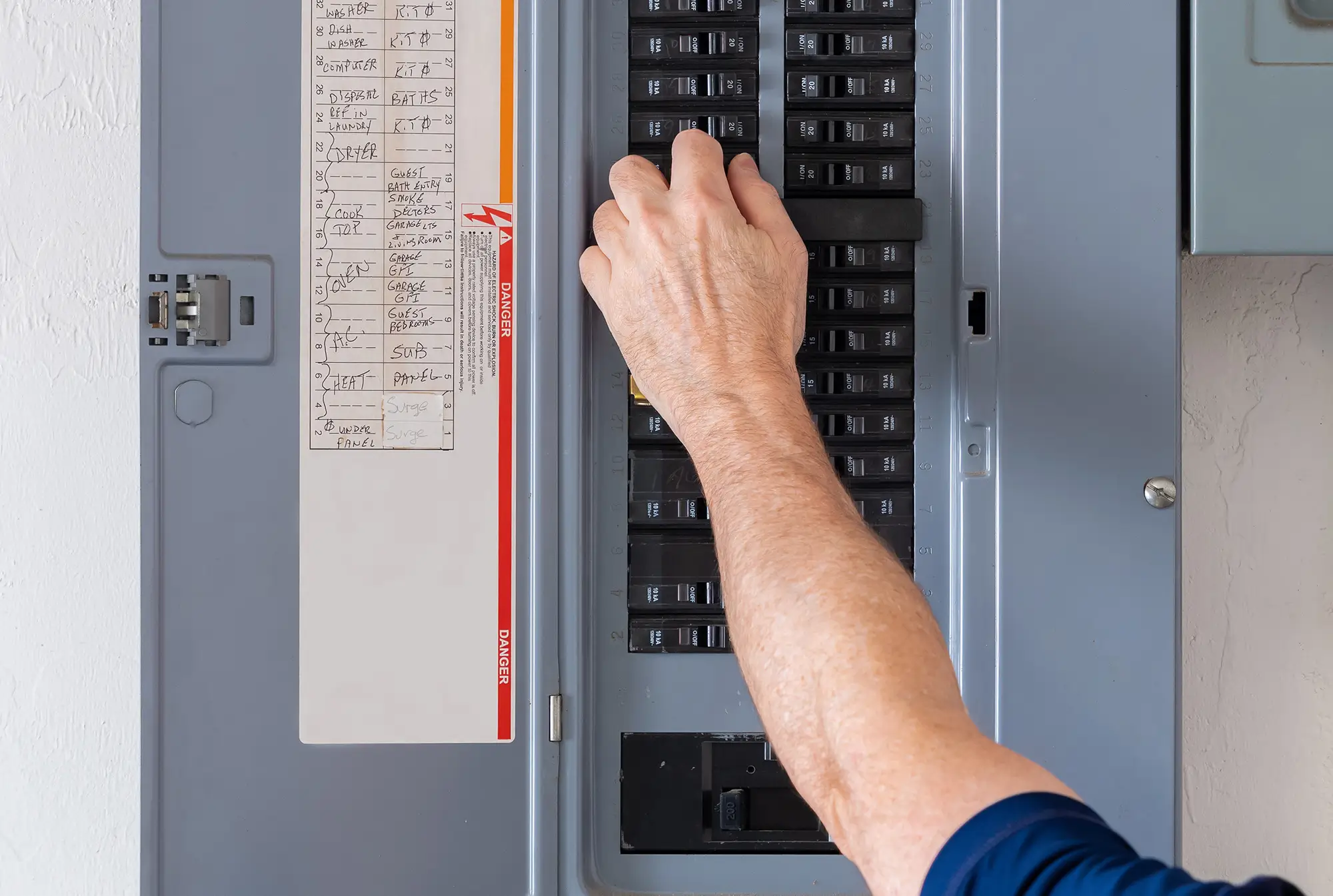
Your electrical panel is the one part of your home you are supposed to never think about. It sits in the basement or the garage doing its job quietly for decades. The trouble is that when a panel starts to fail, it usually does it slowly, and the early signs are easy to write off as quirks of an old house. By the time it gets your attention, you are often looking at a safety problem, not a convenience one.
So let me lay out, plainly, when a home electrical panel actually needs replacing, what happens if you wait too long, and what to expect from the job. I am a licensed electrician working in the Lisle and Naperville area, and panels are one of the most common things I get called about, usually after the homeowner has been living with the warning signs for a while.
The signs your panel is telling you something
A panel rarely fails all at once. It warns you first. These are the signs worth taking seriously.
Breakers that trip again and again
A breaker tripping now and then is the system doing its job. A breaker that trips repeatedly on the same circuit is telling you that circuit is overloaded, or that something is wrong behind the wall. Resetting it over and over is treating the alarm instead of the fire.
Lights that dim or flicker when something turns on
If your lights dip when the microwave, the AC, or a hair dryer kicks on, your panel is struggling to supply enough power to everything at once. An occasional flicker during a storm is normal. A predictable dip every time a big appliance starts is not.
Warmth, buzzing, or a burning smell at the panel
This one is not a “keep an eye on it” item. A panel should be silent and cool to the touch. If you feel heat coming off it, hear a buzz, or catch any scorched or burning smell, shut things down and call an electrician. Warmth and buzzing mean loose connections or overloaded components, and that is how electrical fires start.
No room left to add anything
If your panel is full, with no open slots, you cannot safely add a circuit for a new appliance, a finished basement, or an EV charger without addressing the panel first. A lot of homeowners discover this exactly when they are mid-remodel and least want to hear it.
A fuse box, or a panel that is simply old
If you still have a fuse box, or a breaker panel that is more than 25 years old, it was sized for a different era of electrical demand. The Electrical Safety Foundation recommends having the electrical system inspected on any home older than 40 years, or after a major renovation or the addition of a large appliance. You can read their plain-language breakdown of panels and breakers in the ESFI Fuse and Breaker Breakdown.
Why waiting is the expensive choice
It is tempting to keep resetting the breaker and put the panel on next year’s list. Here is why that math usually doesn’t work out.
The first reason is safety, and it is the real one. An overloaded or deteriorating panel is a genuine fire risk, not a theoretical one. Some older panel brands are worse than others. Federal Pacific and Zinsco panels, common in homes built from the 1950s through the 1980s, have a documented history of breakers that fail to trip when they should, which defeats the entire purpose of the panel. If you have one of those, that is a reason to act now rather than wait for a symptom.
The second reason is that the problem doesn’t stay still. An undersized panel under constant strain wears its connections and breakers faster, so the small annoyances grow into real failures. And the practical reason: a panel you replace on your own schedule is a planned project with a clear quote. A panel that fails in July, or starts a problem you didn’t catch, becomes an emergency call, and emergency work always costs more and happens at the worst time.
What today’s homes actually demand
Part of why this comes up so often now is that homes draw more power than they used to. A house built in the 1980s was not wired for what we plug into it today. EV chargers, home offices with multiple monitors and servers, induction ranges, heat pumps, hot tubs, big kitchen remodels, all of it adds load that older panels were never designed to carry.
Many older homes run on a 100-amp service. A lot of modern households need 200 amps to run comfortably and to leave room for what they will add next. Whether you need that jump depends on a real load calculation, not a rule of thumb, which is the kind of thing worth getting right. Our guide on what size electrical panel you need walks through how that is figured, and if you are weighing an EV charger specifically, whether your home can handle an EV charger covers that case directly. If you just want to know whether your current panel is past its prime, how to tell if your panel is outdated goes through the tells.
What the job involves
A panel replacement is not a DIY project, and it is not one to hand to a handyman. It involves working with the incoming service, sizing the new panel to your home’s actual load, bringing everything up to current Illinois and local code, and a permit and inspection. A licensed electrician calculates what your home needs, installs the right panel, and makes sure it passes inspection so you are not left with a problem that surfaces later.
Sometimes the answer isn’t a full service upgrade at all. If your service has capacity but you are out of breaker space, a subpanel can be the right, less expensive fix. We cover when that makes sense in our explainer on subpanels and when you need one. The only way to know which path fits your home is to have someone look at the actual panel and run the numbers.
The short version
If your breakers trip constantly, your lights dim when appliances start, the panel runs warm or noisy, or you are out of room to add anything, your panel is asking to be replaced. If you have a fuse box or a Federal Pacific or Zinsco panel, do not wait for a symptom. A panel handled on your schedule is a routine, well-priced job. A panel handled after it fails is an emergency. The first is always the better deal.
We replace and upgrade residential electrical panels across Lisle, Naperville, and the surrounding DuPage County communities, starting with an honest look at whether you actually need it. If something on this list sounds like your home, our residential electricians in Lisle page has the full picture, or you can reach out or call (630) 427-5923 for a straightforward panel inspection.
Written by Alexandr Godonoaga, Owner and licensed electrical contractor at Cob Services LLC (Illinois License #26-00032356), serving Lisle, Naperville, Downers Grove, and DuPage County.