
By Alexandr Godonoaga, owner of Cob Services LLC. Illinois electrical contractor license #26-00032356. Over 10 years wiring homes in Naperville and the western suburbs.
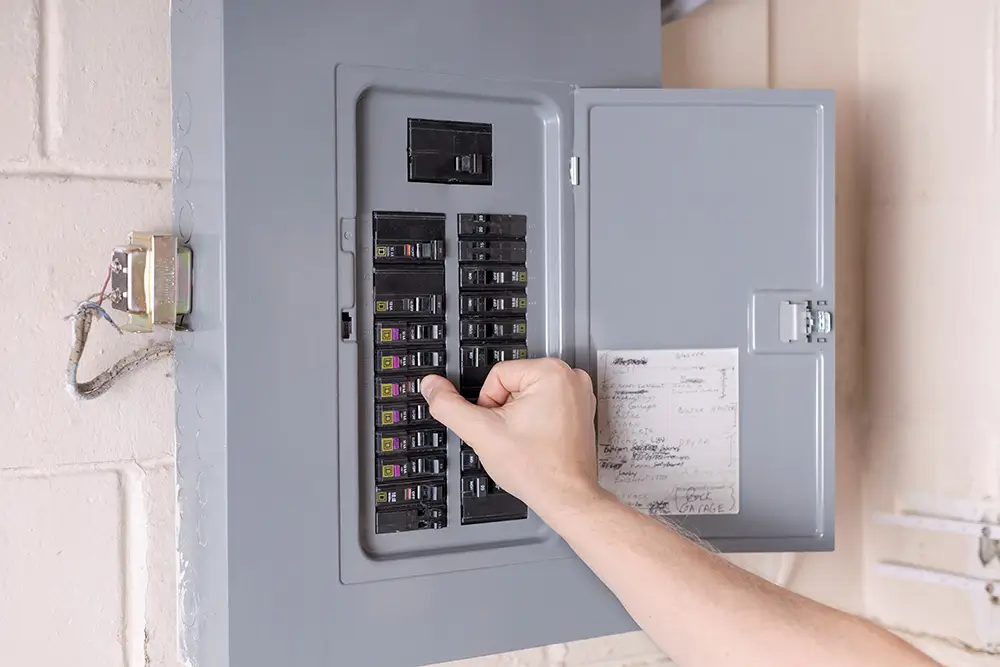
Open the panel door in most Naperville houses and there’s a card taped inside it. Pencil, mostly faded, written by whoever wired the place. “Lights.” “Misc.” “Bedroom.” “Kitchen” next to four different breakers. Plenty of those cards still describe the house the way the builder’s crew saw it in 1994, before anyone moved in.
Nobody reads that card until something stops working, which is the worst time to find out it’s wrong. On a service call for a dead outlet, the first thing we do is find the breaker feeding it. With a good directory that takes half a minute. With six breakers marked “Misc,” it turns into a walk around the house with a tester, and you’re paying for the walk.
You can map the whole panel yourself in an afternoon. The only things you touch are the breaker handles, which is what they’re there for. This is how to label a breaker panel the way we’d do it, and there’s a blank directory further down that you can print and fill in.
Write labels a stranger could use
My test for a label is simple: could someone who has never been in your house find the right breaker with a flashlight? “Bedroom” fails. “2nd floor NE bedroom, outlets and ceiling fan” passes.
The code says much the same thing. Section 408.4 of NFPA 70, the National Electrical Code, requires every circuit to be identified by its specific purpose, in enough detail to tell it apart from every other circuit, on a directory on the face or inside of the panel door. It also rules out labels that depend on who lives in a room. “Emma’s room” stops being true the day Emma leaves for college.
Some before-and-after examples:
| What the card says now | What it should say |
|---|---|
| Bedroom | 2nd floor NE bedroom: outlets and ceiling fan |
| Kitchen | Kitchen counter outlets right of sink (20A) |
| Misc | Garage outlets, garage door opener, front exterior outlet |
| Lights | 1st floor hall, foyer and stairway lights |
| Emma’s room | 2nd floor SW bedroom: all outlets and light |
| (blank) | Spare, controls nothing |
Compass directions and fixed landmarks like front, back and street side hold up better than names. Copy the amperage off each handle while you’re there. Circuits that do something odd, like jumping between floors or running through a GFCI in another room, need a note on the card too. Those are the details the next person wastes time on when nobody wrote them down.
Before you touch a breaker
Leave the metal cover over the breakers, called the dead front, where it is. You only need the handles, and everything live is behind that cover.
Look before you flip anything. Scorch marks, a burnt smell, rust or water stains, a breaker that’s hot to the touch, or buzzing you can hear from across the room all mean you stop and call an electrician. We wrote a separate piece on when a warm breaker panel is a problem.
Then think about what’s going to lose power. In a Naperville basement the sump pump is the one that matters. If it’s raining or the ground is soaked, find that breaker first and keep it off for seconds, or just wait for a dry day. Set the thermostat to off so the furnace and AC aren’t cycling while you work, and turn it back on at the end. The fridge and freezer will be fine for a few minutes if the doors stay shut. Save your work and shut down any computers. Medical equipment or an aquarium heater can wait until last, and you can work out its breaker by elimination. You’ll be resetting the oven and microwave clocks either way.
For tools, you need a helper with a phone or a radio loud enough to hear from the panel, a plug-in outlet tester or a small lamp, painter’s tape, a fine-tip marker, a flashlight, and a sheet of paper for each floor. Working alone, a circuit breaker finder saves a lot of stairs. You plug a transmitter into an outlet and run the receiver along the breakers until it beeps. They sometimes point at the breaker next door, so confirm each one by switching it off.
Number the panel first
Photograph the old card before you touch it. Some of those labels are right, and they’re a head start. Most residential panels number odd spaces down the left side and even spaces down the right, and many have the numbers stamped on the metal beside each breaker. If yours doesn’t, put a strip of tape by each breaker and number it.
Two kinds of breaker confuse people. A double-pole breaker fills two spaces, with one wide handle or two handles joined by a tie bar, and it usually feeds a 240-volt appliance such as a dryer, range, water heater, AC condenser or EV charger. That’s one circuit, so it gets one label covering both numbers, like “1-3.” A tandem breaker goes the other way and squeezes two circuits into a single space with two thin handles. Call those 9A and 9B.
Go one breaker at a time
Sketch each floor roughly, with the basement, garage and outside walls included, and mark every outlet, switch, light and hardwired appliance. Scale doesn’t matter. You just need a spot next to each item for a breaker number.
Turn on every light and fan, plug your tester or lamp into an outlet, and start at space 1. Switch it off, have your helper walk the house and call out everything that went dead, write the number on the sketch, then switch it back on and move to space 2. Flipping several at once is faster, and it leaves you guessing which breaker did what, so don’t.
Check both halves of every outlet. Living rooms and bedrooms often have receptacles where the top half runs off a wall switch, and some older kitchens have split-wired receptacles with the top and bottom on two different breakers.
When the rooms are done, go back for the things almost everybody misses:
- Exterior outlets, front and back
- Garage outlets and the garage door opener
- Hardwired smoke alarms (their small green power light goes out when you hit the right breaker)
- The doorbell, which runs off a small transformer often mounted near the panel, the furnace or in the garage
- Furnace, sump pump, ejector pump and electric water heater
- Attic fan, bathroom fans and under-cabinet lights
- Landscape lighting and soffit outlets
- Dishwasher, disposal, microwave and refrigerator, which often have breakers of their own
For a typical Naperville two-story with 30 to 40 breaker spaces, two people can usually finish in two to three hours. On your own, plan on longer.
Outlets that don’t play along
At some point you’ll find an outlet that’s dead with every breaker on, or one that stays live no matter what you switch off.
The dead one is almost always downstream of a GFCI. In a lot of 1990s Naperville houses, one GFCI receptacle in the garage or a bathroom protects outlets in other rooms, outside, or in the unfinished part of the basement. Find the GFCI with the popped button, reset it, and write it on the card: “Front exterior outlet, fed through GFCI in garage.” Whoever loses that outlet next will know where to look. A garage GFCI that trips often usually comes down to a handful of causes, and we went through why a garage GFCI keeps tripping separately.
The one that stays live is either on a breaker you haven’t reached yet or fed from somewhere else, like a second panel in the garage or basement. Something that still has power with every breaker off points to a subpanel. No subpanel means it’s a call for an electrician.
Press the test buttons while you’re there
Some breakers have a small TEST button. Those are GFCI or AFCI breakers, and if you’re not sure about the second kind, here’s what AFCI breakers protect against. Press each button once and the breaker should trip right away. To reset it, push the handle all the way to off and then back to on. One that doesn’t trip goes on the card, because that breaker needs replacing.
Writing up the directory
Copy your sketch onto the directory below in permanent ink, and date it. Don’t hold out for a label maker. A correct card in ballpoint is worth more than a typed one that’s wrong, though printed labels are fine if the wording is specific. Slide the card into a sheet protector, tape it inside the panel door, and take a photo so it’s on your phone the next time you’re standing in a dark basement.
Free printable circuit directory
Print this section or copy it onto a sheet of paper. The slots follow the usual layout, odd numbers on the left and even on the right. If your panel is numbered differently, cross out ours and write in yours. The grid covers 40 spaces, so print a second copy if your panel is bigger. Write “Spare” next to any breaker that controls nothing and “Empty” next to any open space, so nobody goes hunting for a load that isn’t there.
| Panel details | Fill in |
|---|---|
| Address | |
| Panel location | |
| Main breaker size (amps) | |
| Mapped by | |
| Date |
| Slot | Amps | What it feeds | Slot | Amps | What it feeds |
|---|---|---|---|---|---|
| 1 | 2 | ||||
| 3 | 4 | ||||
| 5 | 6 | ||||
| 7 | 8 | ||||
| 9 | 10 | ||||
| 11 | 12 | ||||
| 13 | 14 | ||||
| 15 | 16 | ||||
| 17 | 18 | ||||
| 19 | 20 | ||||
| 21 | 22 | ||||
| 23 | 24 | ||||
| 25 | 26 | ||||
| 27 | 28 | ||||
| 29 | 30 | ||||
| 31 | 32 | ||||
| 33 | 34 | ||||
| 35 | 36 | ||||
| 37 | 38 | ||||
| 39 | 40 |
What the finished map can tell you
Mapping is usually the first time anyone has looked at the whole house at once, and a few patterns are worth a second look.
One breaker running most of a floor is common in older homes, and it’s often why a space heater or window AC keeps shutting things off. Here’s how to tell whether your home has enough circuits. A kitchen where every counter outlet lands on one breaker is another one to flag, since current code calls for at least two 20-amp circuits for countertop receptacles. So are bathroom outlets sharing a breaker with lights or outlets in other rooms. Today bathroom receptacles go on a 20-amp circuit that serves only bathrooms.
Resetting the same breaker more than about once a month won’t solve anything. A breaker that keeps tripping has a cause, and it can usually be found.
Read the label inside the panel door while you’re at it. Federal Pacific (Stab-Lok), Zinsco and Challenger are all on our list of signs a Naperville electrical panel is outdated. And if every space is full while an EV charger, heat pump or finished basement is on your to-do list, start with what size panel your home needs.
Questions we get about labeling panels
Can I shut off the main and work backward?
No. With the main off everything is off, so you learn nothing about which breaker feeds what. One breaker at a time is the only way to get a map you can rely on.
Do I need an electrician to label my panel?
Not for the mapping, since that’s only switching breakers off and on. Call one if you find any of the patterns above, if a breaker won’t reset, or if anything in the panel looks or smells burnt.
How often should the directory be updated?
Every time a circuit is added, moved or changed. The code covers circuit modifications as well as the original circuits, so an electrician who adds a circuit for a new appliance should update the card before leaving. It’s fair to ask them to.
Does a missing directory matter when I sell?
Home inspectors write it up, and buyers read those reports. It’s an easy item to clear before you list. Buyers should look at the panel card too, and it’s one of the things to check in our 10-minute electrical walk-through before you make an offer.
If you’d rather hand it off
If your map turned up one of those problems, or you’d rather not spend a Saturday flipping breakers, our Naperville electricians can take it from there. We handle electrical panel repairs, replacements and upgrades across the western suburbs, and we pull the permit through the City of Naperville.
Cob Services LLC, 2020 Calamos Ct Suite 200, Naperville, IL 60563. Phone: (630) 427-5923. Illinois electrical contractor license #26-00032356. Licensed, bonded and insured. Free estimates, no trip or dispatch fee. Office hours: Monday through Friday, 9:00 AM to 5:00 PM. Emergency line 24/7. Serving Naperville, Lisle, Aurora, Plainfield, Bolingbrook and Downers Grove.
Request service or call (630) 427-5923.